
Appendicitis in children: symptoms and signs, how to determine
When the stomach hurts in adults, pain relief pills are used. If the condition has not improved, then a decision is made to stay at home, believing that the reason is not serious. Only when the pain becomes unbearable and additional signs of appendicitis appear, an adult decides to see a doctor.
The manifestation of pain in the child's body should alert parents. The child will not be able to describe the symptoms correctly enough to determine if the pain is caused by a serious cause, or if there is nothing to worry about, and the problem is temporary. It is worth seeking the advice of a doctor in order to exclude the occurrence of consequences.
The largest percentage of surgical interventions in the abdominal region occurs due to inflamed appendicitis. At the same time, medical statistics indicate the overwhelming number of school-age children who find themselves on the operating table.
Distinctive features of the development of the disease in the child's body is the rapid course of the disease, with the rapid development of complications and the emergence of a dangerous situation for the life of the baby. The risk of the transition of necrotic phenomena from the appendix to the cecum increases, then further advancement along the intestinal tract. As a result, peritonitis develops, which is fatal if treatment is absent or provided at the wrong time.
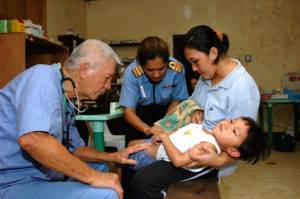
Of the reasons affecting the onset of the disease, one can single out:
- The main factor. When exposed to it, inflammatory processes occur.
- Provoking factor. These are external influences that increase the risk of dangerous symptoms in the body. As a rule, such reasons include the lack of control of the child's health and improper care of him.
Content
- 1 Main reasons
- 2 Provoking factors
-
3 Symptoms
- 3.1 Up to 3 years
- 3.2 From 3 to 5 years old
- 3.3 From 7 years
- 3.4 Over 12 years old
-
4 Classification of appendicitis
- 4.1 Simple
- 4.2 Disease development
- 4.3 Spicy
Main reasons
The follicular apparatus or appendix is a process located at the very beginning of the cecum. Its size can reach up to 20 centimeters, as a rule, the standard length is from 5 to 7 cm. Inside the organ there is a mucous membrane and lymphoid tissue that performs protective functions against viruses, pathogenic bacteria. Nerve endings and blood vessels are located along the entire length of the process.
Acute appendicitis can develop in two ways:
- The lumen of the appendix narrows.
- The passage to the appendix is blocked.
When the process channel is blocked, the normal outflow of mucus produced inside the organ is disrupted. Inside, the balance of local microflora is disturbed, the reproduction of pathogens begins, an inflammatory process occurs. Pediatric surgery highlights the common causes of a blocked passage:
- Fecal stonesformed in the rectum. They spread throughout the intestinal tract and can enter the appendix.
- The presence of foreign objects in the intestines that are not digested in the gastric tract. Often, the causes of inflammation are in the husk of sunflower seeds.

- Worms. Often multiplying, they are able to block the passage in the appendix.
- As a result of improper development of the intestine, torsion of the organ occurs and the lumen is blocked.
- Pathologies discovered at birth, or abnormal anatomical structure of the blind intestine.
Mechanical impact, blocking the lumen, leads to dysfunction of the appendix. Mucus cannot be sufficiently removed from the follicular apparatus or the outflow of fluid stops completely. This contributes to the occurrence of stagnation inside the appendix, an increase in pressure on the walls, and mucosal edema. The supply of oxygen and nutrients is cut off. Pathogenic microflora multiplies. The acute form of the disease develops 12 hours after the onset of the inflammatory process.
A further increase in appendicitis, followed by rupture and the onset of peritonitis, takes a little time, within 1-3 days.
Provoking factors
For the proper course of the digestion process, microflora is located along the entire length of the intestinal tract, which is a balance between beneficial and hostile microorganisms. Therefore, it is impossible to say that the cause of inflammation is the local microflora. A certain factor becomes a provocateur, contributing to the fact that pathogenic bacteria multiply and the balance is disturbed. But what can provoke an imbalance:
- Infection with lymphatic fluid. The purpose of the liquid is to cleanse the internal organs of toxins and other toxic substances and their removal through the lymph nodes. Acute viral diseases become a source of toxins that enter the lymph.

- The infection can come in the bloodstream. The developing viruses produce toxins that poison the body; they are easily absorbed into the bloodstream and spread throughout the internal organs, including the appendix.
It is possible to identify the main reasons that provoke internal changes and become provocateurs of an early disease:
- Eating disorder. The risk group includes children from an early age who are not limited in sweets. Parents allow them to eat chocolates, chips and other foods, whose positive effect on the body is questionable.
- A child's diet is low in fiber, which is necessary for the digestive system to function properly. There is no bowel stimulation, feces pass poorly through the canal.
- Exceeding the permissible dose of sugar in the children's menu. This comes from a large number of chocolates, sweets and other sweets.
- The lack of regular bowel movements for a long time also becomes the cause of the inflammatory process.
- The onset of dysbiosis in the intestinal tract provokes imbalance in the rest of the organ.
- Diseases of the gastrointestinal tract: infections, poisoning, irritation.
- Worms.
Symptoms
The symptoms that appear with appendicitis can be different. How the attack begins, where the pain will be localized, depends on where exactly the follicular apparatus is located.
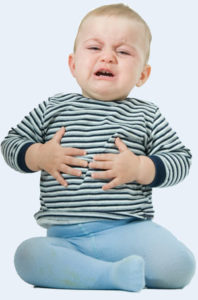
The main symptoms of appendicitis in children are the occurrence of pain in the abdomen near the navel. Gradually, the pain moves and is localized in the area where the inflamed appendix is located:
- The classic position. The pain syndrome comes from the right lower abdomen.
- Position in the pelvic area. The pains are localized in the groin, the bladder is affected, which provokes frequent urine output. There is also an upset bowel movement in the form of diarrhea. At the same time, mucus is present in the feces.
- When the process is located near the liver. Pain and discomfort are present on the right under the ribs.
- If the appendix is hidden behind the rectum, then the pain radiates to the lumbar spine.
It is worth paying attention to the child's appetite. With inflammatory processes, the baby refuses to eat.
Chronic ailment in childhood is extremely rare. Relapses periodically occur: pain on the right, nausea, fever. Symptoms appear depending on the age of the baby.
Up to 3 years
In newborns, children under one year old and up to 3 years old, the development of the disease occurs very rapidly. Sometimes it takes only a few hours from the onset of the disease to rupture and peritonitis. When the first signs appear: pain and inflammation, urgent hospitalization and surgery are needed. The physical examination should take place while the child is sleeping.
What exactly should alert parents in the behavior of the baby in order to understand that these are symptoms of an inflamed organ:
- The child does not want to eat.
- Not active.
- Frequent crying for no apparent reason.
- Sleep disturbance. This can be detected at night, after the first attack.
- The child suffers from nausea, constant vomiting.
- The body temperature rises rapidly, reaching 40 degrees. In babies, the temperature rises to 37.5 degrees.
- Diarrhea. Defecation occurs frequently. Feces have a liquid consistency, mucus is present.
- It hurts when urinating.
- There is no way to check the child yourself. There is a constant pulling of the right leg to the stomach.
- The intensity of the pain syndrome increases with bending, when dressing, lying on the right side.
At this age, simple appendicitis quickly turns into a destructive form, complications arise. Frequent bowel movements lead to a rapid loss of moisture in the body and the onset of symptoms of dehydration.
From 3 to 5 years old
When a child's age is between 3 and 5 years of age, the symptoms of the disease are slightly different. Most importantly, young children have the opportunity to show where it hurts. However, mild pain will go unnoticed. Parents will not be able to find out that inflammation develops inside the child's body. Food refusal is also observed.
The baby's condition is lethargic, moodiness and irritability arise for no apparent reason. The child is unable to characterize the pain, which greatly complicates the ability to diagnose the disease. Body temperature is kept within 38-39 degrees. There is a small white coating on the tongue, which gradually increases as the disease progresses. Nausea and vomiting.
At the same time, urination does not cause discomfort, but excess gases and feces are present in the intestines, whose exit is difficult. The child is restless.
From 7 years
At the age of 5-7, another problem arises - fear. The pain scares the baby, which prevents him from telling his parents about the discomfort that has arisen. But there are other symptoms that help to recognize the onset of the disease:
- Weakness.
- Loss of appetite.
- The pain wanders through the abdomen, and then is localized in the lower right corner. An increase in sensation occurs when you try to bend down.
- The temperature is 38 degrees, chills are present.
- Vomiting is irregular, perhaps 1-2 times.
- There is no bowel disturbance, and there is no pain in urination.
- The pulse quickens, can reach up to 100 beats per minute.
Over 12 years old
In the period of 8-12 years, the manifestation of appendicitis is expressed in an increase in body temperature up to 38 degrees.
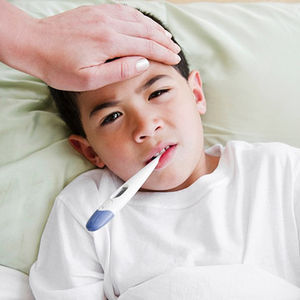
If the course of the disease is severe, then the thermometer shows a mark of 39. Regular nausea, lack of vomiting and gastrointestinal upset.
The pain syndrome does not allow the child to lie down on the right side, as the intensity of sensations increases.
Classification of appendicitis
Doctors distinguish between several stages of the development of the disease, and there is also a division into types according to the severity of appendicitis. Each stage of the development of the disease follows from the previous one. Simple appendicitis, due to the lack of treatment, provokes complications that lead to the appearance of a severe form of the disease.
Simple
Catarrhal or simple type of inflammation. It is considered not spicy. Symptoms are mild. Edema and thickening of the walls of the organ are hardly noticeable. Diagnosis at this stage avoids the onset of more serious symptoms. The treatment is quick and the least painful.
Disease development
The next stage of the development of the disease is destructive appendicitis. At this stage, there are two possible paths for the further course of inflammation:
- Phlegmonous stage. The size of the appendix increases significantly. Inflammatory processes contribute to the swelling of the organ. A thrombotic phenomenon appears in the blood vessels supplying the appendix.
- Gangrenous stage. Necrotic phenomena occurring in the lumen of the Follicular apparatus go beyond. Necrosis of the tissues of the intestinal tract occurs.
Spicy
The emergence of an acute form of appendicitis signals the neglect of the disease. Pus accumulates inside the blind process, leading to a critical increase in the size of the organ and possibly rupture.
The localization of the pain syndrome depends on the location of the appendix in the child's body. The deviation from the norm of the location makes it difficult to diagnose the disease.
Dr. Komarovsky, a renowned pediatrician, gives clinical recommendations on what not to do if there is suspicion of appendicitis The child has:
- If the baby has a stomach ache, it is not necessary to give pain relievers, this will significantly complicate the diagnosis of the inflammatory process during an external examination by a surgeon.
- Also, do not apply cold compresses to the abdomen to reduce the discomfort.
These actions can lead to misdiagnosis or loss of time with developing inflammation.


