Pain in stomach and duodenal ulcers
Pain with stomach ulcers and duodenum often caused by exposure to an aggressive irritant on the damaged mucous membrane lining the stomach or duodenum.
Aggressive substances act on pain receptors, the mass of which is located in the wall of the stomach, causing a number of unpleasant sensations.
Content
-
1 What causes pain
- 1.1 Why does pain occur?
-
2 Types of pain in ulcers
- 2.1 Hungry pain
- 2.2 Early pain
- 2.3 Night pain
- 2.4 Late pain
- 3 Localization of pain
-
4 Well-being with complications of an ulcer
- 4.1 Ulcer perforation
- 4.2 Penetration
- 5 How to deal with pain
What causes pain
Symptoms accompanying ulcerative lesions are usually caused by the following adverse effects:
- Chemicals that make up the gastric juice, food intake and medications.
- Mechanical irritation from rough food.
- Food irritants.
Since pain can occur in a person at any time, it is necessary to control the process, taking preventive measures in advance.
Painful sensations are directly related to the amount of food eaten by the patient, the duration of breaks between meals, with the nature of the food, and its temperature. The most common in peptic ulcer disease is hungry pain. The indicated symptom directly depends on the level of acidity.
When the ulcerative process is affected, the diseased organ responds sensitively to the slightest pain stimulus. The origin of stimuli is varied. Sick digestive organs poorly assimilate food rich in salt, hot spices and animal fats. If you regularly drink hot drinks, eat hot meals, it is easy to get a number of serious complications.
Why does pain occur?
- Often, pain in stomach ulcers is accompanied by increased acidity inherent in gastric juice. This biological fluid is extremely aggressive in chemical composition, contains a significant amount of hydrochloric acid, and many digestive enzymes. Eating the walls of the digestive tube leads to severe pain in the epigastrium. If the disease is accompanied by a reverse reflux of food masses from the stomach into the esophagus or from the duodenum into stomach, additional disorders occur that worsen the state of human health, revealing localization even in the area esophagus.
- If a person does not take food for a long time, this leads to an aggressive effect of the chemical constituents of gastric juice, an increase in pain. Self-digestion of stomach tissues begins.

- The development and intensity of pain is influenced by physical overwork, prolonged insomnia, neuropsychic stress. As a result, the person is forced to start drinking strong analgesics.
- Food products containing an excess of coarse fiber, salt, and acute components are capable of provoking the development of pain syndrome.
Types of pain in ulcers
For proper treatment, it is important to know the nature of pain in stomach ulcers.
In classic peptic ulcer disease, four types of pain syndrome are known.
Hungry pain
A similar kind of pain in case of ulcerative lesions of the stomach or duodenum appears on an empty stomach, which is already clear from the name. Sometimes pain occurs at night. The nature of the pain is manifested by aching, pulling, cutting or spastic.
The patient seeks to take a forced position in order to relieve pain. Usually, when taking a small amount of food or a glass of warm, fatty milk, the pain quickly subsides. Ulcers try to avoid long breaks between meals, keep a light snack on hand. An ulcerative diet involves frequent fractional nutrition of sparing foods in small quantities. Hunger pain is characteristic of a duodenal ulcer.

Early pain
Early pains occur almost immediately after eating, 1-2 hours after the meal. With the aforementioned type of painful stomach syndrome, the pain is associated with the mechanical and chemical effects of food masses on the gastric mucosa. Gradually, the pain goes away on its own, as the food masses are evacuated from the stomach cavity. The substrate does not stay in the cavity, it moves on.
Night pain
Pain in gastric ulcer, which the patient notes at night, belongs to the types of hungry. Late at night or closer to the morning hours, the patient feels severe pain in the epigastrium. The reason is an empty organ: the stomach does not contain food, self-digestion processes begin. For such purposes, patients keep a glass of milk at hand to relieve discomfort, relieve stomach pain.
Late pain
A kind of discomfort is observed if more than three hours pass after the last meal. Sometimes the patient does not experience subjectively uncomfortable sensations, but begins to eat food, trying to subconsciously protect himself from the upcoming discomfort.
The atypical form, often encountered, is a stomach ulcer without pain.
Localization of pain
Frequent zones of localization of discomfort in a patient with an ulcer are the epigastric region, the upper abdomen in the middle and on the sides. Sometimes the pain radiates to the back, under the scapular region, to the chest, to the lumbar region.

Often, localization can mimic pain in acute myocardial infarction, in such cases, it is necessary to carefully carry out differential diagnostics. Back pain is associated with a pathology of the pancreas or kidneys. The nature is diverse, depending on the stage of the clinical course, the presence of complications.
A distinctive feature in gastric ulcer or duodenal ulcer is the disappearance of sensations after vomiting in the patient. This is due to the removal of acidic contents from the stomach, cleansing the walls of the mucous membrane.
Well-being with complications of an ulcer
In the presence of serious complications with duodenal ulcer or stomach, the nature of the pain syndrome is the main a diagnostic sign that allows you to accurately determine the patient's condition before examinations and provide timely help. Whether the ulcer will lead to a tragic outcome directly depends on the actions taken.
Ulcer perforation
With this complication, there is an acute violation of the integrity of the stomach wall, leakage of contents between the sheets of the peritoneum or into the free cavity. The listed factors determine the subjective symptoms. The patient's sensations are equated to a blow to the stomach with a knife or dagger. From the sharp pain, the patient bends, leading to the stomach of the leg. Intense sensations sometimes lead to the development of a state of shock.
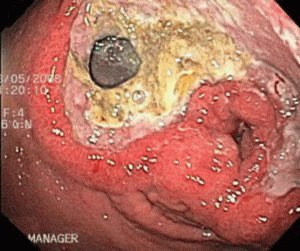
Perforation of peptic ulcer
Hours later, in the phase of imaginary improvement, when the intensity of sensations decreases and the pain has managed to be localized, it seems to the patient that he is already in order. In this phase, there is a frequent refusal of the patient from medical care, the loss of precious time when it is necessary to undertake urgent surgical intervention. In the future, the contents of the stomach are poured into the abdominal cavity, a picture of peritonitis develops, pain spreads to the abdomen.
Penetration
With such a complication, the ulcer penetrates into other organs located in the immediate vicinity of the stomach or duodenum. The nature of the sensations changes. The pain becomes constant, the patient complains that the abdomen constantly hurts, the usual drugs, which previously eliminated the discomfort, do not help, the vomiting urge does not bring relief.
Duodenal ulcer grows into the head of the pancreas, where the intensity of sensations is especially high. A pain symptom is a signal for an immediate examination and treatment.
How to deal with pain
To relieve stomach ulcer pain, the arsenal of modern medicine and pharmacology contains a stock of funds. At home, a glass of warm milk or a decoction of chamomile will help relieve pain. Almagel, Fosfalugel, Maallox drugs give quick relief.
It is required to consult a gastroenterologist. Simple analgesics are not enough to relieve severe discomfort. On the contrary, a number of analgesic drugs can worsen the condition. The doctor will tell you if a certain remedy will help, how to take the drug.
To combat pain, it is necessary first of all to eliminate the cause that caused the symptom. Antibacterial treatment regimens are prescribed, including modern drugs. Those lead to the elimination of the causative agent of the ulcerative process from the digestive system, a decrease in acidity, getting rid of the inflammatory process and an improvement in subjective well-being.
In case of exacerbation of duodenal ulcer, the intake of sorbents - enterosgel or smecta will help to improve the state of health. Preparations based on colloidal bismuth compounds have a protective effect on the walls of organs. Among those mentioned is the popular drug De Nol.
To eliminate intense discomfort, myotropic antispasmodics are prescribed, pain relievers with an analgesic and antispasmodic effect - drotaverin, spazmalgon. These drugs are taken symptomatically, since the drugs do not affect the causes of the disease.