Laparocentesis: technique for abdominal ascites
Ascites is a disease in which fluid accumulates in the abdominal cavity. According to the ICD-10 classification, the disease has the R18 code. In the active phase, the pathological process poses a threat to human life. To be able to send biological material for diagnosis, as well as relieve pain in the patient, surgery is used - laparocentesis. The operation code is a16.30.006.002. When carrying out this type of manipulation, the topographic anatomy of ascites becomes understandable.
Laparocentesis is the removal of fluid from the abdominal cavity. Surgical manipulation is performed by puncturing the abdominal wall and inserting a trocar into the abdominal region. If the pumping of fluid is necessary continuously, a peritoneal catheter is placed in the patient.
This type of surgical assistance to a person with ascites is done only in a hospital, since a strict aseptic regime must be observed during the procedure. A doctor who is going to pump out a pathogenic fluid must be able to do an abdominal puncture.
The cost of the operation in different regions and clinics at prices ranges from 2,000 to 5,000 rubles.
Content
-
1 Indications for the procedure and contraindications
- 1.1 Indications for laparocentesis
- 1.2 Contraindications
- 2 Preparation for laparocentesis
-
3 Operation technique
- 3.1 Puncture technique for ascites
- 4 Possible complications
- 5 Rehabilitation of the patient
Indications for the procedure and contraindications
With ascites, a puncture is done for therapeutic purposes. It eases the patient's condition by reducing the size of the abdomen, but does not affect the causes of ascites. This is a diagnostic method, not a treatment. Draining fluid from the abdominal cavity helps to reduce intra-abdominal pressure. If it is not pumped out, the patient will begin oxygen starvation due to disturbances in the work of the cardiovascular system.
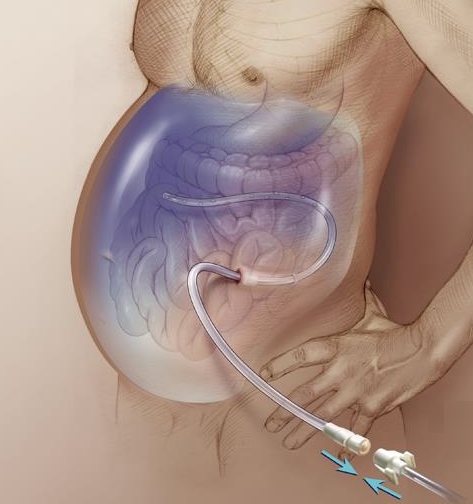
Medical intervention for ascites
Indications for laparocentesis
Indications for this type of medical surgery:
- tense ascites;
- moderately pronounced ascites, accompanied by edema;
- refractory ascites;
- unclear clinical picture of the disease (after surgical intervention, it becomes possible to collect biological pathogenic material for in-depth laboratory diagnostics, which will clarify the nature of the disease and choose the correct tactics for it treatment);
- the need for the introduction of carbon dioxide if the patient is to undergo a laparoscopy of the abdominal cavity;
- as a measure to clarify the diagnosis if an emergency operation is necessary;
- lack of positive dynamics in the patient after a course of drug therapy.

Pumping fluid from the abdomen
Contraindications
Abdominal laparocentesis is not applicable to patients with these symptoms:
- flatulence and bloating;
- hypotension;
- a history of a tendency to hemophilia (threatens with large blood loss during laparocentesis);
- inflammation in the anterior and lateral walls of the abdominal cavity;
- history of pyoderma, phlegmon, furunculosis;
- intestinal obstruction (the risk of damage to the intestinal walls and the ingress of feces into the peritoneum increases);
- large tumors in the abdominal organs;
- with cirrhosis of the liver;
- after surgery, a ventral hernia developed.
It is not recommended to perform the procedure in the presence of adhesions. If a pregnant woman needs a puncture, it is better to perform it in the first half of pregnancy. In this case, it is necessary to observe additional precautions: laparocentesis is done using an ultrasound machine, which allows you to control the depth of trocar insertion and its direction.
Preparation for laparocentesis
With ascites, preparatory measures are necessary before the puncture. Before the procedure, the patient's stomach and intestines are cleaned by means of an enema. The bladder should be empty at the time of surgery.
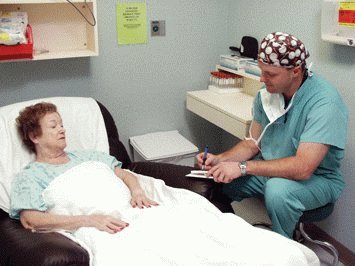
The operation is performed under local anesthesia, it is recommended to first test the patient's sensitivity to anesthetics.
An obligatory stage of the preparatory period is the patient's submission of tests and laboratory diagnostics. Based on the diagnostic results, a protocol of the clinical picture of the disease is drawn up. Diagnostic algorithm:
- general blood analysis;
- general urine analysis;
- coagulogram;
- Ultrasound of the abdominal organs;
- radiography.
Operation technique
The technique of laparocentesis involves sitting or laying the patient on a couch. With ascites, the doctor chooses any part of the abdominal wall for a puncture. The optimal place is the points in which there are no muscle fibers.
If fluid oozes out quickly, the patient's blood pressure drops rapidly. This is dangerous with the onset of collapse. Therefore, it is possible to pump out no more than 1 liter in 5-10 minutes. The patient's condition is monitored by medical personnel throughout the procedure.
During the discharge of the effusion, the doctor slowly tightens the patient's abdomen with a sheet, preventing hemodynamic disturbances.
If there is an indication to leave the catheter for a long time, the patient should stimulate the effusion by changing the position of the body every 2 hours.

Puncture technique for ascites
The set for laparocentesis includes a scalpel, hooks, forceps (sometimes there are 2 of these instruments), scissors, surgical tweezers, linen pins, hemostatic clamps, probes, a set of needles.
Puncture technique for ascites:
- The site of the future puncture is treated with an antiseptic.
- Layer-by-layer tissue infiltration is done with 2% lidocaine solution and 1% novocaine solution.
- The doctor finds a white abdomen line 3 fingers below the navel. In this place, the skin is dissected to a depth of 1-1.5 cm.
- It is necessary to pull off the peritoneal wall using a single-toothed hook, thus opening the tendon plate.
- Paracentesis is performed. The trocar is inserted into the abdominal cavity with a rotational movement at an angle of 45 degrees to the incision until the feeling of emptiness. When the first portion of the contents of the abdominal cavity flows out, the device is pushed inward by another 2-3 cm in order to avoid deviation towards the soft tissues. In order not to damage the internal organs, sometimes the doctor has to do bypass surgery.
- The stylet is removed, and a catheter is placed in its place to drain fluid from the abdominal cavity. If part of the pathogenic effusion is located in the lower peritoneum and in the lateral sections, the doctor rotates the trocar clockwise and removes the fluid with a syringe. The minimum volume of expressed abdominal contents should be at least 500 ml. For 1 pumping out, up to 10 liters of ascitic contents are drained.
- When the effusion is eliminated, the trocar and catheter are removed, the edges of the incision are sealed with a plaster or connected with a special thread. A sterile bandage is applied to the abdomen. The person is laid on the right side for a while.
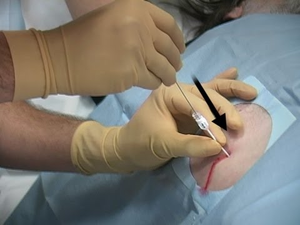
Puncture of the abdomen
Possible complications
Conducting laparocentesis in ascites is rarely accompanied by complications, because the procedure is performed with local anesthesia. A puncture does not imply serious tissue damage. The risk that undesirable consequences will occur increases in case of improper nutrition of the patient, as well as, if necessary, to perform an operation on a pregnant woman.
Puncture can lead to unwanted complications if aseptic rules are not followed and infection of the puncture site has occurred.
In some cases, surgical intervention can be complicated by the patient's fainting, severe bleeding. In addition, medical statistics indicate that in exceptional cases, complications arise after laparocentesis:
- protracted process of effusion (with tense ascites);
- the anterior wall of the abdominal cavity is affected by phlegmon;
- fecal peritonitis due to damage to the intestinal wall;
- hematomas and extensive hemorrhages in the abdominal cavity as a result of vascular dissection;
- subcutaneous emphysema resulting from air entering the puncture;
- active growth of cancer cells (with a history of oncology).
The possibilities of modern medicine make it possible to organize the procedure of laparocentesis in such a way that the risk of complications will be minimal.
Rehabilitation of the patient
Laparocentesis is not associated with global tissue trauma; rehabilitation after it is short-lived. The stitches are removed 7-10 days after the operation. To eliminate the symptoms of the main diagnosis, he needs to stay in bed for a few more days. In the postoperative period, physical activity is contraindicated in the patient.
To prevent relapse, the patient should stop consuming salt and try to drink less fluids. It is allowed to drink no more than 1 liter of water per day. The daily diet should include a lot of protein, chicken, eggs, dairy products. It is necessary to stop eating spicy, pickled foods and sweets.
As practice shows, laparocentesis is effective for most patients. a way to facilitate the course of ascites, prevent the development of concomitant deviations, prolong life person. Refusal of the procedure is reasonable only if the patient has contraindications.