
Ritter's exfoliative dermatitis in newborns and adults
Content
- The reasons for the development of the disease
- Stages of development of exfoliative dermatitis
- Symptoms of the disease
- Development of the disease in adults
- Diagnostic measures
- Drug therapy
- Prevention of exfoliative dermatitis
Exfoliative dermatitis (Ritter's disease) is a severe skin infection that is most common in newborn babies. This type of disease develops according to the malignant variant of pemphigus and is characterized by hyperemia of the skin, the formation of blisters, which transform into erosion.

The inflammatory process begins in the oral cavity, gradually spreading throughout the body and significantly worsening the condition of patients. Premature babies are most susceptible to the disease, after 14 days of life. Very rarely, Ritter von Ritterstein's disease appears in babies after 2-4 days of life. The earlier the pathological symptoms appear, the more severe the possible complications.
The reasons for the development of the disease
Exfoliative dermatitis can be caused by:
- lymphomas;
- an allergic reaction to medications;
- leukemia;
- psoriasis;
- dermatitis (atopic, seborrheic and contact);
- in addition, the disease can develop after the use of drugs;
- the active development of dermatitis occurs due to the immature immune function of the child, which disrupts the barrier function;

- sometimes dermatitis can be observed during immunosuppressive therapy in a child of the middle and older age group.
As a rule, Ritter's exfoliative dermatitis is determined by the development of an infection on the skin of an infant. Staphylococcus aureus, which causes infection in newborns, can be transmitted from the mother, as well as the staff of the institution.
Stages of development of exfoliative dermatitis
In addition to Staphylococcus aureus, Ritter's exfoliative dermatitis can be caused by the interaction of streptococcus and streptococcus.
The disease can develop in 3 stages:
1. ERYTHEMATOUS. This stage is characterized by redness of the skin, edema and the appearance of blisters with serous contents.
2. EXFOLIATIVE. This form is characterized by the formation of exudate in the epidermis, followed by detachment of the affected skin area. At this time, erosive formations can merge together, and the appearance of the child resembles a burn. With the exofolative form of dermatitis, symptoms of insufficient gastrointestinal function may develop.
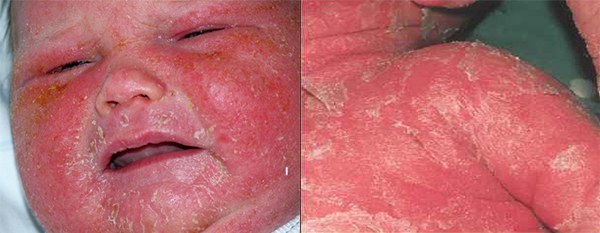
3. RENERATIVE. At this stage of dermatitis, the severity of symptoms directly depends on the age of the patient. Such a disease, as a rule, proceeds with severe complications in the form of meningitis, otitis media, pneumonia, peritonitis, etc. In older children, the condition is gradually improving.
Symptoms of the disease
The symptoms of exfoliative dermatitis depend on the rate of development of the disease and the presence of accompanying factors. The following manifestations are most often noted:
- scalded skin syndrome;
- intolerable itching;
- in adult patients, Lyell's syndrome may appear, which resembles in its symptoms the syndrome of "scalded skin" and the formation of blisters filled with fluid;

- hyperthermia;
- the appearance of ulcerative formations and an increase in lymph nodes.
Of particular note is the scalded skin syndrome, which is caused by infected strains that produce exofoliatins. The process is characterized by a violent onset with the formation of foci of redness and large blisters on the skin, resembling thermal burns. Subsequently, the bubbles burst, exposing the weeping areas of the skin. As a rule, "scalded skin" syndrome is caused by a staphylococcal infection, therefore it is recommended to start specific treatment as soon as possible.
Development of the disease in adults
Exfoliative dermatitis in adults occurs in 2% of patients over 45-50 years old and a hereditary factor plays an important role in the development of such symptoms. Often, erythroderma syndrome appears as a result of a toxic reaction to the use of certain pharmacological drugs or as a result of psoriasis.
In adult patients, Ritter's exfoliative dermatitis can develop in advanced cases or with improper therapy. Often, the disease progresses as a result of the addition of a secondary infection when scratching the skin in the affected area. The symptoms of dermatitis are similar to those of newborns.
Diagnostic measures
When performing a diagnostic examination for exfoliative dermatitis in newborns, it is necessary to exclude syphilitic pemphigus, epidermolysis bullosa, Leiner's desquamative erythroderma, toxidermia and epidermolytic ichthyosis.
The exfoliative form of dermatitis, in contrast to the syphilitic pemphigus, does not reveal the characteristic localization of the rash (palm and soles). In addition, with dermatitis, there is no compaction at the base of the bladder. The result of a serological examination of the contents of the blisters for the presence of pale treponema is sharply negative.
Epidermolysis bullosa differs from exfoliative dermatitis in places of localization of blisters. Bullous dermatitis is characterized by the appearance of blisters on unchanged areas of the skin. In addition, epidermolysis bullosa is not accompanied by serious disorders of the patient's condition.
Ritter's dermatitis is primarily diagnosed based on a history that indicates the cause of the rash (inaccuracies in diet, medication, etc.). The difference between exfoliative dermatitis and toxidermia is a monomorphic rash with a positive Nikolsky symptom.
Drug therapy
Treatment of exfoliative dermatitis should be carried out in a comprehensive manner, taking into account the characteristics of the patient's body. A low birth weight newborn should be placed in an incubator that maintains optimal microclimatic conditions.
Drug therapy includes a number of measures:
- it is recommended to use intravenous cephalosporins (antibiotics), which effectively act on staphylococci, destroying them and preventing further reproduction. Solutions of Polyglyukin and Gemodez are used as infusion solutions, which neutralize dehydration of the body during the infectious process;

- in addition, treatment involves the administration of gamma globulin (antistaphylococcal) to the patient, which leads to an increased body resistance to infections. This tactic is especially often recommended for the treatment of newborns, when, as a result of an immature immune system, the body is not able to produce the required amount of antibodies. If the measures are ineffective, treatment with corticosteroids can be carried out;
- local treatment involves the use of compresses with silver nitrates on the affected skin area, and external treatment with potassium permanganate and emollient vitamin ointments to accelerate regeneration epidermis. With a moderate severity of dermatitis, a newborn baby can be bathed by adding a decoction of chamomile.

It is important to remember that any treatment can be carried out only after prior consultation with the attending physician. All medical procedures are performed by specially trained personnel. During inpatient treatment, the child is in a special box to exclude secondary infection.
Prevention of exfoliative dermatitis
- Preventive measures provide for the prevention of the development of nosocomial infection, as well as the identification of carriers of staphylococcus in the environment of people around.
- It is necessary to change underwear and bed linen as often as possible, to carry out wet cleaning and quartzing in a timely manner. In addition, a sterile gauze bandage should be used to prevent the spread of infection during the treatment, feeding and hygienic treatment of newborns.
In the case when Ritter's exfoliative dermatitis proceeds with extensive skin lesions and, despite drug therapy, there is no improvement, the patient may die from development sepsis. The prognosis for recovery from Ritter's disease depends on the severity of the symptoms, the patient's age and the presence of complications. With a mild form, the disease is effectively cured with antibiotic therapy and steroids.


