
Allergy to iodine: how it manifests itself, how to check at home
Content
- Causes
- Allergy to iodine-containing drugs
- Symptoms
- How to check for iodine allergy at home?
- Diagnostics (analyzes) in Invitro
- Treatment (traditional, folk)
- Allergy to blue iodine
- What can replace iodine?
- Is it possible to dilute iodine so that there is no allergy?
- Allergy to iodine in a child, baby
- Allergy to iodine during pregnancy
- Prophylaxis
Iodine allergy is a rare immunological disorder. For a long time, a person may not be aware of its development, since iodine itself is not an irritant. Intolerance to a trace element consists in altered biochemical reactions in the body, usually associated with its overdose. We invite you to learn more about this condition.

Causes
The pathology is cumulative, that is, the reaction to iodine in the body is not detected immediately, but some time after its use. This mechanism of the disease prevents the determination of the true causes of intolerance, which may include:
- Iodine overdose while taking iodine-containing medications. The risk of encountering allergies in this case is low, since healthy thyroid tissues successfully cope and, if necessary, assimilate any doses of the microelement. For the dose to be really dangerous, you need to eat at least 4 kg of seaweed and other seafood in one sitting, which is unlikely for humans.
- Chronic diseases of the endocrine system. You should not take medications and dietary supplements with iodine on your own without the knowledge of the doctor, since excess iodine the amount can lead to the fact that the body cannot cope with the absorption of the microelement and there will be allergic reaction.
- Predisposition to idiosyncrasy - the reaction is based on the ingestion of pure iodine into the body and on the skin, which leads to malfunctions of the immune system and the release of conjugating antigens that provoke the development of iodine intolerance.
Even drugs with a minimum iodine content can provoke the disease with their prolonged use.
For example, experts are aware of the intolerance of Yodomarin, a common remedy recommended for children and pregnant women. Less commonly, there is an allergy in dentistry to a temporary filling with iodine, prescribed for the treatment of pulpitis.
Provoking factors (indirect reasons):
- unfavorable heredity for allergic diseases;
- individual hypersensitivity to iodine;
- iodine overdose;
- hyperthyroidism;
- bronchial asthma;
- diabetes;
- kidney disease;
- diabetes;
- pathology of the heart and blood vessels.
Also, the risk group for the development of allergy to iodine includes persons over 60 years of age, suffering from neurological disorders.
Allergy to iodine-containing drugs
Common drugs to which an allergic reaction can occur:
- Antiseptics - Iodinol, Iodopiron, Iodoform, Lugol;
- An alcoholic or aqueous solution of iodine.
- Medicines aimed at improving the functions of the thyroid gland - Antistrumin, Thyrocomb, Mikroyod.
- Iodized preparations or sodium and potassium iodides - Iodomarin, Iodbalans, Iodine vitrum.

- Hemostatic and analgesic antiseptic compress with Iodoform - Alvozhil.
- Antiarrhythmic medicines - Sedakoron, Kordaron.
- Different groups of drugs for external and oral administration containing iodine - Dermozolone, Myodil.
- Iodine-bromine therapeutic baths in physiotherapy.
- X-ray contrast agents - Urografin, Yodamine.
Of particular risk are contrast agents that are administered intravenously to check the condition of internal organs. They contain a high concentration of iodine.
Symptoms
How an allergy to external and internal use of iodine manifests itself depends on the characteristics of the organism.
Less dangerous are the symptoms that occur in 8% of people when iodine is applied to the skin:
- hyperemia and swelling, peeling of the epidermis;
- skin rash, itching;
- headache, dizziness.

Clinical signs of moderate severity are observed in 1% of people. They are caused by iodine-containing drugs when taken orally - these symptoms require mandatory medical intervention:
- swelling and hyperemia of the eyelids, lacrimation;
- sensation of metal in saliva, inflammation of the oral mucosa;
- profuse nasal discharge - rhinitis;
- nausea, vomiting;
- dyspnea;
- arrhythmia, tachycardia;
- bronchospasm, cough.
More complex symptoms occur with a severe degree of allergy to iodine on the background of intravenous injection of a contrast agent into the blood, used in MRI and CT. It is important to understand that these conditions pose an immediate danger to a person's life - they include:
- Anaphylactic shock - develops in a matter of minutes: blood pressure drops rapidly, tachycardia, convulsions, fainting occur.
- Quincke's edema - swelling rapidly covers the face area, neck and upper chest, hands, signs of suffocation begin.
With anaphylaxis and Quincke's edema, the patient needs to be provided with emergency medical care as soon as possible.
How to check for iodine allergy at home?
The test technique is simple - let's look at it:
- Prepare an alcoholic solution of iodine and a few cotton swabs.
- Moisten a stick in the preparation and apply several lines to the neck and forearm skin.
- Observe the reaction during the day.
If during this time signs of hyperemia and swelling appeared on the skin, then iodine is an allergen for a person. In this case, the agent must be thoroughly washed off and any antihistamine drug (Suprastin, Tavegil) should be taken. If the stripes disappeared on their own within a short time (no more than 2-3 hours), this indicates iodine deficiency. Normally, the drug is absorbed by the body gradually without signs of allergy.
Diagnostics (analyzes) in Invitro
It is recommended to take tests for iodine allergy in the Invitro laboratory for the following indications:
- endemic goiter, hypothyroidism;
- mental retardation in a child;
- decreased intelligence in an adult;
- cretinism;
- infertility, stillbirth;
- living in an area where iodine deficiency or radiation contamination is recorded.
You can find out the iodine content in the body in Invitro by examining blood serum, urine, nails and hair. Any of the tests will help check if there is a supersaturation or lack of this trace element in a person.

The cost and duration of studies depends on the studied biological product - consider them:
- urine analysis - 1060 rubles, the term of execution is up to 6 days;
- hair analysis - 990 rubles, up to 5 days;
- blood test - 1160 rubles, up to 7 days;
- analysis of nails - 1060 rubles, up to 6 days.
It is possible to determine the iodine content in the body using similar studies in other independent laboratories, for example, Gemotest and Helix.
Treatment (traditional, folk)
Treatment of iodine allergy is based on the following points:
- Immediate cancellation of all drugs and funds containing a trace element is the most effective method that allows you to quickly eliminate the symptoms of pathology.
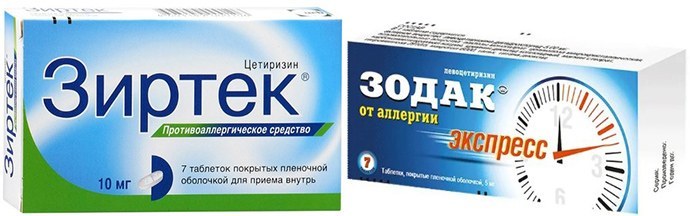
- Symptomatic therapy. Based on the existing clinical signs of iodine intolerance, the doctor may prescribe antihistamines, for example, Zyrtec or Zodak. In difficult cases, subject to the appearance of symptoms of bronchospasm, anaphylactic shock and Quincke's edema, it is used "Heavy artillery" in the form of intravenous administration of glucocorticosteroids - Prednisolone or Dexamethasone on the background Adrenaline rush.
- Detoxification therapy. Intravenous administration of Calcium chloride, the appointment of enterosorbents - Activated carbon or Enterosgel.
- Recovery therapy. The use of eubiotics and probiotics for the normalization of intestinal microflora, for example, Bifiform, Lactobacterin.
Additionally, local preparations can be used - ointments and talkers with antiallergic effect. Also, the patient is recommended fractional sparing meals with the exception of seafood and iodized salt.
Ethnoscience. It is possible to treat an allergy to iodine not only with traditional, but also folk remedies, provided that they are an addition to the main therapy. Let's consider some recipes:
- Celery juice. The product successfully suppresses the manifestations of allergies. The juice should be obtained from the rhizomes of the plant using a juicer. The drink is drunk for 1-2 hours. l. before meals.
- Yarrow decoction. Relieves signs of inflammation and swelling, soothes itching. 2 tbsp. l. dry yarrow brew 200 ml of boiling water, leave for 30 minutes, then strain. Take the finished product 50 ml 4 times a day.
- Birch tar ointment. It has antipruritic, anti-edematous and anti-inflammatory effects, fights signs of irritation. Combine 20 g of petroleum jelly and the same amount of birch tar. Smear the foci of allergic rashes obtained with the product.
- Bathtub with succession. It has a positive effect on the condition of the skin as a whole, has an anti-allergic effect, eliminates itching and inflammation. Brew 50 g of dry string with 200 ml of boiling water. After the infusion has cooled, pour it into the bathing water. The bath is taken at least 3 times a week, the duration of one procedure should be at least 10 minutes.
Allergy to blue iodine
When iodine combines with starch, a blue substance or blue iodine is formed. It neutralizes toxins and alcohol present in water, and is used in medicine, having an extended spectrum of action: sedative, antimicrobial, hemostatic, antibacterial, immunomodulatory etc.
Allergy to blue iodine develops against the background of oversaturation of the body with the drug and impaired functions of the thyroid gland. Symptoms of pathology have the same clinical characteristics as with the appearance of intolerance to conventional iodine. Treatment has the general goals of combating allergies:
- exclusion of contact with iodine preparations;
- taking antihistamines - a course of up to 7 days;
- inpatient treatment in case of severe intolerance.
Additionally, it is recommended to follow a hypoallergenic diet and exclude iodine-fortified foods from it.
What can replace iodine?
There is an iodine solution in almost every home. What if there is a hypersensitivity to this drug? We propose to consider, using the example of the following table, what means and what can be used to replace iodine if it causes allergies.
| Drug name | Description |
|---|---|
| FURACILIN | Disinfectant and antiseptic, which can be purchased at the pharmacy in the form of a ready-made solution, powder or tablets. It is used externally and for rinsing. |
| HYDROGEN PEROXIDE | An irreplaceable preparation for the treatment of wounds and injuries. Possesses antiviral, antibacterial and fungicidal action. |
| MIRAMISTIN | It is characterized by a wide spectrum of antimicrobial action. It is used for treating wounds, treating and preventing purulent complications, and combating burns. |

The listed drugs can be an adequate substitute for iodine in the event of an allergy to it. They can be used both in childhood and in adult patients.
Is it possible to dilute iodine so that there is no allergy?
In the presence of allergies, after any amount of iodine enters the body, specific proteins are formed - antigens, which provoke the appearance of symptoms of intolerance. In this case, it does not matter whether the microelement enters the body orally or the person begins to cauterize their wound - the immune system recognizes foreign agents, regardless of their amount. The difference will only show how the allergy symptoms on the body look and how long they last.
Therefore, it is not recommended to dilute iodine in order to avoid hypersensitivity to the drug. It is necessary to replace it with alternative antiseptics for external use.
Allergy to iodine in a child, baby
In infants, the cause of iodine allergy is excessive contact with this microelement of a nursing mother. Also, aggravated heredity associated with the presence of chronic diseases of the neuroendocrine and immune systems in parents can be called provoking factors in infants.
In older children, the cause of individual iodine intolerance is bronchial asthma, thyroid diseases, and various allergies.
If a child develops the slightest signs indicating an allergy, it is necessary to seek the advice of a specialist. In the future, such children need to be careful when prescribing any antiseptics and preparations containing iodine.
Allergy to iodine during pregnancy
During pregnancy, a woman may be allergic to iodine for the following reasons:
- unfavorable heredity;
- chronic diseases;
- oversaturation of the body with a microelement;
- increased sensitivity of the body to iodine.
The mechanism of development of pathology is the same for everyone, including expectant mothers - iodine accumulates in the body, provoking the synthesis of antigens to the allergen. Systematic repeated use of the drug against the background of contact with antibodies leads to the appearance intolerance reactions, accompanied by skin symptoms and disturbances in the work of the digestive path.
Treatment of allergy to iodine in pregnant women begins with the refusal to use funds with its content, in particular, Iodomarin, which is often prescribed to women in the position. Foods rich in iodine should also be excluded.
For skin manifestations, expectant mothers are advised to use neutral ointments and gels, for example, Bepanten, D-panthenol. With itching and inflammation, baths and lotions based on a decoction of chamomile and a string will help. From the second trimester, the use of Fenistil-gel is allowed.
With allergic rhinitis during pregnancy, it is allowed to use drops based on sea water - AquaMaris, Marimer, etc. Rhinitis in a mother is dangerous for the unborn child by the development of intrauterine hypoxia, therefore, it must be treated under the supervision of a specialist.
In the case of bronchospasm, extensive skin lesions and other complications, treatment should be inpatient.
Prophylaxis
Preventive measures for iodine allergy are simple. It is important to be attentive to your own diet and lifestyle, certain medications and medical procedures. Let's list the basic principles:
- Eliminate iodine preparations and similar halogens - fluorine, chlorine, bromine to avoid cross-reaction of immunity.
- Carefully introduce foods that by definition contain iodine, such as mussels, shrimp, sea fish, iodized salt.
- Before prescribing drug therapy or hospitalization, it is important to inform specialists about the presence of iodine intolerance, which will avoid risky examinations using contrast.
- Diseases of the thyroid gland and severe iodine deficiency should be stopped by appropriate measures under the supervision of a physician to prevent complications in the future.
Allergy is a disease of the XXI century. Nowadays, it can occur on almost any factor, including iodine known to every person since childhood. An experienced doctor will explain why a reaction occurs and how to cope with it. This information will determine in the future the safe possibility of using iodine by a particular patient for therapeutic and prophylactic purposes.