Treatment of heart rhythm disturbances
Heart rhythm disturbances occur with partial changes or almost complete transformation of normal, regular sinus rhythm( frequency - 50-80 per minute) to a different heart rate. In fact, heart rhythm disturbances are treated as changes in the frequency, rhythm and sequence of myocardium contractions. Until the last moment in the world, there was no unified classification of cardiac rhythm disturbances, but all of them are necessarily divided into supraventricular and ventricular. Each type of violation of the heart rhythm requires a certain approach and its own technique of medication, and sometimes, and surgical treatment. In general, we can say with full confidence that treatment of heart rhythm disturbance is not an easy task and requires careful and careful selection of special antiarrhythmic drugs.
For a conservative treatment of arrhythmias or other disorders of the heart rhythm, a sufficiently large number of preparations are intended, which are divided into several classes. But the problem lies in the fact that almost every antiarrhythmic drug is able to treat one kind of heart rhythm disturbances and at the same time cause another rhythm disturbance, if you do not take into account the concrete situation, the patient's condition, do not select the dosage carefully. As a result, from any "antiarrhythmics" you can make "proaritmik".Hence the conclusion that there are no safe anti-arrhythmic drugs, and self-medication is dangerous not only for health, but for human life. And only a specialist doctor can choose from this abundance of drugs the most effective and safe scheme of conservative treatment with a minimum of undesirable side effects.
So, the treatment of the violation of all cardiac arrhythmias requires a serious differentiated approach. The doctor will need to know not only the physiological parameters of the patient's condition, but also his organization of the regime of life, in order to correct it in time. After all, treatment should always begin with the elimination of emotional, nervous and mental stress. It is urgent to stop smoking, drinking alcohol, coffee and strong tea. It will be necessary to organize the fight against overeating, to eliminate constipation. This is especially important for people who suffer from extrasystole. As for the bed rest, if it is shown with sympathetic and dynamic extrasystoles, then with vagal( parasympathetic) it is generally contraindicated, since in these situations the horizontal position only strengthens the arrhythmia.
Classes of antiarrhythmic drugs.
For some patients, it is sufficient to limit oneself to general measures to eliminate cardiac arrhythmias, i.e., do not use antiarrhythmic drugs. But if you have to resort to medical treatment of arrhythmias, then the choice of means is very large.
In the treatment of heart rhythm disorders apply:
- sedatives: Validol, Seduxen, Valocordinum and others;
- agarotropic preparations: atropine, belloid, etc.;
- drugs that reduce the sympathetic effect on the heart muscle or beta-blockers;
- drugs that reduce the excitability of the myocardium: quinidine, novocaineamide;
- drugs that eliminate dystrophic phenomena in the myocardium: cocarboxylase, cardiac glycosides, etc.;
- drugs affecting the metabolism of electrolytes in the heart muscle: panangin and other potassium preparations;
- improving the blood supply of the myocardium: isoptin and others.
Features of drug treatment of various disorders of the heart rhythm.
All drugs do not have the same effectiveness of eliminating rhythm disturbances even in one class. And, by the way, drug therapy is ineffective in the treatment of conduction disorders. In the treatment of extrasystolic arrhythmia, which is of a neurogenic nature, sedatives are used;Vagotropic preparations are used in the treatment of vagal extrasystoles;With sympathetic extrasystoles, rauwolfia and beta-adrenoblockers are used, and cardiac glycosides are used for extrasystoles associated with dystrophic changes in the cardiac muscle, as well as in heart failure. When coronarogenic extrasystoles, isoptin is used. When rhythm disturbances against the background of myocardial infarction, lidocaine is very effective.
Special emergency medical treatment is necessary for paroxysmal tachycardia, but for this it is first necessary to establish which type of rhythm disturbance is present - supraventricular or ventricular. If there is a supraventricular form of paroxysmal tachycardia, then beta-blockers are administered under the control of blood pressure. The use of strophanthin is also used. If the ventricular form of paroxysmal tachycardia is diagnosed, the risk of ventricular fibrillation is high. Then enter mezaton, noradrenaline isoptin, novocainamide. By the way, the last drug is contraindicated in case of cardiac muscle conduction disorders, with pronounced atherosclerosis, with circulatory insufficiency and with great care it is prescribed for myocardial infarction.
Ventricular tachysystole is eliminated quite effectively with lidocaine, which does not reduce blood pressure and weakly inhibits cardiac output. It also prevents ventricular fibrillation. Also, with paroxysmal tachycardia, morphine is administered, especially if the myocardial infarction develops.
Surgical treatment of cardiac arrhythmias.
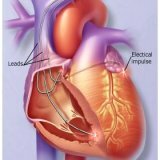
Very often, drug treatment is ultimately ineffective, and against the backdrop of the growing phenomena of heart failure threatening the patient's life, one must resort to electropulse therapy with a defibrillator, but this is done in a complex of resuscitation measures, for example, the treatment of heart defibrillation. In other cases, surgical intervention is required to install a pacemaker, an artificial pacemaker, a cardioverter-defibrillator. This type of treatment can not only save life-threatening arrhythmias, but also completely rid of a serious illness, improve the quality and lifestyle of the patient.