
What is the clasp prosthesis, what they are, the pros and cons of the clasp solutions, the features of care and contraindications
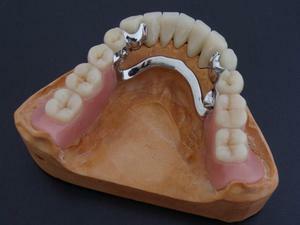 Any person dreams of having a beautiful smile, but many can not boast of this.Teeth can spoil from bad habits, as a result of poor ecology, improper oral hygiene, due to lack of vitamins.An hereditary factor is also important.Too neglected teeth can no longer be cured.Removable prosthetics can save the situation.Removable dentures help restore chewing function and make the smile beautiful.The most popular type of removable dental prosthetics is the clasp.
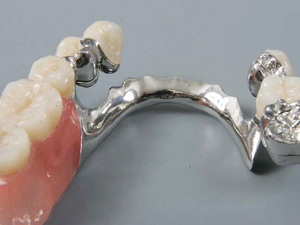 Clasp dentures for teeth represent a removable structure that helps distribute the load when chewing on the entire jaw.Because of this, teeth retain their natural functions , and their further destruction ceases.
They are made of a metal frame in the form of an arc with fixing elements( hooks, crowns, locks).They are attached to a plastic base, which simulates a gum with artificial teeth.
Types of denture prosthesis
Clasp dentures differ in the way of fixation and there are:
- on the clasps;
- on micro-locks( attachments);
- on telescopic crowns.
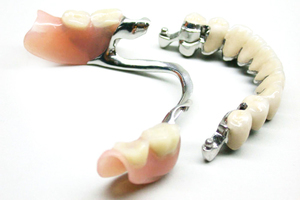
Clasp dowel prostheses are a design that is fastened to the supporting teeth by the using special hooks , called clasps.They firmly hold the prosthesis on the jaw, distributing the masticatory load on all the teeth.The strength and durability of this design is attached by a combination of clasps and a frame, which are cast together.Climmer prostheses are made, given the shape and size of the customer's tooth.They are the most popular means of recovery.Their only drawback is that when you see a metallic smile hooks.
Clasp prostheses on micro-locks use locks instead of hooks, which are completely invisible when smiling.This design is lightweight and robust at the same time, with chewing providing load distribution and supporting teeth.To protect them use cermet crowns.One half of the lock is mounted in them, the other in the supporting teeth.After installation, just snap the lock.High structural strength is achieved precisely due to such locks.They provide an easy removal of the prosthesis for regular cleaning.The main drawback of this design is its complexity.The service life is quite long and can reach 5-7 years.
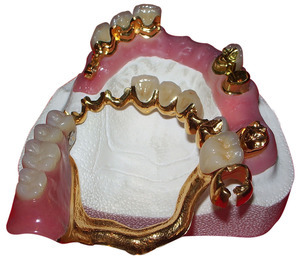 Clasp prostheses on telescopic crowns are considered to be one of the most complex types of prosthetics.It is a construction of telescopic crowns, consisting of two parts.The first part is installed directly on the tooth, the second - in the fixed structure.A strong fixation of the prosthesis is provided due to the fact that the top of the telescopic crown is very tightly worn on the bottom.Such dentures are considered universal dentistry.Patients find many advantages in it, namely:
- , even with a small number of teeth, full recovery is achieved;
- this design is very strong and durable;
- food intake does not cause any inconvenience;
- speech does not change;
- shooting every day is not necessary.Advantages of
Clasp dentures have certain advantages, namely:
- durability.The service life of such a design reaches 5 years, and this is very much for removable elements.For example, plastic structures have a service life of two and a half years.Such a big difference in timing arises from the fact that bone tissue and gingival tissue begin to atrophy under the clasp prosthesis much more slowly than under the plastic one;
- easy to wear.Wearing the clasp prosthesis does not cause any discomfort, because instead of the plastic base, a thin metal arc is used, not covering the front of the sky.After all, it is this site that affects taste sensations and diction.A thin arch is also on the lower jaw, this does not prevent the tongue from moving normally, which does not lead to speech disturbance.This reduces the risk of prosthesis falling out;
- strength and reliability.The cast metal frame has an extremely low risk of breakage;
- is also important to note that this design, although removable, but at night it can not be removed.It is convenient from all points of view - moral and aesthetic.
Disadvantages
Any removable design has its drawbacks, and clasp including.These include:
- high cost.The price depends on the characteristics of their manufacture, as well as on the method of fixation to the supporting teeth.The cost of the clasp dummy prosthesis is 20 000 - 30 000 rubles( the price depends on the complexity of the design).Bugelnaya construction on micro-jaws costs 90,000 rubles and more.The price of the clasp telescopic prosthesis is 22,000 rubles, and one telescopic crown costs 21,000 rubles;
- design requires a certain number of teeth.When the clasp prosthesis is mounted on the micro-locks, the supporting teeth are taken under the cermet crowns, because the locks are attached only to them.Basically, you need to make 4 crowns;
- complexity of the design.Clasp dentures today are considered to be one of the most high-tech designs.They are manufactured by an orthopedic doctor and dental technician, who have very high qualifications;
- at the beginning of the installation of a removable design the patient will be a little uncomfortable;
- metal can cause an allergic reaction.
When are the clasp prostheses installed?
This detachable design is installed in the following cases:
- if there is a defect in the dentition;
- no front teeth;
- no teeth on the lower jaw;
- on one side of the jaw there is no one or more teeth;
- parodontosis;
- abnormality of teeth;
- incorrect bite.
Contra-indications
Clasp prosthetics are not possible in such cases:
- if the tongue bridle has a high attachment, the places for placing the arc may not be enough;
- low part of the crown of the tooth, if it is impossible to increase it artificial;
- large atrophy of alveolar processes;
- presence of deep bite.
Care for the clasp prosthesis
It is quite easy to care for this removable construction.It is necessary to clean it every day in the morning and in the evening with a special disinfection liquid , which destroys all harmful microorganisms accumulating on the surface of the prosthesis.In addition, you need to properly care for the oral cavity.Brush your teeth twice a day, always rinsing your mouth after each meal.


