Osteosynthesis of humerus
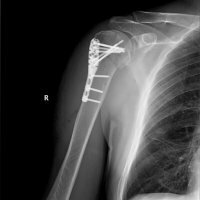
In the case of a fracture of the humerus, it is very effective to apply a curative splint and plaster bandage, but there are also cases when surgical intervention can not be avoided. The operation is performed when it is not possible to compare the fragments in the helical, transverse fractures, which is explained by the interposition of muscles between the fragments.
Indication for osteosynthesis and revision of the nerve is infringement, or damage to the radial nerve. Osteosynthesis is used to treat false joints. To fix the fragments, use rods, plates and screws.
Contraindications to osteosynthesis
Internal osteosynthesis is contraindicated in patients who are in shock, have inflammatory diseases, or if it is impossible to secure reliable fixation of fragments.
Access for operation
To make an outcrop of the site of the diaphysis of the humerus it is possible with internal, rear or anterior access. Anterior access is used for internal osteosynthesis.
For the osteosynthesis of shoulder fragments, plates with removable contractors, such as Kaplan-Antonova plates, Demyanova, etc., are used. They are recommended for use in transverse or proximal fractures during the diaphysis of the shoulder bone, if conservative treatment is ineffective.
Methods of performing the operation
The operation is done under anesthesia. The patient lies on his back. Make a cut, exposing the radial nerve. Access to the fragments is carried out on the back and front of their surface, exfoliating in the area of plate attachment of the periosteum and soft tissue. The fragments are compared, the plate is placed along the front surface of the shoulder for a uniform arrangement on the fragments.
After the compression is achieved between these fragments, the plate is fixed with screws. The bone and plate are covered with muscles, on which the nerve is placed. In the postoperative period, immobilization is carried out with a plaster bandage.
If massive Tkachenko plates are used, which are fixed by means of seven to eight screws, immobilization is carried out already with the use of an external longi during the first two weeks.
Connection of bones with screws
When the fracture line exceeds the diameter of the shoulder bone by one and a half to two times, a helical and oblique fracture is diagnosed. Usually two screws are used for fixation. In the postoperative period, immobilization with thoracobrachial gypsum dressing is used until complete consolidation.
Intramedullary osteosynthesis
This method is performed when the fracture is at least 6 centimeters from the joint ends.
Hardware:
- rods for fixing;
- nozzle;
- hooks are single-toothed;
- chisels;
- pliers.
Before the operation, the rods of the desired thickness and length are selected. The length of the rod should allow the core to fill the medullary cavity of the fragments, and that it protrudes one to one and a half centimeters above the bone. The length of the rod should be less than the shoulder length by 3-4 centimeters, the diameter - by 6-7 centimeters. When a rod is inserted through a fragment, its length should be shorter than the shoulder by 4-6 centimeters, diameter by 6-1 mm. The stem should be a millimeter thicker than the diameter of the medullary cavity.
When inserting the stem, it should be remembered that the medullary cavity is wider in the upper third and narrows to 6-9 millimeters in the distal third. In the cross section, the cavity is oval. If the rod is inserted through the proximal fragment itself, then a rigid and thick stem can be used if, through the distal shaft, the thickness of the rod is limited and it must be plate-shaped so that it easily bends as it enters.
Osteosynthesis with the help of beams
The patient lies on his back, an incision is made under anesthesia, which reveals fragments. They are compared. On the outer surface of the bone make a groove half a centimeter long, or a centimeter more than the beam. The end of the beam is inserted into the medullary cavity of a short fragment, then the beam is slammed into the groove. Additional fastening is carried out with cotter pins or screws. In the period after the operation, immobilization with gypsum thoracobrachial bandage is used.