Therapeutic exercises with obstructive bronchitis
Obstructive bronchitis is one of the varieties of acute bronchitis. Such bronchitis is most often caused by parainfluenza virus, rhinoviruses, respiratory syncytial virus, adenoviruses. Slightly less often it can be caused by mycoplasma pneumonia, influenza virus, virus-bacterial associations. The main sign of this disease is the obstruction of the airways( narrowing of the lumen of the bronchi).Obstruction develops, as a rule, under the influence of ARVI.Treatment of this disease can include various additional methods, one of which is therapeutic gymnastics in obstructive bronchitis.
In order to evacuate the functions of the bronchi, drainage exercises are used. Below are some of them, the essence of which is reduced to a strong contraction of the chest, they serve to cleanse the bronchi from mucus. Perform each exercise should be about ten to fifteen seconds, and begin the movement strictly in the period between inhalation and exhalation.
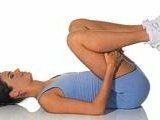
- The initial position is lying on the back. On the "time" the hips should be tightened tightly to the chest, clasping the shins with their hands, for "two" swinging a powerful exhalation to the score of "seven"( the shins still need to be pressed to the chest).At the "eight" they return to their original position, as much as possible, protruding with the diaphragmatic inhalation of the abdomen, and coughing deafly by the force of the abdominal press.
- The initial position is standing, legs are located on the width of the shoulders. Hands should be bent at elbows at an angle of 90 degrees, forearms tightly cover the lower ribs and diaphragm, while the hands are pressed to the sides. On the "times" they lean forward, rounding their backs, forearms, slightly squatting, resting on the hips( head at the level of the knees, and the gaze is directed down and back).The "two" make a powerful exhalation, continuing to count to "seven", lowering their arms, inflating the abdomen with a diaphragmatic inspiration, deeply coughing, and then repeating the inhalation and coughing twice. At the "eight" they return to the IV, while the stomach is protruded with a diaphragmatic inspiration.
If, on recovery, the patency of the bronchi is not fully restored and obstruction that impedes breathing exists, then sound therapeutic exercises are applied with the addition of respiratory exercises with time. All sounds must be pronounced quietly or in a whisper, calmly and without tension. It is important to follow the rule: breathing in through the nose - a pause of one to three seconds - a powerful exhalation through the mouth - a pause.
Exhale, when sounds are pronounced, should ease the cough. A soothing effect on the vocal cords also has whistling and hissing sounds( "c", "sh-sh-sh"), which should also be pronounced in a whisper with a half-open mouth.
In order to increase the inspiration in the sound gymnastics, the exercises should be performed in such a sequence: a small pause, exhalation with the sound of "pf-f"( this exhalation is called purifying).Exhalation should be done quietly and slowly, effortlessly, through the lips, folded with a tube( before exhalation and after it the mouth is closed).After this, a deeper breath takes place, bringing relief to the patient. Then there is a pause and then the breath is exhaled through the nose( mouth is closed with a prolonged reproduction of the sound "mmmm").Such actions contribute to a uniform descending and subsequent smooth expansion of the chest. Exercises are carried out sitting, with a slight inclination of the trunk forward. The brushes are placed on the knees with the palms down, and the entire foot of the foot should rest on the floor.
After that, you need to add two new sound exercises: the sound "p", which is one of the main in sound gymnastics( pronounced with obstructive bronchitis it calmly and gently as a double "rr").
The use of combinations of consonants and vowels causes oscillations in the ligaments, then the oscillations pass to the bronchi, trachea, and thorax. Such vibration provides relaxation of the muscles of the bronchi, and sputum is better off.
One of the important forms of therapeutic gymnastics in this disease is dosed walking. The dose of such walking should be increased gradually, which means that the routes must be of varying complexity and length. The doctor, when walking to the patient, should determine the rhythm of breathing( on level ground and when climbing upward), the pace of walking and the route, taking into account the subsequent increase in the load.