
Tuberous sclerosis
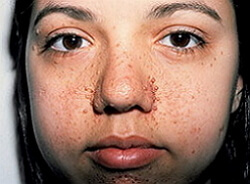 Tuberous sclerosis is a phakomatous disease of a genetic nature that affects many organs and tissues, forming benign tumors. It is rather difficult to diagnose tuberous sclerosis due to the large number of pronounced clinical manifestations and the primary dependence of symptoms on age.
Tuberous sclerosis is more common than it is diagnosed. This suggests that individual forms of the disease, namely the clinical symptoms of nonspecific etiology, are not taken into account, and patients with specific syndromes and symptoms that are not related to nosological forms are very often observed by doctors of narrow specializations.
Tuberous sclerosis can be found mainly in childhood and adolescence in the ratio 1: 10000, in children under five years - 1: 15000, in newborns - 1: 6000, in adults - 1: 40,000.Pathological signs of the disease are characterized by incomplete varying expressiveness.
Heavy forms of tuberous sclerosis appear sporadically, and the mild degree is of a family type. Primary tumors develop in different organs from several types of cells, and this indicates an inferiority of the genetic structures of previous neoplasms.
With tuberous sclerosis, a cell layer dystonia is formed, and abnormal changes in nerve cells occur, which is a sign of incomplete development of some parts of the brain.
Tuberous sclerosis causes
Tuberous sclerosis is inherited by an autosomal dominant type, characterized by heterogeneity with an incomplete form of penetrance, the occurrence of new changes that are detected in 68% of cases in early childhood.
The main causes of tuberous sclerosis are mutations that occur in genes located on the 9th and 16th chromosomes and are responsible for this disease. Depending on the altered gene, there are two types of pathology that arise in TSC 1 and TSC 2 genes, which are encoded by two proteins - hamartine and tuberin. These genes are among the tumor suppressors that do not allow the development of pathological diseases and limit the excessive growth of tissues.
Conducting a comprehensive study of mutations is quite expensive manipulation and directly depends on the size and structure of the mutated genes. Certain pathological defects are detected in 85% of patients. Some studies make it possible to compare sporadic cases of mutations in both TSC 1 gene and TSC 2. Thus, in the latter gene there is a high frequency of mental retardation and the appearance of seizures. In addition, the kidneys are affected and angiofibroma appears on the face. Sometimes such mutations in TSC 2 are manifested by clinical pictures of a moderate nature.
Tuberous sclerosis symptoms
Rapid manifestations of clinical signs of tuberous sclerosis are expressed by characteristic polymorphism. Hamartomas( tumors from embryonic immature tissue) are a single place for all tumors of the disease.
The main clinical manifestations of tuberous sclerosis are disorders of the skin and CNS.Skin pathologies are manifested in the form of hypopigmented spots( hypomelanous maculae), hypopigmented flat spots, having the color of coffee with milk, facial angiofibre, areas of "shagreen skin", fibrous plaques, soft fibers and Koenen tumors.
Hypomelanous maculae are mainly located on the entire body, except for the feet, brushes and genitals, asymmetrically and diffusely. They appear as from birth, and at a two-year, three-year age. The faster a child grows up, the more their number increases with the greatest localization on the buttocks and trunk, where they occupy an asymmetric position.
Hypo-pigmented spots with tuberous sclerosis have a matte-white color, an oval or leaflike shape, a characteristic symptom of confetti. Depigmentation of eyelashes, hair and eyebrows is a special symptom of tuberous sclerosis.
Pringle's adenoma or angiofibroma of the face manifests itself from 45 to 90% since the age of 4.This sign of tuberous sclerosis is characterized by skin eruptions in the form of nodules, reminiscent of millet grains, and can also occur as large neoplasms. The surface of these spots or knots is smooth, shiny, but dense to the touch. They can be arranged in the form of single and multiple elements on the chin, cheeks, nose wings and nasolabial triangle. This species is characterized by a blitherelly symmetrical arrangement. A rash has a pale yellowish and pinkish-reddish color. But if telangiectasias are attached to angiofibromas, then their red color of coloring is enhanced. Histological evidence suggests that these neoplasms contain super-vascular vessels, fibrous tissue that has grown and still unripened hair follicles. In children with this symptomatology, tuberous sclerosis is much more common until 11 years old, beginning at the age of three.
Plots of coarse and hard skin called "shagreen skin" are represented as a locally expressed cluster of gametrum, which merge into a huge spot. These spots are slightly above the skin surface and have a pink, brown and yellow color, and according to external data resemble an orange peel. The localization of these areas is most often the lumbosacral region. For shagreen skin is asymmetric arrangement, and its size can vary from 1 mm to 10 cm. This symptom of Tuberous sclerosis is mostly observed after ten years.
In 25% of patients, a skin symptom of tuberous sclerosis pathognomonic character, called fibrotic plaques, can be detected. As a rule, their color is beige, they are rough to the touch, and appear before the first year of life. Fibrous plaques are considered the first clinical symptom of tuberous sclerosis in children. But mostly such skin manifestations are characteristic for a more mature age. They are located unilaterally in the region of the forehead and head on its hairy part.
Thirty percent of patients with tuberous sclerosis have fibromas in the form of soft multiple or single neoplasms on legs in the form of sacs, which are localized on the trunk, neck and extremities. Sometimes soft fibromas are very small and resemble goosebumps.
There are also such tumors that are on the fingers near the nails or under the nail plate in the form of dull and red skin nodules. They are much more common among women on the toes. The size of such fibers can reach 10 mm. This symptom of Tuberous Sclerosis, also called the Coenen tumor, is formed after puberty and is observed in 50% of patients. Such remote formations can then progress again.
The second major symptom of the clinical picture of tuberous sclerosis is the central nervous system with its lesions in the form of tubers and subependymal nodes. These neoplasms, located on the surface of the brain, lead to the development of hydrocephalus. Tuberses are considered as hamartomas, which are manifested by single and multiple protrusions.
Timely diagnosis by a hamart on the cerebral cortex is an important aspect for the further prognosis of tuberous sclerosis.
Subendymal nodules are detected in CT or MRI of the brain and are localized in multiple-contiguous ventricles. A frequent clinical picture of this type is vision impairment, headache and vomiting.
In cases of CNS lesions, epileptic seizures, mental retardation in development, as well as disturbances in the behavior and cycle of sleep and wakefulness are observed. Exceptions are forms of tuberous sclerosis with erased clinical symptoms, in which epileptic crises and mental retardation are absent.
Epileptic seizures are a significant symptom of tuberous sclerosis and are noted in 90% of patients. These attacks can lead to a violation of intelligence and become the main cause of disability of children. Epileptic seizures appear immediately, in the first year of a child's life. Very often during this period, both Vest syndrome and Lennox-Gastaut syndrome occur simultaneously. But the main clinic of the disease is characterized by underdeveloped spasms, somatory seizures, possible secondary character clonic seizures.
Mental retardation in tuberous sclerosis, manifested in 50% of patients, can be of moderate or deep form.
Behavior change is characterized by autism, aggression or autoaggression, hyperactivity, in which attention deficit disorder is manifested.
Tuberous sclerosis is characterized by a delay pattern in both mental development and speech. Children become unhappy, capricious, they have an explosive reaction. They become very slow and lose communication skills. The earlier tuberous sclerosis begins in children, the more serious are the manifestations of mental underdevelopment. For patients with this diagnosis, sleep disturbance consists in a period of prolonged sleep, very frequent awakenings, somnambulism and insomnia.
On the part of the organs of vision, the clinical picture is divided into retinal and non-retinal symptoms. These tumors( phakomas) are localized next to the optic nerve, but sometimes on the retina, which causes a progressive decline in vision.
Neretinal eye symptoms in tuberous sclerosis are manifested by eyelid tumors, iris changes, cataracts, homonymous hemianopsia, strabismus, sixth nerve paresis.
In tuberous sclerosis, many organs are affected. First of all, the heart affected by rhabdomyoma is affected. It does not cause cardiac disturbances, but with such tumors, there is frequent intrauterine fetal death or the birth of a child with low Apgar scores. Such children always have a symptom of cyanosis. At a young age, tachycardia is heard because of a disturbance of the heart rhythms.
After 30 years, the lungs undergo a pathological change. There is a respiratory insufficiency and a pneumothorax, and on a radiogram define a cystic education in lung.
In tuberous sclerosis, the gastrointestinal tract is in a pathological process in a wide variety. This is the oral cavity, liver and rectum. Even there is a violation in the enamel of the teeth, with characteristic depressions.
Renal pathology in tuberous sclerosis occurs in 85% of cases and occurs with angiomyolipoma almost asymptomatic. It has two-sided or multiple localization. Tumors of kidney size of 4 cm cause spontaneous hemorrhage, which is characterized by abdominal pain, severe hypotension, cold sweat, anemia and possible hematuria. Very often, angiomyolipoma leads to chronic renal failure. Frequent signs of tuberous sclerosis are renal cysts, manifested by a violation of urine outflow, increased blood pressure, and less often - bleeding.
Changes from the skeleton are determined only during X-ray studies. In such patients, defects in the bones of the skull, pelvis and extremities are revealed.
Tuberous sclerosis treatment
To cure patients of tuberous sclerosis is almost impossible. The only treatment is the provision of symptomatic care.
For cessation of convulsive attacks infants are prescribed corticosteroid drugs. If after the application of Nitrazepam, clonazepam succeeds in arresting seizures successfully, it is possible that the process of development of mental retardation is slowing down.
Older children use carbomazepine, sodium valproate, phenytonin, and acetazolamide reduces the frequency of seizures, sometimes even leads to their cessation.
In hydrocephalus patients undergo a bypass operation.
Patients in whom intelligence is preserved experience severe discomfort in facial symptoms( skin defects).In such cases dermatoabarasia is used, although after it relapses are not excluded. Therefore, at present, a positive result is achieved by using an argon laser.
Emerging kidney bleeding stops nephrectomy. And the kidney cysts are successfully punctured.
Cardiac insufficiency caused by rhabdomy is treated with therapeutic drugs.
For lesions of the lungs, progesterone is prescribed.
All problems that combine mental retardation and physical disabilities are corrected by clinical psychologists.
Tuberous sclerosis is considered one of the diseases with an unfavorable prognosis for life. Basically, it becomes the cause of death, and life expectancy with such a complex pathology does not exceed five years.