Carbuncle Kidney, Symptoms and Treatment
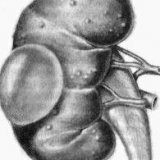
Kidney carbuncle is a purulent-necrotic lesion, in which an infiltration occurs in the cortical substance of the affected kidney. This disease can often occur again in the presence of any purulent foci in the body, as well as infection occurs hematogenously( through the blood) or through the ureter.
Mechanisms for the formation of kidney carbuncle occur when a septic embolus enters the renal artery, which can cause a septic infarction of the kidney and, consequently, the development of the carbuncle.
In addition, the development of the disease contributes to the incomplete overlap of the embolus in the branch of the renal artery with the subsequent development of infection, the process of infection at the site of its penetration into the tissue of the kidneys, which can subsequently lead to necrosis.
In the area surrounding the affected areas, inflammation occurs with the formation of a protective granulation shaft. Infiltrates spread on calyx and renal pelvis. In the pericardial tissue also develops a reactive edema and suppurative inflammation. On the surface of the kidney in the region of the carbuncle, the convexity of the cyanotic color is macroscopically determined. Carbuncle in the section has a wedge shape, consists of numerous small abscesses, which are surrounded by an infiltrate with areas of necrosis. The size of the carbuncle can be different - in diameter from a few millimeters and up to large sizes the size of a chicken egg. Carbuncle is most often localized in the right kidney, symptoms of the disease are observed in its upper segment.
In order to determine the correct diagnosis of "kidney carbuncle," the doctor observes and appoints symptoms and treatment individually, after which a course of therapy begins. In most cases, inflammatory processes develop in one kidney. The causative agents of the disease are staphylococcus aureus and white, E. coli, Proteus. In 30-40% of patients with kidney carbuncle, its combination with apostematous pyelonephritis is observed. There are cases when the carbuncle breaks the renal pelvis and the granulation tissue starts to grow at the site of the rupture with the formation of scarring.
The causes of the origin of the kidney carbuncle.
Often, the kidney carbuncle can result from a blockage of the microbial embolus of a terminal large vessel of the kidney. Microbial embolus penetrates from the focus of inflammation with blood flow. There is a violation of blood circulation in a limited area in the cortical layer of the kidney, this leads to its ischemia and necrosis. Then, penetrating organisms cause an inflammatory process. The development of the kidney carbuncle depends on the fusion of small abscesses in apostematous pyelonephritis, squeezing the terminal vessel in the cortical layer of the kidney with a purulent-inflammatory infiltrate that is localized in the intermediate tissue of the kidney. The disease can be multiple or single, has a different value. Localized carbuncle in the cortical layer, but sometimes there is a risk of spreading it to the medulla. When the carbuncle is localized, a protrusion on the surface of the kidney appears with a large number of merged pustules. At later stages of the disease, carnuncle is purulent melting. Inflammatory processes in the field of paranephric fiber can be limited to leukocyte infiltration. In the walls of the pelvis there is edema and leukocyte infiltrates. With favorable currents, resorption of infiltrates occurs with the formation of connective tissue in their place and the entrainment on the surface of the kidney. The disease is very similar to other forms of purulent pyelonephritis, including apostematous pyelonephritis. The main signs of the disease - a sharp general weakness, pale skin, as well as high body temperature with a hectic character with chills and torrential sweat and other septic conditions. Local symptoms are characteristic muscle tension in the anterior abdominal wall and lower back, a sharp positive symptom of Pasternatsky, besides, a painful and enlarged kidney is clearly palpable. These local symptoms can not be expressed far from always. There is also a high leukocytosis with a left shift of the leukocyte formula.
Diagnosis of carbuncle.
In the diagnosis of kidney carbuncle, the most valuable are radioisotope and X-ray methods of investigation. In addition, in a survey of urinary tract, the doctor discovers whether the size of one of the kidney segments is enlarged, whether the external focal bulb is focal, the rims of the muscle on the side of the lesion are missing. On urograms of excretory or retrograde pyelograms, compression of calyx or pelvis is detected, and one or more calyxes are amputated. X-ray telescopic pyeloscopy reveals hypokinesia and hypotension of the upper urinary tract on the affected kidney. The renal arteriograms determine the avascular region in the arterial phase in the cortical layer of the kidney, the nephrogram of the doctor reveals the localization of the carbuncle, the defect in the image of the wedge-shaped shape, respectively. With static scintigraphy with neohydrin, an accumulation defect in the location of the carbuncle can also be detected.
Therapy of kidney carbuncle. Treatment.
With kidney carbuncle, antibacterial massive therapy will not lead to cure, due to the fact that medications due to circulatory disorders can not reach the lesion. In the absence of the effect of treatment in the first two to three days, the disease shows decapsulation of the kidney, excision of the carbuncle, a cruciform dissection or drainage of the pericardial cellulose. If the passage of urine is disturbed, the patency of the urinary tract is restored by removing the obstruction or by excretion of urine. Timely begun therapy of rational treatment of acute pyelonephritis leads to a reduction in purulent-inflammatory processes in various locations.