Alkaponuria
 Alkaponuria is a fairly rare genetic disorder that develops as a result of the absolute deficiency of the homogentisinic acid enzyme, which is shown by black urine at the exit. This disease is characterized by a disorder of tyrosine metabolism, as a result of which homogenticinic acid is released in urine in very large quantities.
Alkaponuria in adults is often manifested by foci of pigmentation on various organs and tissues, and arthrosis is often observed. This is due to the fact that the congenital deficiency of the enzyme homogentisinase, leads to its accumulation in various tissues, more often in articular cartilages and tendons. Mental and physical development of people with this disease does not suffer at all.
Alkapturia, being a systemic congenital disease, is very rare - one case per 25,000 people, while having a sufficiently strong geographic linkage to a certain locality of the Dominican Republic and Slovakia. This disease is directly associated with a violation of the amino acid exchange, inherited by the recessive type. The exchange function of tyrosine subsequently reaches exclusively to the stage of homogentisic acid. After this, due to the inherent lack of acid oxidase( an enzyme that cleaves the benzene nucleus of homogentisinic acid), the transformation does not proceed further, but accumulates in sclera, cartilage, bones, skin and other organs, and is then excreted in the urine.
Alkapturia in a child is diagnosed almost immediately after birth - on urine-wetted diapers, due to the release of a large amount of homogentisinic acid, dark spots remain unexposed.
Alcaptonuria of the cause of
The main cause of this pathology is the mutational processes in the genes responsible for the production of homogentisin oxidase, which helps the cleavage of phenylalanine amino acids and tyrosine. Due to these disorders in the human body there is a conglomeration of homogentisinic acid. Most often, its excess, as well as an excess of other compounds, is deposited in the connective tissue, thereby causing a blackening of cartilage and skin.
There is also a gradual accumulation of homogentisic acid in the joints, which leads to the development of arthritis. In addition, this substance in large quantities is excreted with excreted urine, which for this reason, when interacting with air, significantly darkens.
Alkaponuria Symptoms of
The earliest and most characteristic sign of alkaponuria is the excretion of urine, which, after interaction with air, very quickly darkens. In the future often develops pyelonephritis complicated urolithiasis. Also characteristic feature of this disease is the damage to the spine and large joints, which in their clinical picture are very similar to chondrosis and Bekhterev's disease.
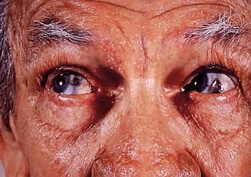
For alkaptonuria, the following symptoms are also characteristic: change and pigmentation of the skin and sclera, limited movements, calcification, inflammatory processes, destruction of articular cartilage, mechanical pain. Approximately 20% of patients present a change in the aortic valve, there is calcification of the ascending section and the aortic valves, as well as the fibrous ring.
To non-standalone symptoms of alkaptonuria include triangular pigmentation of the groin, axillae, nose, sclera;Calcification and bluish color of the outer ear. Perhaps the appearance of heart murmurs, due to the deposition of pigment in the valves. In men, stones are often found in the prostate gland.
Usually in the fourth decade of life with alkaponuria, the symptomatology of progressive degenerative arthropathy develops. In this case, lesions of large peripheral joints and spine with chondrocalcinosis( development of osteochondral bodies) are noted. Initial deposits of pigment are observed in the stadinous nucleus and the fibrous ring of the intervertebral discs. Somewhat later, the hip, shoulder and knee joints are involved. The defeat of small peripheral joints is not observed. The first sign of adult spondylosis is usually acute disc syndrome, clinically reminiscent of ankylosing spondylitis.
In addition to alkaptonuria, severe functional impairment, usually associated with restricted mobility and joint stiffness, is often detected. Often in the knee joint there are effusions, flexion contractures, crepitus. In some cases, fragments of dark pigmented cartilage are found in the joint fluid.
Diagnosis of alkaponuria usually does not represent difficulties. Most often, this disease can be diagnosed almost immediately after the birth of the child. On all diapers impregnated with urine there are no dark spots left even after qualitative washing. In the absence of this distinctive feature, the most informative diagnostic method is the method that determines the quantitative equivalent of the presence in the urine of benzoquinoacetic and homogenesinic acids. To obtain these results, enzymatic spectrophotometry and / or liquid chromatography are used. It is very important to conduct a differential diagnosis with melaninuria, porphyria, hemoglobinuria, hematuria and vitamin C deficiency.
Alkaponuria treatment of
Unfortunately, at the moment no specific treatment for alkaponuria has been developed. Most often, after a comprehensive examination, strict symptomatic therapy is indicated. In diseases of the musculoskeletal system, anti-inflammatory drugs are recommended, with urolithiasis, spasmolytics, etc. are indicated. It is necessary to take vitamin C in large doses.
Due to the genetic nature of the development of alkaptonuria, it is not possible to develop specific preventive measures.