What kinds of non-removable dentures exist, types of structures, advantages and disadvantages of each of them
 It happens that tooth decay leads to partial or complete destruction of one or more teeth.And further, the loss of even one tooth leads to deformation of the entire series, an increase in the load on the rest, changes in bite, which leads to rapid erasure of the enamel layer, significantly increases the risk of new caries and can lead to gum disease.Completely restore the chewing function and aesthetic appearance of the dentition can be done with the installation of prostheses.
On the way of fixation in the oral cavity, dental prosthetic structures are removable and non-removable .
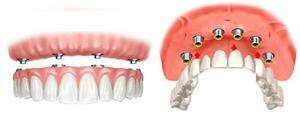
Fixed prostheses are firmly attached instead of removed teeth or replace the damaged part of the destroyed tooth.They assume a long-term wearing on an ongoing basis.
Depending on the design, the following types of fixed dentures exist:
- Dental microprostheses.
- Single crown.
- Bridging non-removable dentures.
- Dental implants.
The type and design of the fixed dental prosthesis is determined exclusively by the dentist orthodontist depending on the
of the individual pathology of the client and the anatomical structure of his jaw.Dental microprostheses
-
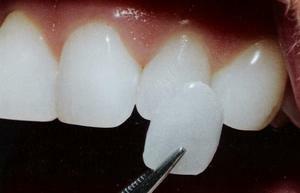 Veneers - thin, translucent non-removable plates of high-strength ceramics, manufactured on the basis of precise impressions.With the help of heavy-duty cement, a carefully fitted veneer is installed instead of a previously removed thin layer of enamel in front of the surface of a solid dental tissue.Microprosthetics of this kind is carried out in cases of appearance of dark age spots or spots from old fillings on the surface of the front teeth;Cracks and chips of tooth enamel, formed as a result of wipe or trauma;The presence between the teeth of a wide natural gap;Irregular tooth shape.Veneers help to strengthen and restore the aesthetic appearance of the front dentition, the so-called smile zone.
 - Lumineers is a variety of veneers.It is made of porcelain, for stronger strength strengthened by crystals.Installation of lumineers does not require removal of enamel and turning.They can be attached both directly to the surface of the tooth enamel, and to old crowns and bridges.The ultra-small thickness of lumineers avoids the convexity effect typical of conventional veneers.
- Dental tabs - in fact, are seals of high strength and accuracy of installation.Applied in cases of formation of large cavities;Significant destruction of hard tissues of the crown part;As a basis of dental crowns and support of bridge prostheses.Such non-removable prostheses are made of exact replicas of damaged teeth made of metal, various synthetic alloys or ceramics.The use of ceramics makes it possible to give a tab a natural shade.In addition, this material is almost not destroyed and does not absorb colorants, permanently retaining color.
Single crown
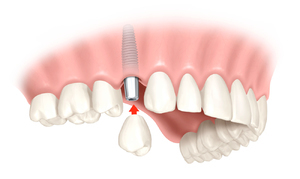 This type of non-removable prosthesis is used for the destruction or of strong damage to the crown part of the tooth .In the case of maintaining a healthy root, using a special pin crowns allow you to restore almost completely destroyed tooth.Crowns with absolute accuracy imitate the anatomical features of healthy, natural teeth, performing all their inherent functions.Modern technology allows you to install such prostheses without removing the nerve, which is important for preserving the root tissues.
Currently, in the manufacture of crowns, metal ceramics, metal plastic or ceramics are most often used.
Ceramic-metal crowns
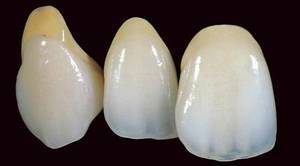 The carcasses for an exact copy of the tooth are created on the basis of the alloy of cobalt and chromium , which is then covered with an outer layer of ceramics.Such prostheses are characterized by high strength, durability and aesthetics.Metal ceramic crowns are installed in both the front and back dentition.
Metal plastic crowns
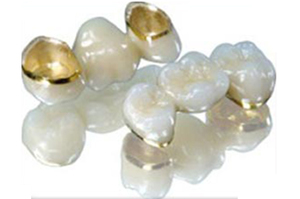 Differ in their ease and affordability, performing an aesthetic function.However, the composite material of such a crown is less strong, subject to color changes over time and influence on it, for example, tobacco or coffee.
In addition, the plastic absorbs various odors of and can cause an allergic reaction of the gums.
Ceramic crowns
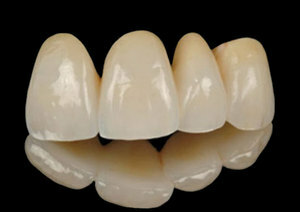 From cermet crowns, such fixed dentures differ with a more natural color and the absence of oxidative processes , characteristic for metal, and the inflammatory reaction possible with the use of composite materials.
Ceramic crowns are distinguished by a higher price, due to the cost of ceramics and the high-tech manufacturing process of the prosthesis.
Bridges
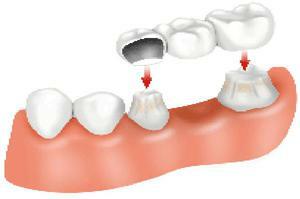
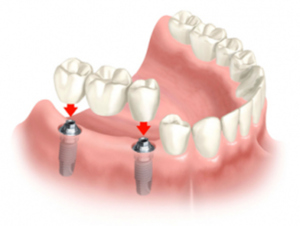 The installation of dental bridges is a classic method of prosthetics, which is used in the absence of multiple teeth of the same row.Such a non-removable prosthesis is a monolithic construction of several artificial teeth, with crowns on each side.These crowns are attached to the ultra healthy teeth turned under them, which serves as a support for the bridge prosthesis.
Depending on the material of manufacture, there are plastic, metal-ceramic and metal-plastic bridges.
By way of fastening, the bridge dentures are divided into the following types:
- Bridges on the locks .Such constructions allow to do without installation of crowns on supporting extreme teeth.
- Adhesive bridges .Such fixed prostheses are attached with the help of special plates and tires, which allows to avoid the operation on grinding adjacent teeth.For reliable fixing of the bridge, glue is used.Adhesive bridges are not recommended for the replacement of chewing teeth due to insufficient strength for this, but it is quite possible to replace incisors or front teeth.Such prostheses are mainly used in the absence of no more than two teeth.
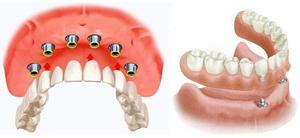
- Bridges on implants .Applied in cases of absence of a significant part of the dentition.As a support for such bridges are dental implants made of metal, which are screwed into the jaw instead of one or more removed teeth.Then they put crowns of the bridge prosthesis.
The advantages of non-removable bridges are minimal preparation of dental tissues, painless operation, reversibility of treatment, absence of contact with the mucous membrane, low cost.
The main drawback of bridges is the additional load on neighboring teeth and teeth used as support.This can lead to problems with the shrinkage of the prosthesis.On the site of missing teeth, bone resorption occurs, as a result of which the bridge may collapse.To this, the composite materials of such a prosthesis are subject to the influence of substances that change the shade of artificial teeth, they are quickly erased and do not possess a sufficient degree of strength.
Dental implants
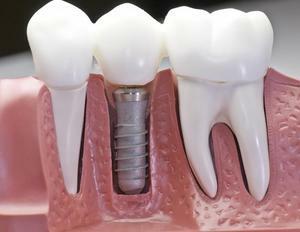 These prostheses are used to replace one or more teeth.The dental implant is a titanium artificial root in the form of a cylinder, screwed into the bone jaw tissue.
After a few months, necessary for the full implant implantation, the ceramic crown is installed on it , which completely fulfills all the necessary functions of a healthy tooth.
A lightweight plastic crown can be used as a temporary crown before installing a permanent crown made of ceramic.The dental implant performs all the necessary functions to the fullest extent, while ensuring the load of the jaw bone, which prevents its weakening and deformation.
Necessary hygiene measures for the care of non-removable dentures
The process of taking care of dentures differs little from the hygiene of natural teeth, however, requires regular examination of the dentist.
- As well as natural teeth, dentures need a daily, morning and evening brushing with a toothbrush, preferably of medium stiffness.
- The interdental spaces should be cleaned of food residues with a special hygiene thread.
- Very solid products should be avoided.
- Carry out mouth rinsing and tooth cleaning with the tools recommended by dentists.
- Avoid mechanical damage to the prosthesis material.Do not clean them with metal needles or other similar objects.