
Shereshevsky-Turner Syndrome
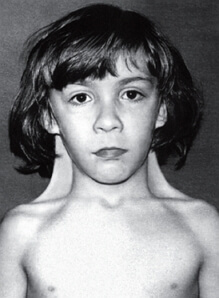 Syndrome Turner - a disease of genetic hereditary character, which results in disturbances in the structure of the X chromosome, accompanied by malformations of the internal organs, and short stature. This hereditary disease as described in 1925 by endocrinologist Shereshevskiy, according to which, it is due to incomplete development of the pituitary gland in the front of his share and gonads with concurrent congenital somatic character. But in Turner in 1938, three additional symptoms were identified for general signs of the disease. These include deformations of the elbow joints, skin folds in the form of wings and sexual infantilism present on the skin.
Syndrome Turner causes
chromosomal abnormality in the fetus is the basis of the causes of the disease, which leads to severe pregnancy and preterm birth, whereby the child is born having Turner syndrome. This anomaly, as revealed, does not depend on the age or any pathological diseases of the parents. Therefore, a set of pathological chromosomes forms the basis of the syndrome. This defect occurs after the nondisjunction of the chromosomes of the mother or father.
There are forty-six chromosomes in the body of a healthy person, and patients with the Shereshevsky-Turner syndrome do not have a single chromosome, it simply does not exist. Instead of the double XX chromosome, which are inherent in women, contains only one X chromosome forty-fifth( CW).If this chromosome is completely absent or undergoes changes, the formation of enzymes and proteins in the body is disrupted, which leads to a general imbalance. This pathology is one of the cytogenetic forms of the Shereshevsky-Turner syndrome.
But the second most common is mosaicism, which is characterized by structural rearrangements of the isochromosome localized on the long arm of the X chromosome. Therefore, if the main cause of Turner syndrome - a violation in the karyotype, already these changes may cause different effects of ionizing radiation on cells during division, harmful toxic substances, and predispose the body at the genetic level to the formation of pathological etiology of chromosomes.
Syndrome Turner symptoms
Syndrome Turner has major clinical and pathophysiologic features, including, primarily, dysplasia, premature ovarian failure, congenital malformations with the cardiovascular and urogenital systems, skeletal defects, lymph edema of handsAnd legs, pathology of the organs of vision and hearing, as well as metabolic and physiological changes.
Almost 95% of cases with Shereshevsky-Turner syndrome show stunting. The final result is the average value of 140-147 cm growth. Stunting with this syndrome is due to a collection of skeletal dysplasia with abnormalities in chromosomes and intrauterine growth retardation.
Disturbances occurring in the hormonal epithelium lead to primary gonadal insufficiency and gonadoblastoma.25% of girls with Shereshevsky-Turner syndrome have spontaneous puberty, which has a mosaic variant of a karyotype. In general, it is complete, and therefore does not allow normal and long-term functioning of the ovaries.
Also pubertal period is characterized by the absence of secondary sexual characteristics. Absolutely not developed mammary glands, amenorrhea and meager pubic hair loss are revealed, external genital organs are underdeveloped. Very rarely, follicles are found, which causes the impossibility of procreation. The lack of estrogens develops in women osteoporosis, which causes frequent fractures of the neck of the hip, spine, wrist.
Very often patients with Shereshevsky-Turner syndrome complain of an increase in blood pressure. In addition, on the legs it is below the norm or, in general, is not determined.
The main cause of the death of patients with Shereshevsky-Turner syndrome is the dilatation of the dilated aorta. Also, in many patients, coarctation of the aorta( provokes pressure) and the bicuspid aortic valve is detected.
A common phenomenon in this disease is the pathology of the urinary system. Ultrasound reveals developmental defects in the form of double kidney and malorotation. Also there is bilateral hypoplasia of the kidneys, the number of arteries and veins varies, the ureters and pelvis doubles. As a rule, such changes do not disrupt the function of the urinary system, but lead to hypertension and cause the development of many infections.
With lymphostasis, patients with Shereshevsky-Turner syndrome have swelling of the hands and feet, which disappear with age, vocal folds on the neck, dysplasia of the nails, anomalies in the development of the auricles.
A typical sign of the Shereshevsky-Turner syndrome is the deviation from the norm of the elbow joints, the curvature of the shins, the presence of the shortened fourth and fifth fingers on the hands. Frequent pathology of patients is dysplasia of the hip joint, scoliosis, gothic palate, sometimes abnormalities in the growth of teeth, infantile physique with mature facial features. Visually, the skin shows pigmented spots, neurofibromas and vitiligo. When examining the patient, minor anomalies in the development of the eye in the form of an antimonogloidal incision are noted.
Patients with Shereshevsky-Turner syndrome in their behavior resemble small children, although mimicry and facial expression reflect an adult.
Syndrome Shereshevsky-Turner diagnosis
Newborn children diagnosed with Shereshevsky-Turner syndrome are difficult, but after the first year of life, with the advent of phenotypic signs, it becomes quite possible. To make a diagnosis, it is necessary to carry out a molecular-cytogenetic analysis to exclude Mozzacism.
Diagnosis of Shereshevsky-Turner syndrome is carried out in the process of karyotype research, detection of somatic anomalies and laparotomy. Carriers of this pathology are under the regular supervision of an oncologist, since non-developing gonads can develop into dysgerminomas or gonocytomas.
In a blood test of patients with the Shereshevsky-Turner syndrome, a reduced amount of estrogens is detected with increased hormones of the pituitary( foliotropin).On ultrasound - underdevelopment of the uterus and the absence of ovaries. Radiologic examination reveals osteoporosis of bones and various types of anomaly of the skeleton. Very often other diseases of the internal organs join the main disease.
Shereshevsky-Turner syndrome treatment of
First of all, treatment of Shereshevsky-Turner syndrome begins with the use of growth-stimulating therapy. This is necessary in order to normalize growth at an earlier age, induce pubertal also in the normal period and finally achieve significant results in growth.
Today, there is an effective and safe drug used to treat patients with the syndrome of Shereshevsky-Turner - a recombinant growth hormone( RGR).Genetics proved that the use of high doses of RGR allowed to increase the growth of patients to 157-163 cm. In the first year of treatment, a maximum growth rate of 8 to 15 cm is noted, and then it decreases to 5-6 cm per year.
Early started regular treatment for Shereshevsky-Turner syndrome gives a positive result in the socially significant final growth of these patients.
In addition to increased growth, when using recombinant hormone, there is a positive dynamics of the hormonal, mental and metabolic background.
Simultaneously with this drug, patients are prescribed somatotropin, which increases muscle mass, improves renal blood flow, increases cardiac output, increases calcium absorption in the intestine, and enriches bone minerals. As a result, the level of lipoproteins in the blood decreases, and the levels of alkaline phosphatase, fatty acids, urea and phosphorus increase to the norm. Patients with Shereshevsky-Turner syndrome feel an increase in vitality, and their life is significantly improved.
Induction of pubertal is carried out with estrogen preparations that mimic normal sexual development. If estrogen replacement therapy started earlier with fifteen years to optimize growth potential, then according to the final data of the International Consensus on the treatment of Shereshevsky-Turner syndrome, it is customary to start estrogen therapy from the age of twelve at the same time as RGR.This is due to the proven positive therapy of these hormones. But with the delay of puberty, which contributes to the early manifestation of ovarian insufficiency, the negative psychological state of such patients may increase.
Many women with Shereshevsky-Turner syndrome after such treatment have chances to give birth to a child. After all, after the application of growth hormones, the uterus grows to normal size, which makes it possible to bear the child. For this, IVF is used with a donor egg.
Various corrective methods for the treatment of the Shereshevsky-Turner syndrome have been developed. For example, to regulate the body's energy system, acupuncture is used. It contributes to the normalization of metabolic processes, improves the functions of vegetative-endocrine organs, restores the balance of the whole organism. Acupuncture is one of the unique methods in therapy that improves the microcirculation of biofluids in systems and organs, helps to better function the brain and the heart, and has an anesthetic effect in the body.
With Shereshevsky-Turner syndrome, there is a visual defect on the neck in the form of additional skin folds, which can be surgically removed by performing a plastic operation.
For the removal of shortness of breath, many patients are prescribed physiotherapy courses. In a particular case, these are inhalations with moistened oxygen. Also very well helps and therapeutic exercise, which includes certain exercises aimed at specific muscle groups( breathing, hands or feet).These exercises can be either active( performed by the patient himself) or passive( with the help of a medical worker or by helping yourself with a healthy part of the body).
Thanks to this complex treatment, life with the Shereshevsky-Turner syndrome is getting much better.