Causes and treatment of movement coordination disorder
- Contents:
- Symptoms of coordination disorder
- Causes of coordination disorder
- Symptoms of ataxia
- Treatment of movement coordination disorders
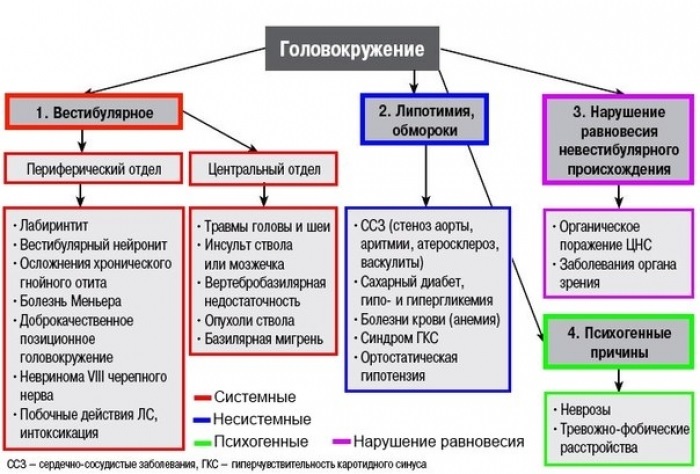
 There are a number of reasons for the lack of coordination of movements or ataxia, leading to motor disorders, loss of strength in the extremities. The vestibular apparatus is located in the inner ear, divided into several zones. The peripheral department is responsible for the balance, spatial orientation, coordination of movements. When the head turns, the muscles contractively contract, resulting in the straightening of the body.
 Abnormal changes in the semicircular canals of the inner ear, where the primary receptors are located, lead to a loss of balance. Depending on the lesion of receptors, proprioceptive( weight, vibration, etc.) and tactile sensitivity are lost in some areas.
Symptoms of coordination disorder
Loss of stability is classified according to the phases of the movement, the expected diagnosis. Delayed actions, unstable position of the body - a common sign of Parkinson's disease, polyneuritis.
Involuntary twitching( chorea) - consequences of CNS damage after rheumatism or a symptom of vertebro-basilar insufficiency. Chaotic muscle contractions indicate a latent form of epilepsy. With an unbalanced gait, the cerebellum, cerebral circulation is examined.
Symptoms of impaired movement coordination:
- profuse sweating;
- horse racing;
- change in the rhythm of breathing, color of face and neck;
- movement coordination disorder;
- sudden attacks of nausea.
The changed condition is accompanied by involuntary movements of the eyeball( nystagmus): vertical, rotary, transverse, diagonal. There is paroxysmal positional dizziness with the formation of the illusion of rotation of the external image. The ringing in the ear signals problems with receptors in the peripheral department.
Causes of coordination disorder
Loss of coordination, dizziness sometimes associated with organic brain damage, neurotic conditions. Attacks are accompanied by diplopia( bifurcation), bulbar signs( violations of the medulla oblongata) lasting from a few minutes to several hours.
Symptoms occur suddenly. The patient may develop frustration of breathing and heart rhythm, impaired muscle sensitivity, swallowing and chewing. Predisposing factors may be:
- pungent odor;
- weather change;
- is any annoying factor.
Symptoms of ataxia
 A typical imbalance often causes cerebellar lesions. The patient is difficult to be in one position. When walking, he spreads his legs widely, chaotic waving his arms. In a difficult stage without help, he can not sit, stand, hold his head.
 The vestibular form develops when one of the elements of the vestibular apparatus is affected. Suffer patients with encephalitis, neoplasms of the cerebellum. The main symptoms:
- feeling of rotation of objects;Motion sickness
- ;
- nausea;
- loss of orientation, dizziness.
The cortical form develops when the function of the frontal-bridge system is violated. In addition to typical manifestations, the psyche changes, the grasping reflex weakens, and smells disappear. Causes of the condition: abscesses, problems with cerebral circulation. Still distinguish kinetic, sensitive, static ataxia with subjective signs.
Important! One of the dangerous symptoms is occlusion of the auditory artery.
Thrombosis or embolism interfere with blood flow, provoke severe pain, ataxia, the appearance of noise, lead to loss of stability. With partial blockage, the patient suffers from high-frequency sounds.
The phenomenon is fraught with stroke, unilateral deafness. With the violation of blood flow associated bouts of Meniere's disease - dropsy endolymphatic space. Usually, on the eve of the attack, noise begins. With chronic attacks, hearing is reduced, it is difficult to perceive individual sounds.
Vestibular neuritis manifests itself after infectious diseases. In addition to classical symptoms, spontaneous rotator nystagmus with rotation of the eye across and in orbit is observed. After treatment, the syndrome of movement coordination disappeared after 3 days.
After 60 years, vertebral-basilar insufficiency may develop. The disease is typical for people over 60. The cause of the loss of balance are: cerebellar strokes, middle ear ischemia, problems with the vestibular nerve. Subjective signs: falls, nasal pronunciation of sounds, double vision.
Treatment of movement coordination disorders
Since the problems of the vestibular apparatus are caused by pathologies, it is necessary to eliminate the provoking cause. Treatment of coordination disorders when walking begins with gymnastics. Movements help to adapt the vestibular system to the existing pathology. The patient is encouraged to perform corrective exercises that irritate the receptors of the peripheral parts.
When re-gymnastics is getting used, the symptoms are weakening. For the normalization of blood circulation by a neurologist, appropriate medications are prescribed - Cinnarizine, Flunarizine, in severe cases - hormones, a massage is prescribed. However, it is not always possible to restore coordination.
Warning!An Israeli clinic specialist can advise you -
write the question in the form below: