Therapy of erectile dysfunction 1, 2 and 3 lines
Modern treatment of erectile dysfunction is a complex exercise. It includes etiotropic( treatment aimed at eliminating the effect of the causative factor of this condition) and pathogenetic( restoration of the functional activity of structures that participate in penile erection) therapy. Modern methods of treatment were developed on the basis of recent advances in the study of the erection process, as well as the mechanisms of its violation.
The basic principles of therapy used by the andrologist are based on the concepts of the recommendations of the European Urological Association, which were developed in 2007.They include stepwise therapy of erectile dysfunction with 3 lines of basic treatment. The essence of this stepwise therapy is that, usually after the diagnosis, the treatment includes the first line, in the absence of the necessary effect, the therapeutic measures of the 2nd line, and subsequently, if necessary, the third line, begin.
Contents
- 1 The main directions of etiotropic and pathogenetic therapy
- 1.1 Therapy of erectile dysfunction 1 line
- 1.2 Erectile dysfunction therapy 2 lines
- 1.3 Erectile dysfunction therapy 3 lines
- 2 The newest therapies
The main directions of etiotropic and pathogenetic therapy
Conventional distinguish 2 main groupsthe causes that lead to the development of erectile dysfunction, namely:
- psychogenic factors;
- organic changes in the penis.
To eliminate the impact of psychogenic factors( stress, depression, men's fear of lack of erection during sex), various methods of psychotherapy are used, which are usually conducted with a married couple. With erectile dysfunction associated with depression( prolonged depressed mood), only some antidepressant drugs( in particular Trazodone) can be used.
Read on:
- Treatment of psychogenic erectile dysfunction.
- Methods for overcoming the anxiety syndrome of sexual failure.
In the diagnosis of organic erectile dysfunction, the main direction of treatment is pathogenetic therapy using drugs of the phosphodiesterase-5 inhibitors group( PDE-5), which by blocking the corresponding enzyme lead to an increase in the concentration of nitric oxide( NO) in the cavernous bodies of the penis, their expansion andbetter filling with blood. For psychogenic and organic erectile dysfunction, additional physiotherapy techniques are also used, in particular LOD-therapy( local negative pressure), etc.
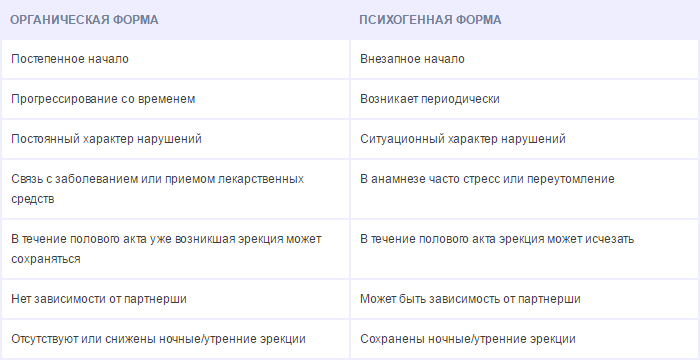
Table 1 - Differential diagnosis of organic and psychogenic forms of erectile dysfunction.
Therapy of erectile dysfunction 1 line
The first line of therapy for erectile dysfunction involves the use of drugs of the pharmacological group selective( selective) inhibitors of PDE-5.The mechanism of action of these drugs is based on increasing the concentration of nitric oxide in the cavernous( cavernous) bodies of the penis, due to which there is a relaxation of their walls and an improvement in filling with blood, leading to an erection.
For a sufficient effectiveness of preparations of PDE-5 inhibitors, there are several basic mandatory conditions, which include:
- the presence of libido in a man( sexual attraction to the opposite sex);
- sufficient level of male sex hormone testosterone in the male body( some andrologists with concomitant testosterone deficiency in the first line of therapy for erectile dysfunction also include the use of hormone therapy);
- mandatory sexual stimulation during the accumulation of the active substance of the drug in the blood( usually sexual stimulation has the best effect on erection 15-20 minutes after taking the drug).
The pharmaceutical market for these drugs is represented by several major active ingredients, which include:
- Sildenafil( Viagra) is the first and main representative of this group of drugs. It begins to have an effect within 30 minutes after taking the tablet with a duration of up to 12 hours. Produced in an oral dosage form( capsules or tablets) in several dosages: 25, 50 and 100 mg of sildenafil in a tablet. In severe erectile dysfunction, an initial dosage of 100 mg is recommended, then it decreases as the necessary effect is achieved. Bioavailability of the active substance decreases with simultaneous consumption of food and alcohol, so it is recommended to use an empty tablet.
- Tadalafil( Cialis) - characterized by a longer lasting effect up to 36 hours. The drug is available in oral form in a dose of 10 and 20 mg. Treatment is recommended to begin with 10 mg, then, if necessary, to achieve a positive result, the dose may be increased( individual titration is performed).
- Vardenafil( Levitra) - is a representative of PDE-5 inhibitors with a short lifespan of up to 12 hours. However, in 21% of men the effect comes in just 10 minutes after taking the drug, while providing spontaneous and natural intimacy, which is important during the treatment of psychogenic erectile dysfunction. There are several dosages of the drug - 5, 10 and 20 mg. The average therapeutic recommended dose is 10 mg, if necessary, it is changed.
- Udenafil( Zidena) - a new drug( in Russia on the pharmacological market has appeared recently) with a rapid onset of therapeutic effect and a long-lasting effect( on average about 1 day).Alcohol and fatty food practically do not affect the absorption of the active substance.
Table 2 - Clinical efficacy of PDE-5 inhibitors( EU drug profile data - EU Summary of Product Characteristics, 2007).

Almost all representatives of this pharmacological group of medicines have certain negative effects after their application, which include sensations of hot flashes, headache, dizziness, nasal congestion, muscle pain( myalgia), violation of color perception, dyspepsia( nausea, vomiting, bloating, Unstable stools).The most common side effects are headache and dizziness.
In connection with the increased incidence of erectile dysfunction, which develops as a result of lowering the level of the hormone of testosterone, before the start of the use of drugs of the group of PDE-5 inhibitors, a blood test is performed to determine the level of testosterone. In case of detection of a decrease in sex hormone, the andrologist decides whether to perform additional hormone replacement therapy.
During the 1-line therapy, a drug based on alpha-lipoic acid Tioccatide can also be used additionally. However, in connection with the possible development of side effects, it can be used only after the appointment of a doctor.
Erectile Dysfunction Therapy 2 lines
In case of ineffective treatment of erectile dysfunction 1 line, the doctor prescribes the application of the 2nd line of medical measures. It includes intracavernous and intraurethral administration of vasoactive( vascular) drugs.
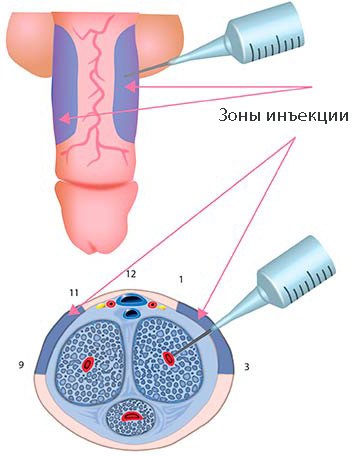 The technique of intra-atrial administration involves the injection of several groups of drugs directly into the cavernous bodies of the penis. This ensures the effectiveness of treatment up to 70%, such preparations for intracavernous administration include:
- Papaverin is a broad-spectrum antispasmodic that promotes the expansion of cavernous bodies and their better filling with blood.
- Fentolamine is a drug of the group of alpha-adrenoblockers, which due to blockade of the corresponding receptors leads to the relaxation of the walls of the cavernous bodies and their better blood filling.
- Prostaglandins are biologically active compounds that positively influence the functional state of cavernous bodies.
For greater effectiveness, these drugs can be administered in combination( mixture).
For intraurethral injection into the urethral cavity, special soluble capsules containing prostaglandins are used. In comparison with intracavernous drug administration, this technique is less traumatic( there is no need to puncture the skin), has a high enough efficiency( up to 70%), but sometimes after the course of use can develop pain in the urethra.
Erectile dysfunction therapy 3 lines
In the case of ineffectiveness of the first 2 lines of therapy for erectile dysfunction, the doctor can designate the 3rd line. It involves performing a surgical reconstruction of the arteries of the penis. The most effective such operation can be for men of younger age with local occlusion( a blood flow disorder or blockage of lumen) of one or more arteries of the penis, in particular as a result of the transferred trauma. In older men, against the background of systemic atherosclerotic arterial lesions( cholesterol deposition in the walls of the vessels with the formation of atherosclerotic plaques that reduce or overlap their lumen), the effectiveness of this intervention is questionable, and a positive result with respect to erection is short-lived.
Performing reconstructive surgical interventions includes dorsal ligation of the penis veins, as well as ballooning of the arteries. According to the indications, an endoprosthesis replacement of the penis can be performed with the implantation of a dense material or special air cylinders into cavernous bodies.
All 3 lines of therapy for erectile dysfunction are a common tactic, the choice of specific drugs, their dosages, administration techniques, and the use of additional mechanical techniques( LOD-therapy, special rigid condoms) is performed by the doctor individually.
The newest methods of therapy
Scientists are constantly looking for new, more advanced ways of treating certain pathologies. Successful clinical trials have undergone a fundamentally new method of treating erectile dysfunction. It consists in the gene modification of endothelial cells of the cavernous bodies of the penis, leading to an increase in the production of a special protein( Maxi-K), which takes a direct part in the erection process.
General Practitioner Krivoguz IM
Recommended for viewing: