Cancer of the kidney: what if that diagnosis is made?
Kidney cancer is a malignant transformation of the epithelial tissues of the renal parenchyma. Among all the neoplastic processes of the urinary system, this is the most common.

Cancer of the kidney is formed from atypical epithelial cells formed from tubules in which urine is formed.
Content
- 1 Etiology and pathogenesis
- 2 Risk Factors
- 3 clinical picture
- 4 Diagnostics
- 4.1 Instrumental investigations
- 4.2 Laboratory methods
- 5 kidney cancer
- 6 Therapy
- 7 forecast
- 8 Preventive measures
Etiology and pathogenesis
Until some time been the leading theory is that the aetiologyThe disease was associated with congenital malformations. The author of the hypothesis was Paul Gravitz. At the moment, the failure of this theory is proved. Kidney cancer is recognized as a multifactorial disease caused by a mass of causes. Among them:
- The effect of ionizing radiation on the patient's body. It causes the formation of free radicals in the body and the development of mutations and atypia of cells.
- Weighed down with heredity. It is of great importance in the formation of pathology. It is proven that if there were people with kidney cancer in the family, the risk of getting sick increases by 15-20% on average. Fortunately, this does not mean that you can not avoid defeat. With proper behavior and observance of preventive measures, it is possible to prevent the development of the disease.

A number of kidney diseases: insufficiency, pyelonephritis, nephritis, polycystosis can lead to cancer
- Immune disorders. The presence of problems with immunity is an almost guaranteed way to develop neoplasms. Every second in the body of any person tens and hundreds of atypical cells are formed. Immunity in time stops their development, reducing proliferative activity to zero. Weakened immunity is not able to perform its functions. As a result - a cancerous defeat.
- Contact with toxic substances: arsenic, antimony, uranium salts.
- Hormonal failures of various types. The imbalance of active substances in the body often causes neoplastic processes.
- Presence of kidney diseases: insufficiency, pyelonephritis, nephritis, polycystosis. At the heart of the process is a violation of the regenerative function of the body. At a certain point, stem cells, designed to replace the cells of the kidney tissue, cease to differentiate.
- Presence of an abnormal pathology of the endocrine system: diabetes mellitus, etc.
- Presence of pathologies of the cardiovascular system: arterial hypertension, heart failure.
Risk factors for
- Dialysis. The risk of getting sick is significantly increased with constant hemodialysis.
- Smoking. The risk of developing the disease almost doubles. Moreover, quitting smoking does not bring a visible clinical effect to reduce the likelihood of cancer. Excess weight. Increases the risk of cancer formation by 25%.Optimizing the diet and normalizing body weight leads to a decrease in the likelihood of getting sick.
- Alcohol abuse. Alcohol significantly "loads" the kidneys, stimulating their work for wear and tear.
Clinical picture
The intensity of the manifestations depends on the stage of development of the neoplastic process and its nature. Symptoms of the disease:
- Pain syndrome. At 1-2 stages there is a slight aching pain sensation in the lumbar region. Irradiation is possible( a phenomenon in which pain is given to some remote site) into the thorax, the lower abdomen.
- Hematuria. Blood in the urine structure, visible to the eye. The exit of the blood is characterized by intense pain in the affected kidney( renal colic).
- Sensation of foreign body in the lumbar region. If the tumor reaches a significant size, the neoplasm can be felt upon palpation.
- Symptoms of poisoning the body by the products of disintegration of the formation. This includes: fever to febrile markings, weakness, lethargy, headache, nausea, abnormal weight loss.
- Formation of edema. Puffiness is caused by compression of the main vessels.
- Dysfunction of the liver.
After the tumor reaches a significant size and begins to metastasize, focal symptoms from the affected organs and tissues are noted. The clinical picture is not specific enough. It equally fits into manifestations of nephritis, pyelonephritis, urolithiasis. To diagnose it is possible only by results of objective researches.
Diagnostics
Diagnostic measures are divided into two stages: the setting and verification of a clinical diagnosis. Both the first and the second should be conducted under the supervision of a specialist. Problems of this kind are dealt with by nephrologists( not to be confused with neurologists) and urologists. At the initial consultation, the doctor conducts an oral interview with the patient, clarifying the nature of the complaints. Then kidney palpation is performed. Even at this stage, it is possible to detect nodal formation of kidney tissues. Then comes the turn of instrumental and laboratory research.
Instrumental studies of
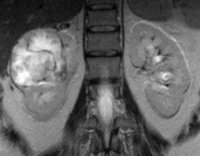
MRI diagnostics: right upper kidney cancer( vertical section)
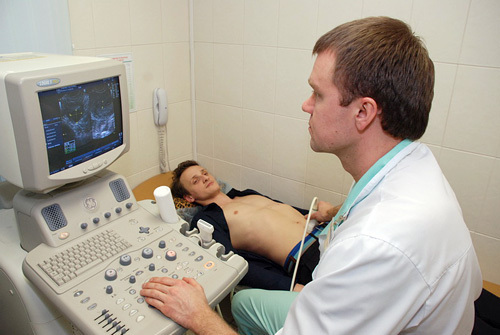
- They are based on ultrasound diagnosis of the kidneys. This is a cheap and accurate method of examination, which allows one to accurately detect the presence of neoplasm in the structure of the kidneys.
- MRI / CT scan. Appointed to clarify the nature of the neoplastic process. Performed with contrast to assess the size and degree of blood supply to the tumor. Due to the low availability of this study in Russia and CIS countries are rarely resorted to, but it is absolutely necessary to verify the clinical diagnosis. Biopsy puncture of the kidney. It is used for the collection of biological material.
Laboratory methods
- General blood test. It is necessary for the detection of blood in the structure of urine.
- Histological( morphological) study of biological material. Allows to accurately outstrip the type and structure of the tumor.
These methods are assigned in the complex. They are also shown to determine the extent of surgical intervention( assigned right before the operation in the preparatory period).
Kidney cancer stages

The stage is determined by the prevalence of the neoplastic process
- The first stage. The size of the tumor does not exceed 4 centimeters. Neoplasm does not grow into the structure of the renal parenchyma, it grows extensively.
- The second stage. The tumor does not exceed 7 centimeters in volume. Metastases are absent, infiltrative growth is also not observed.
- Third( A) stage. Neoplasm germinates through the renal parenchyma. The size does not exceed 7 centimeters. Metastases in regional lymph nodes are not observed.
- Third( B) stage. Tumor up to 7 centimeters, single or multiple metastases are noted in the regional lymph nodes.
- Fourth stage. The size of the tumor is any. Metastases are seen in distant organs and tissues.
Therapy
Therapy must be prescribed no later than 2 months after the diagnosis was made. Otherwise, the effectiveness of treatment is sharply reduced. Therapy is exclusively surgical. There are two main methods used:
- Nephrectomy. Otherwise, total removal of the kidney. It gives hope for a complete cure. With a large size of the neoplasm, the operation is performed by open access. If the neoplasm does not reach 4 cm, laparoscopic removal is possible.
- Tumor resection. It is shown with a small size of the tumor. The essence of the treatment is to remove the tumor directly from the part of the organ tissues.
There are less radical methods of treatment. As a rule, they are used for complicated unresectable cancer, when it is impossible to remove the tumor. Such operations are palliative:
- Ablation. Removal of formation by cold or ultrasound.
- Embolization. Elimination of tumor nutrition by overlapping vessels.
These operations do not heal, but they allow you to live longer and better. In combination with the operation, radiation and chemotherapy are prescribed. They do not work alone due to the high resistance of malignant neoplasms of the kidneys.
Read also: Advice on the prevention and improvement of kidney condition
Forecast
Kidney cancer is considered relatively unfavorable in terms of disease prediction. The five-year survival rate is:
- At the first stage of the disease development - about 90%.
- At the second stage - about 70%.
- At the third( A) stage - half of the patients survive.
- In the third( B) stage, survival is associated with 30%.
- The fourth stage is most unfavorable: a five-year threshold is exceeded by only 10% of patients.
It is important to note: five-year survival is a conditional term adopted in oncology. This is a disease-free disease. In practice this does not mean that the patient will live 5 years. This means that the patient will live 5 years without relapse. At the end of the specified period a person is considered cured. To be afraid of such formulations should not be.
Preventive measures
- Normalization of body weight( see How to remove the belly to a man).
- Optimization of the diet( a diet low in animal fats).
- Refusal from smoking and abuse of alcoholic products.
- Maintaining blood pressure as part of the norm.
- Regular check-ups of preventive examinations.
Kidney cancer is a serious disabling disease, requiring urgent treatment. The prognosis is favorable only in the early stages, therefore it is impossible to delay with therapy. At the first suspicions it is necessary to go on reception to the doctor. Fortunately, to identify kidney cancer is not so difficult.
Recommended for viewing: