After what time after tooth extraction it is possible to prosthetize
The ability to restore teeth with a prosthesis or implant can appear suddenly - after accidental bruising or trauma, serious oral disease, etc.Therefore, many people are interested in whether prosthetics are possible after tooth extraction, what are the terms of the procedure and the types of crowns used.Especially when it comes to an amputated anterior tooth, the absence of which greatly spoils the appearance.This procedure is common for all modern clinics, but involves the fulfillment of a number of requirements and stages to provide the patient with maximum comfort and safe healing.
Prosthetics or restoration
The tooth is reconstructed immediately after its removal due to fracture, cleavage, natural stitching, acute forms of caries and other diseases of the oral cavity.That is why the amputation procedure is carried out in most cases of implantation and prosthetics.In rare cases, the elements of the series are restored with the help of restorations, inlays, veneers, filling composite, etc.
What are the differences between the partial replacement and restoration restoration?
- Teeth look homogeneous and whole only after prosthetics, and in the case of restoration, you can see the place where the composite was added, because in time it can change color or even fly off.

After the restoration, the added component can change the light with time or even fly off
- The duration of implantation is 3-4 steps, while the restoration is done promptly with the tooth retained.
- Patient bypasses several doctors to obtain permission to perform a mini-operation in the oral cavity.
- Restoration of the damaged tooth is cheaper, however, the prosthetics allows to restore a long-distant molar.
- After implantation, the crown will last much longer than the restored tooth.
- Unfortunately, prosthetics has a number of contraindications and side effects.
After the above, it seems that it is much easier to restore the tooth than to remove it and replace it with another one.But dentists have different views.The service life of various inlays, seals and veneers does not exceed 5-7 years, after which they should be replaced.To do this, the enamel of the tooth is again subjected to grinding and turning until a weakened cult remains.
Features prosthetics after removal
As for the prosthesis itself, it should be carried out only in the absence of infection of the well, inflammation, active diseases of the mouth, poor hygiene.The gums should not bleed, just like the hole itself.
Many are interested in how many days after removal you can put an implant in the hole.Unfortunately, exact terms are difficult to lead, because each case is individual, and much depends on hygiene, healing speed, the presence of ailments or weakened immunity.
In addition, the timing varies depending on the type of prosthesis chosen by the patient, the type of construction and fixing system used materials.For the manufacture of plastic implants, for example, it takes much less time than for the production of metal-ceramic crowns.

Metal-ceramic crowns
Of course, in the case of removal, it is better to prefer implantation to prosthetics.First, the socket for the core and the crown is ready and does not require additional manipulations, which facilitates the whole process for the patient.Secondly, the implant provides a healthy load and pressure on the hole and jawbone, which improves the blood supply to the area, and, hence, its nutrition is useful components.Thirdly, the prepared well allows performing so-called "one-shot" or express-implantation, which saves time and money of the patient, makes it possible to enjoy an aesthetic dental row in a few days.
In any case, dentists advise to perform all manipulations( removal, preparation of the socket, prosthetics or implantation) not only in one clinic, but also with one specialist.He will follow all the rules of gentle amputation, which allows you to exploit the hole and to install artificial structures.That is, the doctor prepares the well at the removal stage under the prosthesis chosen by the client.
Implantation after amputation of the tooth
After extraction of the tooth, there is a feature - the absence of a supporting tooth or even a stump, on which it was possible to put on a crown.Also the root is removed, on which the prosthesis could be based in the future.That is why implantation is considered one of the most correct decisions.
At the first stage a well is prepared.The process of gentle removal significantly facilitates and shortens the preparation time.
Then a rod of titanium( zirconium oxide) is installed in the jaw bone through the hole, on which the abutment and the selected crown will be attached in the future.The crown can be put immediately, but only temporary( plastic), as the production of modern durable options( ceramics, cermets) and their adjustment takes several weeks.

Classical implantation of teeth
Many people want to know when it is possible to prosthesis after tooth extraction by implantation.Typically, the entire process from the beginning to the end takes from 3 to 6 months, but you can restore the removed tooth in a few days with the help of temporary crowns, which return the dentition functionality and aesthetics.
With regard to the types of implants, the most common can be considered plate-shaped( suitable for the elderly or in the case of a specific structure of the area) and basal( constructions that allow the molar to be recovered promptly).
Temporary( removable) prosthesis after removal of
Of course, the implantation option is the most successful, but lasting, not expensive and has a number of contraindications.And what about patients who do not like this technique?
There is another way to restore the aesthetics of the dentition - to install a temporary( several years) removable denture for 1-2 teeth.
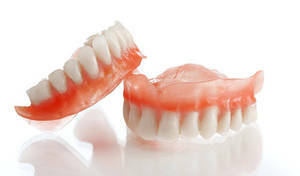
Removable prosthesis for temporary recovery is made of acrylic, which allows you to repeat the contours, texture and natural shade of any tooth.Plastic( acrylic) is a fairly strong and elastic material, which is easy to care for.
The prosthesis is secured with special hooks or locks that cling to adjacent healthy teeth.As a rule, they have a natural pink or white hue, merging with the dentition.Which material of crowns is better to use after amputation?
Depending on the type of restoration( prosthetics, implantation), you will encounter such a concept as "crown" or "bridge".In fact, these are the elements that will be visible to an extraneous person - the supragingival part of the structure.Therefore it is very important to choose the right material for the manufacture of this element, because each has its own advantages and disadvantages.

Tooth bridge
There are prostheses from such materials: ceramics, metals( noble and alloys), cermets, acrylic, silicone and nylon.
Ceramic and cermet products are the most expensive in this segment.Metal ceramics is more accessible financially, but metal fasteners can be visible to the interlocutor.They are distinguished by their high strength and reliability, they serve for decades and perfectly repeat the natural color of the enamel.Technologists make models that shape, texture and color fully correspond to the remote tooth.Ceramics in the base does not absorb food colorings and pigments, it does not fade and does not turn yellow with time, it does not scratch, it does not crumble or crumble.Due to the natural balanced severity and functionality of such crowns, habituation comes in a matter of days.
Acrylic( plastic, plastic) products are used exclusively as a temporary prosthesis for 1-2 years.After the stated period of use, they fade, change color, scratches and microcracks are formed.In addition, the porous material can absorb pigments and dyes such as tea, coffee, nicotine, wine, beets, etc.
Nylon and silicone dentures are used to repair multiple removed teeth.They are an innovative, soft and elastic material that nicely adjoins soft fabrics without irritating the surface.Despite the flexibility of the material, the design of the products is sufficiently strong and evenly distributes the load, allowing the teeth to fully perform natural functions.Yes, and the price of such prostheses is quite acceptable, and the period of socks is more than that of acrylic( 5-6 years).

Nylon prosthesis for several teeth
Patients are often interested in how long after tooth extraction can be made with permanent materials( ceramics, metal, etc.).It all depends on how quickly the patient heals the hole, how soon the implant will survive without the need for adjustment and correction.As a rule, permanent products are installed a few months after wearing plastic.
Whatever material or type of recovery has been selected, always follow the rules of oral care and hygiene, and visit the dentist at least once every six months for professional cleaning of the prosthesis and fitting as needed.