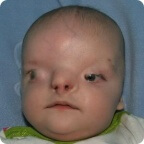
Arnold Chiari Syndrome
 Arnold Syndrome - Chiari( anomaly Arnold - Chiari) - congenital disorder of brain development that manifests inappropriate dimensions of the posterior fossa and being in the area of brain structures, whereby there is the omission of the tonsils of the cerebellum and the brain stem to the foramen magnum, resultingTo their infringement at this level. Often, this defect is combined with anomalies in the development of the spinal cord and hydrocephalus. Most patients with Arnold-Chiari syndrome have no symptoms or signs of the disease and therefore do not need treatment. Most often, this pathology is found quite accidentally when performing diagnostic manipulations for suspected other diseases. The incidence of the Arnold-Chiari anomaly is 3-8 people per 100,000 population.
causes of this syndrome to date not been fully established
Arnold Syndrome - Chiari
symptoms When this anomaly is usually observed several of the below listed symptoms:
- shakiness and / or dizziness, which intensified when cornering
head - noise, hum, Hissing, hissing, ringing in one or both ears, which can also be amplified by turning the head
- Due to increased intracranial pressure, or as a result of an increase in the tone of the neck muscles, there is enough sensationpheno- headache( most pronounced in the morning)
- There is an involuntary jerking of the eyeballs( nystagmus)
In more severe Arnold anomalies - Chiari present the following symptoms:
- observed visual disturbances( expressed in twins, coming blindness and so on.), Which are often amplified by turning the head
- There are disorders of coordination of movements, tremor of the legs and hands
- The sensitivity of part of the trunk, part of the face, several or one of course is reducedstey
- Urination becomes difficult and / or involuntary
- There is muscle weakness of the body, the face, a few, or one limb
- There may be loss of consciousness( most often triggered by turning the head)
- Perhaps the development of conditions that can lead to myocardial spinalOr / and the brain
Possible consequences and complications of Arnold-Chiari syndrome
- Paralysis .Paralysis can develop as a result of compression of the spinal cord and even the field of the surgical intervention
- hydrocephalus remains. Consequences of accumulation in the brain of excess liquid may require placement of a shunt( flexible tube) for draining cerebrospinal fluid exhaust and in which - either another part of the body
- Syringomyelia .Sometimes patients suffering from the Arnold-Chiari anomaly develop a disease in which a cyst or cavity is formed in the spine( a pathological cavity in the spinal cord or brain).After formation, this cavity is filled with liquid, which leads to malfunction of the spinal cord
Arnold Syndrome - Treatment Chiari treatment
Arnold anomalies - Chiari is purely individual approach and directly dependent on the state and severity of each individual patient. In the absence of severe symptoms, the doctor prescribes observation as a treatment with periodic regular examinations. If the primary symptoms are painful sensations, the administration of pain medications is recommended. In some cases, patients with this syndrome are significantly relieved in taking anti-inflammatory drugs, which can delay or completely prevent surgical intervention.
Surgical treatment of
The most common treatment for the Arnold-Chiari anomaly is a surgical technique that aims to stop the progression of changes in the structure of the spine and brain, As well as to stabilize the symptoms. If the operation is successful, the pressure on the spinal cord and the cerebellum decreases, and the normal outflow of the CSF is restored.
The most common operation for this syndrome is decompression of the posterior cranial fossa or craniectomy of the posterior cranial fossa. The operation consists in removing a small fragment of bone from the posterior part of the skull, thereby providing more space for the brain and lowering the pressure. In time this surgery takes from one to two hours, and the recovery period usually does not exceed seven days.