Зубни имплантати без гингиве рез у једном дану
Implantation of teeth has a number of advantages over prosthetics, since it allows to restore any number of teeth without the use of complex structures that require special care and regular adjustment.In addition, scientists regularly apply the latest technology and use unique materials to make the process quick, least traumatic and effective.At the moment, scientists have achieved that implantation of teeth in one day was possible.In addition, it is performed without serious surgical intervention, which drastically reduces the possibility of complications.
The essence of implantation without surgery
The procedure has many names( implantation without a cut, without operations, laser, endoscopic, transgingival, one-stage, express, etc.).
As a matter of fact, it represents the minimal intervention, not demanding performance of a cut of a gum and isolation of a periosticular flap of a tissue.The surgeon does not expose the bone in the process of manipulation and does not impose sutures after cutting soft tissues.

The cut is still available for implantation without incisions, but it is not linear, but circular
In this work a developed template is used, due to which the incision is minimal - no more than the diameter of the implant.Such minimal surgical intervention( it is still present, despite advertising) is bloodless, low-traumatic and seamless.In addition, the installation process is reduced by 15-20 minutes.
Stages of express implantation
The entire process takes several days, as the gum needs time to restore to the installation of permanent crowns.But most of the work is really done in 1 day.
Let's take a closer look at the event.
At the first stage the dentist examines the oral cavity, determines the condition of soft tissues, mucous, jawbone.He also determines the presence of allergic reactions to the material of the implant or contraindications.In the case of caries detection, inflammatory, fungal, viral processes, exacerbation of chronic diseases of the oral cavity, a preliminary treatment is required.
After collecting the necessary data, the dentist chooses the type of design, the color of the crowns with the patient, and selects the zone for implant implantation.
The doctor then takes pictures of the patient's jaw and uses a computer simulation program to recreate the project, where you can specify the angles of the location and incline of the implants.The project is sent to the laboratory, where specialists promptly produce a special surgical template, which indicates how and where to put the implants.The received dentist template is installed directly in the oral cavity of the client and is engaged in the preparation of gums.

The implantologist places the implant in the finished gingival hole, and the gum former
on top of it. Next, the doctor prepares the hole before fixing the structure - giving it the necessary depth and width with the help of milling cutters.
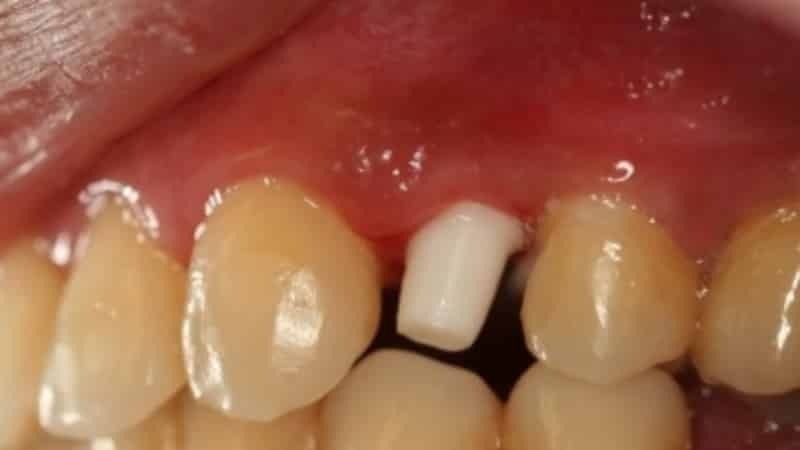
Implantologist places the implant in the finished gingival hole, and the gingiva former on top of it.A temporary plastic crown is also installed.
The final step is to follow the recommendations of the dentist.They include carrying out antibiotic medication, possibly taking painkillers.It also requires a gentle regime, accurate, but proper hygiene of the oral cavity.
Advantages of this method
The classical implantation procedure is associated with tissue traumatism, stress, long healing and recovery time.Therefore, the patient receives a beautiful smile and functional dentition after 3-8 months.Also, from the deep incision in the gums, it is common to bleed, there is bruising, swelling, severe pain and even hyperthermia.
Implantation of teeth without incisions allows to bypass all complications and side effects and to get a beautiful smile in a few days.Unpleasant sensations after the procedure are minimal and pass for a couple of days, so the patient can safely go to work already the day after the event.
Another positive feature is the ability to restore all teeth in a couple of hours.Thus, you can get rid of full adentium in one day and return home with beautiful, even temporary crowns.
Another nice possibility is that the implantation can be performed immediately after the amputation of the damaged or old tooth, as the doctor simply widens the screw hole and installs the structure in a matter of hours.

Implantation can be performed immediately after amputation of a damaged or old tooth
All of the above advantages greatly reduce the number of trips to the dentist, which saves not only your time, but also finances.
Disadvantages of express implantation
Unfortunately, even modern innovative approaches to the process have their drawbacks.
During the procedure, the dentist can not visually track the implantation process, which causes situations where the elements have been installed or not selected correctly.
The non-surgical method does not allow for the installation of the system in the case of bone deficiency.In this case, the buildup takes up to six months, which is in no way commensurate with the promised days.
Despite minimal trauma there are a number of contraindications to the procedure.
Indications and contraindications
The fast implantation technique is only used when the required indications are available.As a rule, through the puncture, you can restore absolutely any tooth or all elements of the series.
That is objective evidence is the absence of teeth( 1, several, all), including "difficult"( extreme) or the need to restore the dentition in the shortest time( important event, departure, professional requirements, etc.).Also the procedure is carried out with a strong destruction( damage) of the tooth without the possibility of recovery, with unsuccessful treatment, which led to amputation.
Contraindications to tooth implantation for one day also exist.Although, their list has decreased quite enough compared to other methods.For example, rapid implantation can be carried out to people with diabetes mellitus and in the presence of endocrine system diseases.Also, the procedure is similar to those who have bleeding disorders, poor healing.
List of contraindications:

Pregnancy does not allow the implantation of teeth
- Mental diseases, pathologies and disorders of the nervous system;
- heart and vascular disease;
- severe form of osteoporosis;
- serious disorders of the hormonal background, endocrine system;
- deficiency of bone tissue and a small area of soft tissues;
- presence of active diseases and inflammatory processes of the oral cavity, untreated gums and teeth;
- oncology;
- severe disease systems;
- poor blood clotting;The period of lactation, pregnancy;
- ;
- work with increased traumatism, professional sports.
Laser Implantation for 1 Day
A popular subspecies of express technique in which implantation of teeth without gum incision occurs with the help of a laser.
The surgeon performs an easy incision of the gum with the help of a laser beam( non-contact), so that the wound remains sterile.In addition, under the influence of high laser temperature, abnormal microflora is destroyed around and inside the well.
An advantage is minimal anesthesia( reduction in the dose of anesthetic), as the area of exposure is limited.

Laser implantation of teeth
Minimal intervention promotes rapid healing, after which it is possible to establish a permanent crown in a few days.
All modern methods for installing implants for 1 day require the patient's attention and regular maintenance of the structure, especially in the first few weeks.It is also necessary to make a control trip to the dentist to control the healing of the wound and the survival of the Imanta.