Test for allergy
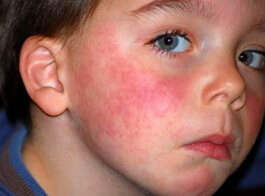
 The action of the immune system of every person is aimed at protecting the body from pathogenic viruses and bacteria. In addition, cells of the immune system are able to recognize and destroy cancer cells. However, in some cases, this very complex defense system begins to overreact to unnecessarily harmless substances such as house dust, animal hair, pollen of various plants, etc., which are absolutely harmless at first sight. Most of these stimuli are not dangerous, butImmune response to them poses a serious threat to health, and sometimes to human life.
The allergy test is designed to detect allergen-causing allergens. Only after the final establishment of a provoking allergen, the doctor can prescribe the appropriate adequate treatment for him. I want to make a reservation right away that it is not possible to cure completely of allergy for today, however, taking certain medications, the right way of life and playing sports will help to forget about allergies for quite a long time. Treatment usually begins in winter, when the main provocateurs of this disease are as if "in hibernation"
Causes for an allergy test
Allergy test is released by a provoking allergen with a 100% guarantee and very quickly. Thanks to this, the prescribed treatment will be adequate and effective. However, there are other reasons that we will list below:
• This test will help to identify other pathogens that were not previously suspected by
• Guaranteed confidence that the body reacts inadequately, for example, to household dust, Immediately and effectively act, in particular, to start taking antihistamines or to conduct allergen-specific immunotherapy
• In case of not confirming the allergic nature, the allergy test can detect other mucusBani, for example - in the case of a lack of enzymes for dairy products can be a rash similar to allergic. Outward signs of allergy are often similar diseases such as pancreatic diseases, fungal skin infections, chronic bronchitis, psoriasis and pr
• Without a test, it is impossible to distinguish a drug allergy from pseudoallergia. This is due to the fact that drug intolerance is observed in both cases.
The allergy test is designed to disprove or confirm the doctor's suspicions.
The most common tests are skin tests and a blood test for immunoglobulin E. These tests are not interchangeable, as their task is to supplement each other. The analysis of blood and several samples, as a rule, is sufficient for revealing the allergen-provoking disease. In exceptional cases, it is not immediately possible to determine the culprit of poor health. In such cases, a test is carried out for a mixture of various provocateurs, after which, by elimination, the range of suspected allergens narrows and the provoker is established.
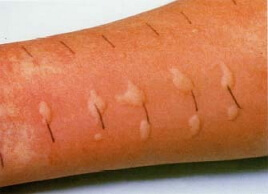
Skin test implies that the test substance must be directly into the thickness of the skin, for which a superficial injection is usually done. Initially, the most common allergens( house dust, pollen of plants, etc.) are investigated, for which small punctures are made on the skin of a special needle, onto which several drops of the solution of the allergen chosen for the sample are applied. Thus, a small amount of the test substance droops into the surface layer of the skin. You can usually evaluate the result in 15-20 minutes. In the event that the subject has an allergy to the substance administered, swelling and redness will occur at the puncture site.
Along with skin tests are often conducted provocative tests. These samples are based on the reproduction of allergic reactions by introducing a provoking allergen into the tissue or organ that is most often affected in this disease. Provocative tests are divided into inhalation, nasal and conjunctival. An inhalation provocative test is conducted to establish an allergy to certain food products and to diagnose bronchial asthma. Conjunctival test consists in instilling the chosen allergen into the nose or the lower conjunctival sac. In case of itching, redness or lacrimation, the reaction is considered positive. 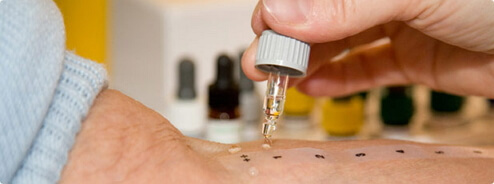
Are tests dangerous? In the event that the allergy test is carried out in a specially trained for this polyclinic conditions by qualified personnel, the likelihood of complications is extremely low. However, there are people with such a strong reaction to the allergen that the introduction of even a microscopic amount of substance can lead to serious consequences, up to the danger to life. In this respect, provocative tests are the most dangerous and powerful, which can be manifested by a fit of suffocation and extensive skin rashes. It is for such cases that an allergist should always have an allergy-suppressing essential medicine
Allergy tests - are there any mistakes?
The probability of false responses is about 10%, and these misses usually occur in cases of errors in the diagnosis or if a drug was taken immediately before the tests. For a couple of minutes before the test, to eliminate the error, additional drops are applied to the skin, in one of which there must necessarily be a r-r histamine. If there is no reaction, skin tests will not give 100% guarantee. The second droplet contains a control liquid with diluted allergens. Reactions exactly to this rp, contrary to logic, should not be
Express test for allergy
Not so long ago, the world's first home test for allergies Imutest, capable of detecting several allergens at once was presented to the general public. At the same time, the results of this test are no different from the results of the test, if it were conducted in a polyclinic setting. In application Imutest is very simple, since it is designed for independent home use.
The basis of his work is to identify in the blood of a specific immunoglobulin class E. Along with skin tests, this type of testing worldwide is considered to be the "gold standard".
According to statistics, out of ten, nine people with allergies are sensitive to the cat's epithelium, pollen of plants or to house dust. Imutest determines the sensitivity to this triumvirate of key allergic triggers that cause symptoms of rhinitis, eczema and asthma. It is assumed that in the case of a negative result for these three allergens, the observed symptomatology may not be caused by allergies.
Imutest works very simply. For analysis, a single drop of blood is taken with the help of an automatic disposable lancet, which is then added to the test device and diluted with a buffer solution. For thirty minutes, the test results will appear on the test device in the form of one / several red lines.
Allergy test Imutest - registered med. The clinical trials of which showed complete coincidence of the results with skin tests and radioallergosorbent tests( RAST).