
Where is the pancreas located and why?
It is important to know where the pancreas is located and how it hurts, because the diseases of this organ can lead to serious complications.
The pancreas is constantly in an active state, so the risk of illness increases with age. If an attack occurs, call an ambulance immediately.
It should be noted that treatment, for example, pancreatitis at home will not be successful.
Pancreas location and function
Contents:
- Pancreas location and function
- Symptoms and causes of diseases
- Treatment of diseases of the gland
The pancreas is an organ that is located in the abdominal cavity on the lower right.
Iron is located directly under the stomach, which is the reason for the name, close to the organ abut the thin and thick parts of the intestine.
Without the pancreas, the digestive process is impossible - it can not be removed without tragic consequences for life, unlike, for example, the gallbladder.
The body can be prone to various diseases, which are important to be treated in a timely manner so that the person continues to live a full life.
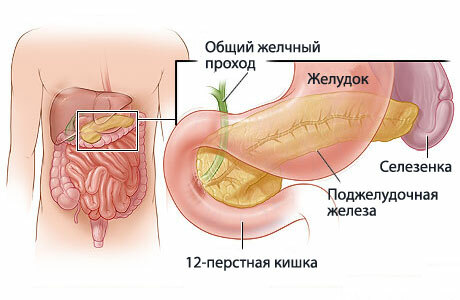
It should be noted that it is impossible to relieve an attack of pain in the pancreas at home without the help of doctors.
Therefore, when the pancreas starts to hurt, the first thing to do is call the ambulance.
The pancreas performs two major functions: endocrine and exocrine.
Endocrine function consists in the production of hormones( insulin, gastrin, etc.), which then enter the blood.
Their main task is to regulate the blood glucose level, with an overabundance of which there is a failure in the activity of the cardiovascular system until a heart attack, myocardial infarction and death.
It is worth noting that the lack of glucose in the blood is also harmful to humans.
The exocrine function of the pancreas consists in the production of enzymes, without which the digestive process is impossible.
Enzymes enter the 12-colon, where they actively participate in the cleavage of proteins, fats and carbohydrates, through which further delivery of nutrients takes place.
The pancreas is almost always in working condition. It is not surprising that with age and non-compliance with the rules of a healthy lifestyle, the body often becomes inflamed, which can lead to a variety of diseases.
To provide first aid, you need to know where the organ is and how the pancreas hurts.
Symptoms and Causes of
Disease The answer to the question why the pancreas hurts depends on the patient's lifestyle and the presence of organ diseases. The most common disease of the gland is pancreatitis.
It can occur in both acute and chronic forms. Pancreatitis is the cessation of the performance of pancreatic functions, caused by necrosis, that is, the death of organ tissues. Treatment of this disease at the initial stage, as a rule, is successful.
The causes of pancreatitis in women and men in most cases are associated with an incorrect lifestyle.
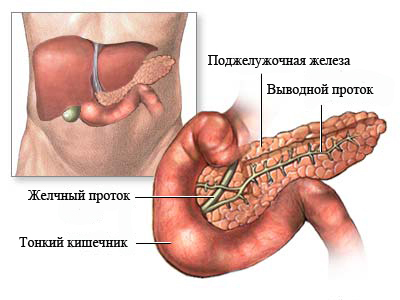
Excessive consumption of alcohol, sweet and spicy food has a particularly severe negative effect on the pancreas, causing it to produce enzymes and hormones with increased strength, which can lead to necrosis and, as a consequence, to pancreatitis.
Acute pancreatitis, despite the name, rarely begins suddenly. Usually it is preceded by a long time spent drinking alcohol or eating harmful, heavy food, or, conversely, chronic malnutrition.
It is important to know where the pancreas hurts, what to do in such a situation and how to provide first aid, in particular, to relieve severe pain.
The first signs and symptoms of acute pancreatitis include the emergence of intense shingles in the epigastric region, in particular its lower part, after eating.
Sometimes pain can be felt elsewhere in the body, for example, to give to the lumbar region( in this case it is difficult to understand and determine what exactly causes pain, so often patients think that they have kidneys, not the organs of the digestive tract) or intercostalSpace( patients in such cases mistakenly believe that these are symptoms of heart problems or signs of intercostal neuralgia).
First aid is to understand and determine when the causes of pain are associated with the pancreas, and then relieve the painful syndrome.
Painful symptoms are always accompanied by vomiting, which is common in diseases of the digestive tract.
But it is thanks to vomiting that it is possible to put the right diagnosis with almost 100% probability, since with an ulcer or, for example, gastritis, vomiting brings physical relief.
In pancreatitis, on the contrary, after a fit of vomiting, the patient's condition not only does not improve, but on the contrary, often gets worse.
Video:
Vomit necessarily contains particles of undigested food, since the enzymes of the pancreas no longer enter the duodenum.
The patient may experience the symptoms of an acute respiratory illness, such as subfebrile body temperature( above 37 but below 38 degrees), headache, dizziness, general weakness.
A patient who has been diagnosed with acute pancreatitis is to be placed on inpatient treatment.
To know exactly why the pancreas hurts, diagnostic tests are necessary.
The patient is taking blood for general and biochemical tests, which should show the level of blood in the products of secretion of the pancreas.
If this indicator is lowered, then the diagnosis is confirmed, and the causes of severe pain in the pancreas consist in tissue necrosis.
With the help of ultrasound examination and radiography, the surgeon sets the limits of the spread of pancreatic necrosis.
Usually, acute pancreatitis is treated successfully, and the patient's condition quickly normalizes.
But if the attacks of acute pancreatitis are repeated many times, and the painful symptoms torment the patient regularly, then a chronic form of the disease is observed.
Video:
It is considered much more dangerous, because the pancreas wears to the point that every new exacerbation can lead to death. Aching pain, as a rule, is characteristic for the chronic form of the disease.
As in other organs, in the pancreas of men and women, various tumor formations can be formed, including malignant ones.
Organ cancer is a fairly common form of cancer, its symptoms are similar in many respects to chronic pancreatitis.
These include severe pain in the pancreas. Mortality from cancer of the gland is high, because neoplasms often give metastases to other organs.
Treatment of diseases of the gland
If there is an attack of acute pancreatitis, it is important to know what to do and quickly call an ambulance.
In case of an attack, the most important thing is to deliver the patient as soon as possible to the hospital, only there it is possible to hold urgent medical events. To begin with, the patient must be strictly limited in intake of food and liquid.
At first, the treatment is based on such principles as cold( the patient is placed in a cool room, which helps to fight the spread of infections), hunger( it is necessary to prevent any strain on the organs of the gastrointestinal tract) and rest( a person's body, Caused by the necrosis of a part of the internal organ, needs the restoration of physical and psychological forces).
In addition, treatment after a few days is supplemented by the introduction of pancreatic enzymes. By this time the patient, if he could "run" his pancreas, is already allowed to eat a little food and water.
If the treatment was not successful, the operation of the pancreas was not restored within a few days, and the area of necrosis spread increased, then an emergency operation is performed, during which part of the organ is removed.
Video:
In the chronic form of pancreatitis, the patient is recommended to use pancreatic enzymes after each meal, as well as adherence to a strict diet.
It should be remembered that the patient's treatment can not be compatible with the use of alcoholic beverages. Also, you should strictly limit the consumption of sweet, spicy, salty and fatty foods.
Best if at home, the patient will eat often, at least 5 times a day, but the portions should be small, not exceeding 200 g.
In addition to diet and enzymatic treatment in stationary or home conditions, in especially severe casesRecommended removal of the gallbladder, which directly affects the pancreas.
Its functions take on the bile ducts, and the pancreas continues to work without additional obstacles.
With pancreatic cancer, the symptoms and the treatment regimen are similar, but there is also a constant monitoring of the oncologist and some procedures.
Video:
In order for the treatment to be most successful, you need to know in advance what to do: first aid should be limited to eating and drinking and immediate delivery of the sick person to the hospital.
At home, you can not treat pain in the pancreas, you can only relax the symptoms a little.


