Analysis of feces for Helicobacter: how it is carried out and what is it for
Problems in the gastrointestinal tract cause discomfort, interfere with living a normal life. Painful cramps, nausea, heaviness, belching - symptoms that destroy any plans, unsettling. The culprit of the manifestations is the bacterium Helicobacter pylori, which can infect the mucous membrane of internal organs.

Helicobacter pylori causes significant stomach discomfort
Content
- 1 Insidious Helicobacter pylori
- 2 Provoking factors
- 3 Symptoms in the presence of Helicobacter pylori infection
- 4 Preparation for delivery of material
- 5 Cultural method
- 6 Immunological method
- 7 PCR
- 8 Reliability of analyzes
-
9 Decoding
- 9.1 Video - Analysis of feces for Helicobacter
Insidious Helicobacter pylori
It is a parasite that infects the stomach and the initial section of the small intestine in humans. The type of bacteria is pathogenic. The toxins released by it tend to damage the walls of the internal organs. At the initial stage of the disease, due to the presence of Helicobacter pylori, inflammatory processes develop. If the stage is advanced, there is a high risk of erosions and ulcers.

How Helicobacter penetrates the gastric mucosa
Compared to similar bacteria, Helicobacter pylori feels comfortable in an acidic environment. Therefore, the stomach is her favorite place to stay. Rotating flagella and a spiral shape allow the elements to move through the thick mucous membrane.

The bacterium moves freely in the aggressive environment of the stomach
Under unfavorable conditions, bacteria take the shape of a circle and die out in the body.
The analysis of feces for Helicobacter is carried out by such methods as: PCR, cultural, immunological. The PCR accuracy is up to 95%. This is the simplest type of diagnostics recommended for children, patients in serious condition, and the elderly.

PCR analysis
Provoking factors
100% indication for analysis - gastric ulcer and duodenal ulcer. In addition, a similar diagnosis is prescribed in the following cases:
- oncology;
- lymphoma of the stomach;

How does lymphoma manifest?
- atrophic, Helicobacter pylori gastritis;
- dysplasia of a part of the digestive tract;

Dysplasia of the esophagus
- history of stomach cancer (first line);
- Menetrie's disease;

Menetrie's disease
- dyspepsia for more than 6 months;
- long-term use of proton pump inhibitors;

Proton pump inhibitors
- blood diseases.
Symptoms in the presence of Helicobacter pylori infection
Signs of bacteria may not appear immediately. The development of the disease is facilitated by such factors as:
- unbalanced diet;

Improper nutrition contributes to the development of the disease
- stressful situations;

Stress weakens the body
- low immunity.

Due to low immunity, the likelihood of contracting Helicobacter increases
Infection occurs through food, liquid, contact with a patient (sneezing, coughing). If Helicobacter pylori is activated, then the person feels nausea, heartburn, there is a poor appetite, heaviness after eating, an unpleasant odor from the oral cavity.

One of the signs of Helicobacter pylori infection is bad breath.
Symptoms are similar to the manifestations of gastritis, therefore, in order to detect pylori, it is important to be examined and tested.
Preparation for delivery of material
30 days before the study, it is undesirable to drink synthetic drugs and drugs that stimulate the contraction of the walls of the stomach. In addition, it is recommended not to eat coloring products (red wine, beets, black currants) 3 days before the sampling of the material.

It is better not to use coloring products before taking the analysis.
Also, do not eat carrots, cabbage, bran, since they contain coarse fiber.
The feces are collected in a special container for analysis. It can be purchased at the pharmacy. Feces should fill a third of the container, this will be enough for research. Do not take faeces from the toilet, as disinfectants can get into it.

A special container is used to collect the analysis.
The excrement should be brought to the laboratory as soon as possible (within the next two hours). They can be stored for up to 12 hours at temperatures from -8 ° C to + 2 ° C.
Cultural method
The bacterium in the form of a spiral is almost never found in feces. Stool is not a suitable environment for harmful germs. Once in the large intestine, the pylori takes the shape of a circle. In feces, it is occasionally observed in this form.

It is difficult to identify Helicobacter in feces
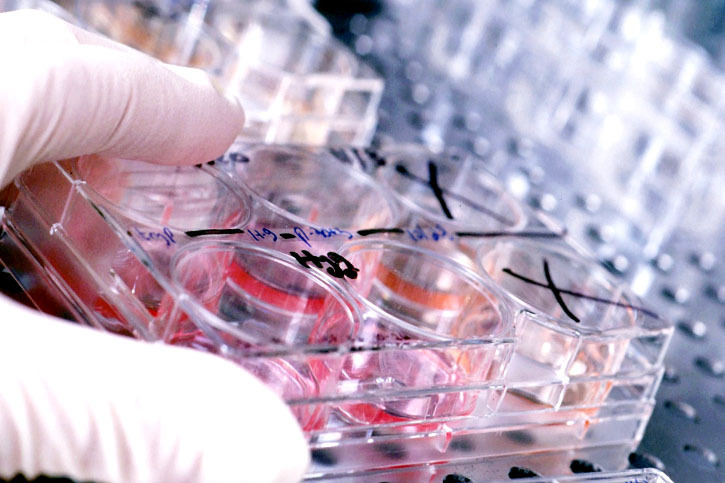
The culture type of research is sowing feces on a comfortable environment for further reproduction of Helicobacter pylori. Then the colonies grow, studied by laboratory assistants, stained with chemicals and sent for examination under a microscope. Such manipulations make it possible to grow pathogenic microorganisms and analyze them.

Sowing feces for microflora
In addition to detecting pylori, the method is able to establish the sensitivity of the infection to a particular drug. If, in the process of research, an antibacterial agent is added to the bacteria and the growth of colonies remains the same, then we can talk about resistance. With the death of microorganisms, it makes sense to prescribe this medication to a person for treatment.

Additionally, a study is being conducted on the resistance of the bacteria to various drugs.
The action will be correct in case of detection of a spiral shape of Helicobacter pylori. Cultural research is not popular for reasons such as:
- the study period of the material is up to 12 days, but not less than 6 days;
- expensive culture medium for bacteria;
- conditions for the existence of microbes are difficult to implement in the laboratory;

In the laboratory, it is not always possible to recreate the conditions necessary for research.
- The S-shaped contour of the pylori is rarely seen in feces;
- Abnormal conditions for microbial proliferating environments that are difficult to reproduce in classrooms with standard equipment.
Immunological method
Human stool is subjected to a study to detect Helicobacter pylori antibodies. For this, certain protein compounds are taken that can detect a foreign antigen. Parts of Helicobacter pylori, its waste products, can be found.

Antigen to pylori
When interacting with an antigen, the antibodies of the bacteria create their own complex. It is this that is determined by the immunological method. Such an analysis of microbes in the Russian Federation is rarely carried out, although laboratories are equipped with everything necessary.
PCR
A popular way to identify H. pylori is excreted. The accuracy is high, therefore, almost only it is used in all clinics. The analysis process consists in isolating a portion of the bacterial DNA from the stool. After that, the selected part is duplicated on the apparatus that restores the genetic code.

Device for the restoration of the genetic code
When the desired size is reached, the remainder of the bacteria is compared with the standard, Helicobacter pylori is determined. A positive PCR is a sign of the presence of bacteria in the intestine, parts of the DNA matched the original.
Reliability of analyzes
PCR is the most reliable of the three described methods for recognizing bacteria. In some cases, it is inferior to endoscopy and biopsy. The chain reaction rarely gives a false positive response and has a high specificity. In addition, the method allows you to study the coccal forms of Helicobacter pylori.

PCR analysis is one of the most reliable diagnostic methods that can detect different forms of Helicobacter pylori
On a note! Culture and immunological methods are less reliable than PCR. The reason is the frequent false positive responses. But if they are used in conjunction with similar studies, then they will be a good help for establishing a diagnosis.
Decoding
If stool is tested by a chain reaction method, the result will be negative or positive. Accordingly, in the first case, bacteria will not be detected in the feces, in the second, a specific molecule of Helicobacter pylori is found.

A positive result means that Helicobacter was found in the feces.
Analysis for inoculation of a biomaterial implies an assessment of the quality and quantity of microorganisms in a specific environment.
Bacterial growth has 4 steps
- Suitable, watery environment. Slight microbial growth. Solid environment - no organisms in sight.
- A certain type of bacteria can spread up to ten colonies.
- Solid environment. Significant growth of the pylori.
- Bacterial growth creates over a hundred colonies.
Grades 3 and 4 speak of inflammation that a certain bacterium provoked.

The last two degrees indicate severe inflammation of the mucous membrane.
If Helicobacter pylori is found in the feces, this does not mean that there is an ulcer or similar diseases. Only the presence of the causative agent of the disease is determined. With abundant colonization of the gastric mucosa, Helicobacter pylori, we can talk about gastritis, peptic ulcer disease, pancreatitis.
After indicating the degree, the infection is written, indicated by pluses:
- + the number of bacteria is less than 20 in the field of view;
- ++ no more than 50;
- +++ show more than 50 bacteria.
Table. Infestation rate
| Infestation rate | Description |
|---|---|
| + | Weakly positive result. Helicobacter is there, but the dissemination is minimal. |
| ++ | Positive response. Pylori is present. We need additional research and analysis. |
| +++ | High bacterial activity. Pronounced inflammatory process. |
The results of the analyzes are influenced by many factors, including the preparation for the study, the storage time of the material before sending it to the laboratory. To get the most reliable answer, it is important to follow all the prescriptions and recommendations of the doctor.