Why does a child have a white coating on the tongue: possible diseases
Mothers, especially those raising very young children, are attentive and anxious to any changes in their condition and physiologists. Even such a seemingly insignificant phenomenon as the appearance of a white bloom in a child's language can frighten and disturb parents. In this article, we will figure out why the child has a white coating on the tongue, what it says and in what situation you need to make a visit to the hospital.

Why does the child have a white coating on the tongue?
Content
- 1 Standards for the appearance of plaque in children in the language
-
2 Pathological factors of the appearance of white plaque
- 2.1 The relationship between the causes and the appearance of white plaque in the child's tongue
- 2.2 Video - Treatment of thrush in the mouth of a baby
- 2.3 Ayurveda diagnostics
- 2.4 Video: White plaque on the tongue of a baby
-
3 Diagnosis of diseases characterized by plaque in the tongue
- 3.1
- 3.2 What should parents do if the plaque is physiological in nature?
- 4 Summing up
Standards for the appearance of plaque in children in the language
When a healthy baby sticks out his tongue, parents may notice that it is pale pink in color, a groove is visible in the middle, and dark pink papillae in the form of fungi are visible on both sides of it. At the same time, a small whitish plaque is normally allowed, through which both taste buds and a groove are visible. In infants, a white insignificant plaque, in principle, speaks of a dairy diet and is most often the remnants of mother's milk or formula.
In children over one year old, eating from a common table, the appearance of a whitish coating on the tongue is permissible in the morning - this is is associated with natural processes in the body, when fungi, germs and bacteria absorb food debris and leukocytes. Such plaque should be easy to clean with a toothbrush and not reappear during the day.
Also, non-pathological reasons for the appearance of plaque include:
- Poor oral hygiene - bacteria multiply and form white plaque if the baby does not brush his tongue and teeth poorly.
- The abundance of dairy products in the child's diet, cottage cheese, ice cream, flour and other confectionery products made from white flour, biscuit or with protein cream.
- Teething or change of milk teeth to molars.
- Often breathing is not through the nose, but through the mouth.
- "Geographical language" - the appearance of whitish spots on the child's tongue, resembling objects on a geographical map. This may be a congenital feature that does not leave a person all his life and does not require treatment.

"Geographical language"
If the plaque on the tongue appeared as a result of some malfunction in the body, it is almost impossible to determine "by eye". Only a doctor can make a diagnosis with test results. But the parents themselves are able to understand that something is wrong with the child, for several days examining the language on which the plaque appeared. The following changes should alert you:
- A dense layer of plaque that cannot be removed with a toothbrush and quickly builds up again.
- A thick layer of plaque that rises a few millimeters above the tongue, like a cap.
- Plaque consistency: loose or wet, on the contrary - dry, covering the tongue with a crust.
- Changes in the color of plaque - from white, it can turn greenish, yellowish or acquire a different shade, regardless of the food eaten by the child.
- Teeth marks are imprinted on the plaque layer and remain.
- An unpleasant, pungent odor comes from the child's mouth.

Plaque on the tongue of a child
Pathological factors of the appearance of white plaque
There are at least a dozen reasons that can lead to the formation of a whitish plaque in the child's language. Conventionally, they can be divided into several groups, which is easier and clearer to do in the form of a table.
Table 1. Plaque formation factors
| Problem type | What's the point? |
|---|---|
| Diseases of the gastrointestinal tract | Pathologies of the digestive tract are reflected in the tongue already in the first days of appearance. With gastritis, colitis, ulcers, pancreatitis, problems with the biliary tract, the tongue is coated with a plaque. |
| Colds, infectious (viral) diseases | Influenza, acute respiratory viral infections, scarlet fever, tonsillitis, measles are characterized by strong rashes of a white tint on the tongue. Often, doctors mark a young patient's card: "Lined with tongue." |
| Diseases of the oral cavity | Caries, pharyngitis and laryngitis, inflammation of the salivary glands and tongue are manifested by a whitish coating. |
| Fungal diseases | Candidiasis or thrush is a common occurrence in infants, characterized by abundant growth of the fungus in the body. At the same time, a whitish plaque forms on the mucous membranes. |
| Parasites | Plaque on the tongue is a common sign of helminthic invasion of the body. This is due to immune abnormalities and an increase in the level of eosinophils in the child's blood. |
| Anemia | As a result of a decrease in hemoglobin and erythrocytes, the child's body receives insufficient oxygen, all organs suffer, the tongue signals a problem with the appearance of plaque. |
| Dehydration of the body, intoxication | With a small amount of fluid consumed by a child, a violation of the electrolyte balance in the oral cavity, dryness and plaque are observed, covering the tongue with a crust. In case of intoxication of the body, the tongue is coated with a "cotton" coating. |
| Allergy | In case of allergic reactions, the baby's tongue may swell, acquire a whitish tint, and become covered with plaque. Dryness in the mouth is characteristic, the absence of saliva in the right amount. |
| Failure of the immune system, taking pharmaceuticals | Frequent illnesses, taking antibiotics and other drugs, low activity are prerequisites for the appearance of plaque on the tongue. |
| Other | Lack of vitamins, macro- and microelements, chronic diseases, overwork, weather conditions can affect the appearance of plaque in the child's language and change its characteristics. |
The relationship between the causes and the appearance of white plaque in the child's tongue
Acute or chronic diseases of the stomach, intestines, pancreas, gallbladder - the reason for digestive disorders, poor absorption of nutrients, general depression of tender baby organism.
That is why in case of gastritis, cholecystitis, colitis, ulcers, diseases of the duodenum, gastroenteritis and similar diseases, the tongue reacts with the appearance of a white coating. Violation of microflora, which can lead to fungal diseases, for example, thrush.
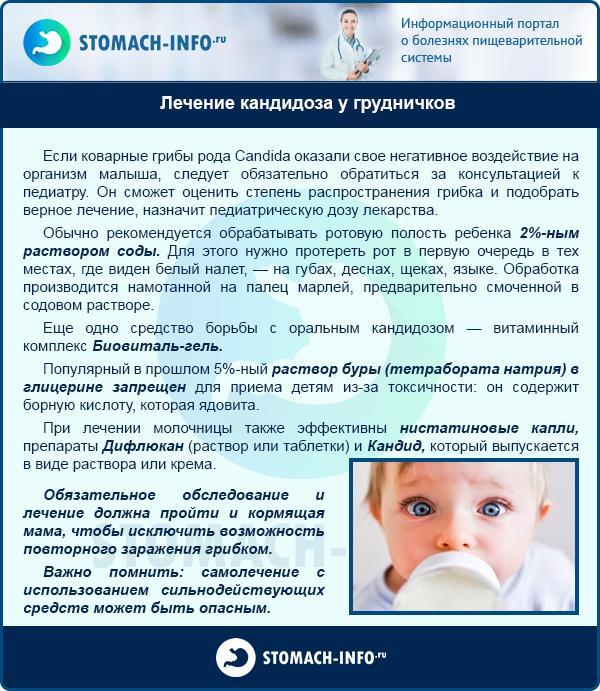
Treatment of candidiasis in infants
As for infectious and viral ailments, they also undermine the immune system. Treatment most often occurs with pharmaceuticals, which is a factor for the appearance of plaque on the tongue, possible allergic reactions. In diseases of both the gastrointestinal tract, and of a viral nature, dehydration of the child's body is characteristic - as a rule, with high temperature, repeated vomiting occurs, the baby suffers from diarrhea, therefore, from water loss. In this case, white plaque, as well as lethargy and dryness of the skin, will be a signal that it is necessary to give the child a drink and bring the electrolyte balance back to normal.
It is not for nothing that it is believed that only a completely healthy child will have a pink, moist, moderately shiny tongue.

Any change and tightening of the tongue bloom is a reason to pay attention to the baby's health.
The plaque itself is not a reason to immediately run to the hospital. But if this symptom is accompanied by others, for example, fever, pain when swallowing, the child's refusal to food and water, fear of the upcoming meal - it is worth, without delay, bring the baby to the doctor or even call the team "Emergencies". Severe hypothermia, indomitable vomiting, child depression - these are the reasons for going to the ambulance.
Video - Treatment of thrush in the mouth of a baby
Ayurveda diagnostics
This ancient medical practice also has its own vision of diseases characterized by plaque on the tongue. There is even an Ayurvedic map showing how the location of plaque on the tongue is associated with pathologies of various organs. Of course, such a card does not have official medical recognition and confirmation, but many parents, who found a plaque in the child's mouth, consulted this card and received similar test results and surveys.
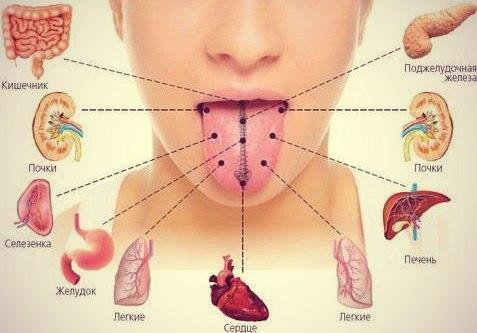
Ayurvedic card
An important point! Using the Ayurvedic card for self-diagnosis and unauthorized prescription of treatment and therapy for a child is completely impossible! This is only an auxiliary tool that allows parents to analyze the health of the baby before going to the hospital.
Table 2. Ayurvedic map that deciphers the cause of the plaque in the language
| Localization and nature of plaque in the language | Which body to pay attention to |
|---|---|
| White coating along the edges of the posterior third of the tongue, near the pharynx | Kidney |
| The front third of the tongue is covered with a whitish coating | Heart |
| Plaque builds up on the tip of the tongue and around the edges | Lungs |
| Plaque in the middle of the tongue | Stomach, spleen, pancreas |
| The lateral parts of the tongue are covered with plaque | Liver |
| Plaque gathers in a crease in the middle | Spine |
| Plaque on the root of the tongue | Intestines |
Video: White plaque on the tongue of a baby
Diagnosis of diseases characterized by plaque in the tongue
If there are no abrupt changes in the child's condition, you can make an appointment with the local pediatrician. The doctor will examine the baby, make his assumptions about the plaque in the language and, if necessary, offer to consult a specialized specialist. There may be several options:
- Dentist - will help to determine the presence of caries, stomatitis, inflammation in the oral cavity. The parent is not always able to competently examine the child on his own and draw conclusions. This is especially true for young children.
- Gastroenterologist - if you suspect a gastrointestinal disease, you need to register the child for an ultrasound scan or endoscopic examination, pass a urine, blood test, coprogram.
- Immunologist, endocrinologist - these specialists will help if the child has a shortage of some substances in the body, hormonal imbalance, reduced protective functions of the immune system.
- Oncologist - a whitish plaque on the tongue can indicate tumors of a malignant nature. To exclude oncology, in some situations it is required to donate blood for tumor markers and visit a specialist.

A doctor examining a child for any reason must necessarily assess the condition of the tongue and oral cavity as a whole.
What should parents do if the plaque is physiological in nature?
Parents who are confident that white plaque on the tongue is not caused by a disease should take the time to to carry out the hygiene of the baby's oral cavity on their own, or to teach him how to do it carefully and regularly.
The child should have his own toothbrush, comfortable for children's hands, and a toothpaste appropriate for his age. It is necessary to tell the baby that not only the teeth, but also the inner surface of the cheeks, the tongue need to be cleaned. To do this, many toothbrushes have not only the main bristles, but also silicone or rubber bumps on the other side - with their help it is convenient to clean the tongue and cheeks. There are special devices for cleansing the tongue, reminiscent of a spoon.

Soft scraper to clean the tongue from plaque
You can also teach your child to use additional mouth rinses. To do this, you can purchase special solutions at the pharmacy, or mix them yourself. For prophylactic rinsing, a weak soda or saline solution, an infusion of chamomile or mint flowers are well suited.

Chamomile and mint tea is great for plaque prevention
Babies also need oral hygiene, including the uvula. To do this, after each feeding, you need to wrap your finger with clean gauze, wet it in boiled water and clean the tongue and the inner surface of the baby's cheeks. This will remove the layer of milk or mixture, prevent the development of bacteria in this favorable environment for them. Nipples and pacifiers given to babies must be disinfected.
Children who have already learned how to move around on their own like to put all the found objects in their mouths. This can cause bacterial stomatitis and profuse plaque on the tongue. To prevent this from happening, it is worth limiting the child's access to not the cleanest areas of the apartment - the corridor, the toilet, and on the street carefully monitor this moment.
It is also important to carry out the prevention of helminthic invasion on time, regularly donating scrapings and coprograms. If a parasite or its eggs are detected, all family members need to drink anthelmintic drugs.
Summing up
Seeing a white bloom in the baby's mouth, the parent should not be scared. It is worth analyzing what could have caused this phenomenon. If the plaque becomes thick, it is poorly cleaned off, and gives the child discomfort, you need to visit a doctor. In the absence of other symptoms, you can visit the pediatrician or tell him about the problem during the routine examination.
But, in any case, from the very first days of the baby, you need to devote sufficient time to oral hygiene, teach with age the child to do it on their own, telling what disastrous consequences the refusal of hygienic procedures. It should be understood that even against the background of complete health, plaque has a negative fusion on the mucous membrane of the mouth and teeth, provoking the appearance of bacteria.

The tongue is called "the mirror of health", as it should normally be light pink and moist.