Scatology of feces - what is it and what pathologies it can indicate
Many centuries have passed since the Aesculapians learned to diagnose ailments by the urine and feces of the patient. Analysis technologies have reached unprecedented heights. And today laboratory tests not only make it possible to make a one hundred percent diagnosis, but literally save human lives. Scatological analysis of fragments of stool is one of such vital studies. Thanks to its decoding, it is possible to quickly obtain information about the presence, dynamics and nature of changes in the pathologies of all organs of the gastric and excretory tract, but, which is especially important, in the rectum. It is her condition that is poorly subject to diagnosis, for which it is necessary to use too complex methods.

Analysis under a microscope
Content
-
1 The essence of the feces scatology method
- 1.1 Who is this analysis assigned to?
- 1.2 Video: Histological coprology
-
2 Preparation and delivery of analysis
- 2.1 Collection of material
- 2.2 How to collect material from a baby
- 3 What is investigated by the method of scatology of feces
-
4 Detailed interpretation of the results
- 4.1 Consistency and shape
- 4.2 Color changes
- 4.3 Disease and smell
- 4.4 Impurities
- 4.5 Quantity
- 4.6 Video: Deciphering the analysis of feces in adults and children
-
5 Chemical and biological indicators
- 5.1 pH reaction
- 5.2 Protein fibers
- 5.3 Blood
- 5.4 Stercobilin
- 5.5 Bilirubin
- 5.6 Leukocyte cells
- 5.7 Fats and acids
- 5.8 Elements of helminths
- 5.9 Video - General analysis of feces
The essence of the feces scatology method
Evaluation under a microscope, as well as by chemical methods of physicochemical manifestations of fecal masses, makes it possible to timely identify pathologies, even barely emerging. Also, the process of absorption of substances in the intestinal walls, motility and the entire mechanism of digestion are under the control of specialists. And all this can be done with one laboratory test.

Laboratory research
A coprological study will allow you to correctly determine the composition of feces and find the cause of non-compliance with the norm in the digestive system. The study reveals deviations in the acid balance, inflammation in the gastrointestinal tract, latent internal bleeding.
By the way. This analysis is simply necessary for patients with acute and chronic diseases of the intestines and stomach. With the help of a coprological study, you can also track the results of treatment, the effectiveness of the therapy used.
What scatology can "show":
- diseases of the bile ducts and bladder;
- problems with the pancreas;
- violations in the liver;
- improper bowel function;
- disturbed activity of the stomach.

Scatological analysis of feces
How does it happen that by analyzing the stool, you can get comprehensive information about the work of almost the whole organism? The fact is that the food lump, called chyme, moves through the body through the entire digestive tract. First, it is structurally a liquid gruel from digestible food, water and gastric juice. All gastrointestinal organs are involved in its transformation. As a result, chyme turns into feces, and its condition bears the imprint of the work of all organs of the system.
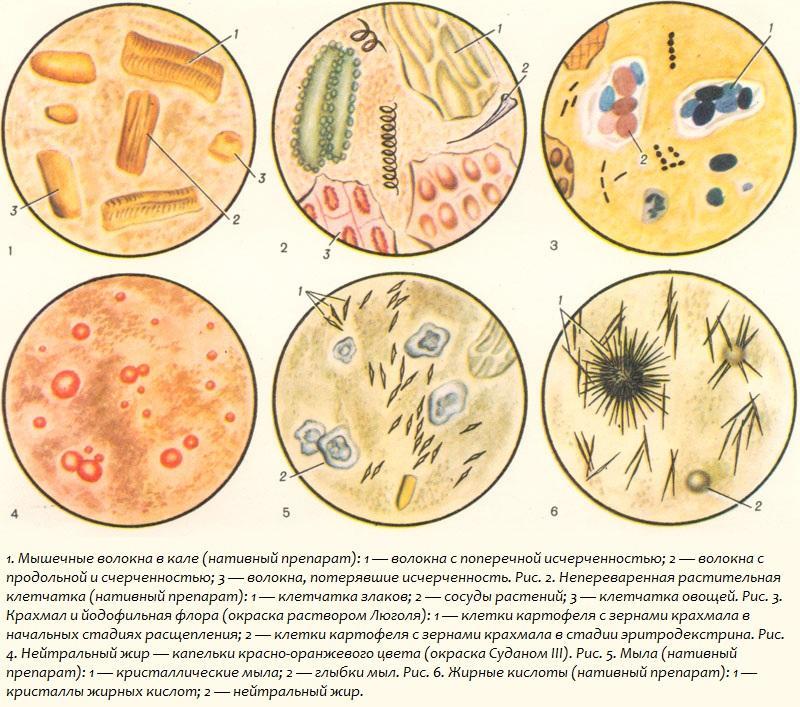
Stool micropreparations
Important! If fats, carbohydrates, mucus, fiber, water, blood are visible in the feces, all this will indicate the absence of a norm in one or another section of the digestive and assimilation organs.
Who is this analysis assigned to?
The coprogram is usually prescribed in conjunction with other studies, but it can also be performed as an independent autonomous analysis.
It is shown when the following diagnoses are confirmed:
- acute and chronic gastric pathology;
- duodenal ulcer disease;
- diseases of the small intestine;
- colon pathology;
- pathological changes in the sigmoid colon;
- diseases of the gallbladder and pathology of the bile ducts;
- liver problems;
- diseases of the pancreas;
- total infection with parasites (helminthic invasion);
- infectious and inflammatory processes;
- dysbiosis and other disturbances of the environment of microorganisms;
- cancer problems.

Referral to the coprogram is prescribed if various pathologies of the gastrointestinal tract are suspected
An analysis is also carried out in order to assess the effectiveness of the prescribed drugs for the patient in the treatment of the confirmed diagnosis of drugs.
Video: Histological coprology
Preparation and delivery of analysis
The patient does not have to carry out any special complex preparation for collecting feces for scatology. There is no need to change the diet, sit on one of the special diets that are recommended before instrumental examination of the intestines and esophagus. You do not need to fast or purge the gastrointestinal tract with a laxative.
Recommendations.
- Taking laxatives on the eve of delivery is categorically not recommended, they will disrupt the consistency of feces.

Do not drink laxatives
- It is forbidden to install suppositories with a laxative effect, enemas, taking castor and other oils.
- It is forbidden to take iron-containing drugs, they will change the color of the feces.
- Medicines with barium and bismuth will also affect the color of the feces. After barium enters the body, for example, during other studies where it is used as a reagent, scatology is carried out no earlier than seven days later.

Banned medications with barium and bismuth
- You should not use enzymes, they will affect peristalsis and lead to atypical changes in it.
- It is recommended to limit sweets and not eat flour for two days before taking the test.
- Also, exotic and spicy dishes should be excluded from the menu.
- It is better to refrain from fatty foods, smoked meats, marinades.

It is better to exclude sweet, flour, fatty foods from the diet.
- Women don't get tested when they have their period.
Advice. If the study aims to confirm the presence of latent bleeding, from the diet for three days before collecting feces, tomatoes, meat and fish products and dishes from them, beets, herbs and greens are excluded vegetables.
What should the patient's diet consist of before taking the test? Basically a normal diet with minor short-term restrictions. Porridge, vegetables, fruits, sour milk. Keep track of the size of the portions, it should be small.

Healthy and nutritious porridge with fruits
Collection of material
It is performed by the patient independently, early in the morning on the day of the analysis, in compliance with the following rules.
- It is necessary to collect the feces fresh, while making sure that no foreign impurities (water, urine) get into it from the outside.
- Use only pharmacy containers specially designed for collecting biomaterials. Do not collect feces in cardboard or wooden boxes or glass food containers.

Special containers with a spoon will provide convenience and ease of taking stool analysis
- For a full analysis, 10-15 g of material is enough. This is no more than one teaspoon. When collecting, try to limit yourself to this volume.
- To avoid the presence of urine in the feces, you must first empty the bladder.
- The next step will be the toilet of intimate areas, which is carried out as carefully as possible, using neutral, non-aromatic soap.

Use fragrance-free soap for washing.
- The biomaterial is collected from different areas little by little, using a special spatula.
Collected stool should be delivered to the laboratory as soon as possible. If there is a delay, the results rapidly lose their validity. If necessary, the analysis can be stored in the refrigerator for about eight hours, but it should be a medical refrigerator with a stable temperature of + 5 ° C.

Medical refrigerator
Results can be seen on the second or third day, but sometimes it can take up to six days to get them.
How to collect material from a baby
Babies and small children are a special category for which it is not always easy to collect feces for analysis. If the baby is already potty trained, the collection rules are almost the same as for adults. If a child is an infant, an oilcloth should be used.

Preparing a child's feces analysis
While waiting for the baby to poop, especially if he suffers from mild constipation, parents can massage his tummy. And if gases have accumulated there, put a gas pipe.

Tummy massage
Before proceeding with the procedure for collecting feces in both children and adults, the actor must wash his hands as thoroughly as possible.
Last but not least, don't collect your baby's feces from the diaper. Never do this, the chemical compounds in the diaper will likely affect the accuracy of the test.
What is investigated by the method of scatology of feces
There are a number of standard physical indicators that are examined in this analysis. These include:
- consistency;
- Colour;
- smell;
- the form;
- the presence of impurities.
Table. Indicators studied on the coprogram.
| Index | Decoding |
|---|---|
 Consistency |
Formed, depending on the presence of fat, water and mucus in the feces, indicates pathology. |
 Colour |
It is formed depending on the food consumed and the intake of medicines, but it can also indicate the presence of bleeding and a number of diseases. |
 Smell |
May indicate a number of different medical conditions. |
 The form |
It largely depends on the consistency, but indicates pathology. |
 The presence of impurities |
It can be observed both with incomplete chewing of food (undigested food debris), and in the presence of pathologies. |

Coprogram norms
Detailed interpretation of the results
Based on the list of the main studied indicators, there is a possibility of a detailed analysis of the coprogram with the definition of cause-and-effect relationships.
Consistency and shape
This first most important visual indicator, depending on the content of fat, slimy supplements and water, has a lot to say.

Bristol Feces Shape Scale
If you know that normal feces of a healthy patient contain 80% water, a violation of the indicator in the direction of increase or decrease demonstrates the presence of various kinds of problems. Thus, an increase in the presence of water masses up to 95% accurately indicates diarrhea. A decrease to 65% or less indicates constipation.
Mucous masses in normal feces are present, but their increased secretion, especially when the accumulation occurs in the colon, changes its consistency, making it viscous and thin.
Fat, which is normally also present in feces, but in scanty amounts, with a high content forms a special sticky consistency.
Important! In a healthy middle-aged person, normal feces are well-formed and rather dense, but not dry and overly hardened. In infants, viscous, slightly liquefied feces are considered the norm.
Nevertheless, dense and well-formed feces are also found in serious pathological processes that are associated with a violation of the digestion process in the stomach. A viscous pasty stool can be observed with pathologies of the secretory function, with a weak bile.

Assess the shape and consistency
Liquefied masses, replete with oily impurities, mean steatorrhea. This is a process of increased production of fat and its insufficient absorption into the intestinal region. Also, with pathologies of the small intestine, such as enteritis or rapid evacuation of feces, and the large section, such as colitis, fermentation dyspepsia, irritable bowel syndrome - feces change their structure to mushy and loose, up to liquid diarrhea.
Hard feces in the form of tight "balls" or ribbon-like form may indicate not only chronic constipation, but also hemorrhoids, all types of tumors and oncology.

Stool consistency
Color changes
To a greater extent, the color of the stool depends on what kind of food a person eats.

Brown feces are considered normal, but slight deviations are permissible
For example, in babies who eat only milk, the feces are light yellow. If an adult eats a lot of dairy products, a yellowish tint will also dominate in his feces.
After eating various types of meat, the feces acquire a brown or dark brown color. If you ate a lot of beets, it will be red or burgundy red.

See if there are traces of blood in the stool
Also, some medicines that contain dyes affect the color. So after black activated carbon, the stool will also turn black.
But color changes can also signal various diseases and disorders.
Table. Color change in diseases.
| Disease | Color change |
|---|---|
| Blockage of the general bile duct | Feces are painted white |
| Pathological changes in the pancreas | Gray-yellow, light |
| Intestinal motility and digestion are impaired | Yellow feces |
| Inflammation of the intestinal mucosa with open ulcers | Red color |
| Rapid evacuation of feces from the large intestine | Light brown color. |

Do not worry if the stool has become an unusual color for a while.
Disease and smell
A parameter such as smell can also say a lot when analyzing it. Normally, a characteristic odor is formed due to the presence in the feces of substances formed as a result of protein metabolism. If the food is oversaturated with protein, the smell will be stronger, but still characteristic.

Feces always smell bad. At the same time, an unpleasant odor is an indicator that you have normal intestinal flora.
- If the smell is weak or absent at all, then the patient has chronic constipation, in which the result of the breakdown of proteins is completely absorbed by the intestines and is not excreted from the body.
- The smell of moderate intensity can alert the fact that it is most often accompanied by obstructed digestive reactions in the colon. Also, a decrease in odor intensity signals a high-speed evacuation.
- If the smell is not sharp, this may well be a confirmation of ulcerative colitis.
- The acid present in the smell indicates fermentation dyspepsia, in which volatile acids are released.
- The smell of oil, which gives butyric acid, means a violation of the absorption processes in the small intestine and high-speed evacuation in it.
- A rotten smell can mean disturbed digestive processes, as well as dyspepsia, impaired intestinal motility, and ulcerative colitis.
- Too strong fetid odor betrays disturbances in the pancreas when its functional abilities are weakened. It may also indicate the absence of bile in the digestive tract or that the secretion of the colon is increased.
Impurities
In feces, insoluble fiber may be present within acceptable limits. These include fruit peels, seed and nut husks, legumes and kernels, and so on. These impurities are important because it is with them that cholesterol and toxic poisons are removed from the intestines.
By the way. Vegetable fibers in the feces should be absent. If they are, this means that hydrochloric acid is released in insufficient quantities in the gastric compartment, that is, it indicates pathology.
Also, an impurity can be mucous formations that help the feces slide. But if the mucus is abundant, and not streaked, this may indicate inflammatory formations in the colon mucosa.
Blood, like pus, as fecal impurities, clearly indicates pathology. The first is about bleeding. The second is about a colon ulcer, dysentery lesions, or a disintegrating tumor.

Blood in the feces always means the presence of pathologies
Quantity
This parameter is difficult to establish in laboratory analysis, but the question of the amount of feces and their the regularity will certainly be asked to the patient by the doctor who sent him for the study of feces by the method scatology.

Pay attention to the amount of stool
According to medical standards, with a balanced diet, an adult should allocate from 100 to 200 g of stool during the day. A child, especially a baby, usually does not excrete more than 90 g.
By the way. Of course, the quantitative parameter varies greatly depending on the quality of the food consumed. If there is a lot of biofiber, fiber, plant products in the diet, the volume of feces increases. With a protein diet, or with a predominance of protein foods, it decreases.
What does the insufficient or excess volume of excreted feces indicate? If the parameter is less than 100 g - constipation. At 200 g or more - impaired digestion, no bile flow, rapid evacuation.
If the body excretes feces up to a kilogram, there is pancreatic insufficiency and everything connected with it.
Video: Deciphering the analysis of feces in adults and children
Chemical and biological indicators
A number of the main analyzed chemical and biological indicators indicate the presence of the corresponding diseases.
pH reaction
If we talk about the norm of an adult, then it is in the range of 6.8 -7.6, that is, neutral. In infants, the environment is more acidic, which is due to the peculiarity of their nutrition at an early age.

PH test
- A weakly alkaline environment is formed in case of gross violations of the food processing process.
- An alkaline reaction is characterized by any constipation, manifestations of ulcerative colitis, impaired digestion functions. It also indicates a weak pancreas and the inability to perform its secretory function, on the contrary, about hypersecretion of the large intestine.
- If the environment is sharply alkaline, then there is dyspepsia.
- In an acidic environment, fatty acids are absorbed by the small intestine in insufficient volume.
- A hyper-acidic reaction also indicates dyspepsia, but with a pronounced fermentative effect.
Protein fibers
If there is protein in the feces, even a very small amount of it, this may directly indicate pathological phenomena, such as:
- gastritis or stomach ulcers;
- cancer;
- enteritis;
- colitis;
- polyps;
- duodenitis;
- proctitis;
- dysbiosis.

Protein in feces
Blood
The presence of even minor blotches of blood or bloody streaks in the feces speaks of an unambiguous pathology. It can be bleeding, hidden or open, of any part of the alimentary and excretory tract (including bleeding in the oral cavity).
Especially often bloody discharge indicates a stomach ulcer, ulcerative colitis, ulcerative lesions of the duodenum, hemorrhoids, the presence of polyps, tumors.

See your doctor as soon as possible if there is blood in your stool
Stercobilin
This substance is one of the breakdown products of hemoglobin, which tends to stain excrement in a brown color characteristic of a healthy person. If the feces become discolored, which occurs with all types and groups of hepatitis, acute stage pancreatitis, anemia and with existing cholangitis, which means that stercobilin is produced in insufficient quantity.

Stercobilin is a tetrapyrrole bile pigment and an end product of heme metabolism
Bilirubin
It should not be in the scatology of the feces of a healthy adult.

Bilirubin is a unique bile pigment with a rather bright reddish brown color
In children, the presence of a small amount of this substance is allowed while they are in infancy, up to three months.
If bilirubin is found, this indicates the following pathologies:
- hyperactive motor skills;
- high-speed evacuation;
- severe stage of dysbiosis, which led to long-term use of antibiotics.
By the way. If both bilirubin and stercobilin are simultaneously present in the analysis, the absence of normal intestinal microflora in the colon can be diagnosed.
Leukocyte cells
Normally, their presence should also not be detected. If there are leukocytes in the feces, then there is an inflammatory process that is currently taking place in the colon.
- Dysentery.
- Cancer.
- Tuberculous lesion.
- NNC.
With the massive appearance of leukocytes in the feces, with a simultaneous absence of mucous secretions, a pararectal abscess is diagnosed.
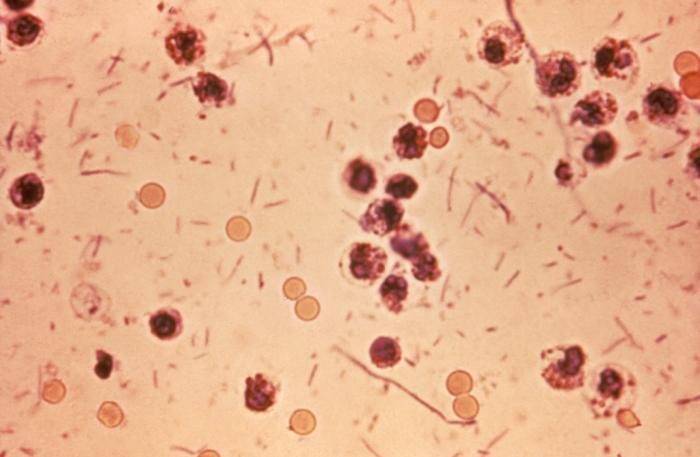
Leukocytes in feces
Fats and acids
This type of biomaterial should not be in the feces either. The presence states disturbed food processes, bile formation and bile duct, lack of secretory function. In infants, small inclusions of neutral fat are allowed.
As for the fatty acids, their presence means pathological disorders of the bile, fermentative dyspepsia and other multiple pathologies.
Elements of helminths
Of course, this cannot be the norm, but helminth larvae, their particles and eggs are found in the feces of more than a third of patients passing scatology. Even if they are available in small quantities, even if the detection is single, it is still necessary to take measures to rid the body of helminthization.

What do the eggs of worms look like in feces
No self-diagnosis can replace the medical decoding of scatological analysis, which will be prepared for you in a clinical laboratory. But it is necessary to be aware of what the feces should be in the norm, and what changes may indicate violations. Even with a visual examination, a person may suspect something was wrong. This will be enough to go to the doctor who will prescribe scatology of the stool. Perhaps this attention shown to your own body will save you from serious health problems.