Acute stomach pain
Unpleasant sensations in the stomach are common for many people, which are often overlooked. However, intense pain in the abdomen, which rapidly appears and increases, is most often a sign of serious disorders. This symptom may be the only signal for an urgent operation, so the patient should be immediately examined by a doctor. Abdominal pain should be of particular concern in children and the elderly, as well as in carriers of the human immunodeficiency virus or taking medications that suppress the immune system.

Acute stomach pain - what to do
In older people, pain may be less severe than in younger people with a similar disorder, and even if the condition is severe, pain may develop more gradually. Abdominal pain also affects children, including newborns and infants, who are unable to communicate the cause of their discomfort. In any case, the question arises quite rightly - if there is an acute pain in the stomach, what to do?

Abdominal organs
Content
- 1 Types of abdominal pain
- 2 Peritonitis
- 3 Possible Causes of Stomach Pain
- 4 Alarming symptoms
- 5 When to see a doctor
- 6 How is a doctor's examination for abdominal pain
- 7 Additional diagnostics for abdominal pain
-
8 Treatment
- 8.1 Video - What can not be done if the stomach hurts?
Types of abdominal pain
Doctors classify specific types of abdominal pain based on the organs and structures involved.
-
Visceral pain comes from the abdominal organs. The nerves of the internal organs do not respond to damage, rupture, or inflammation. Instead, the nerves respond to an organ stretching (for example, when the intestines are expanded by gas) or surrounding muscles contract. Visceral pain, as a rule, is localized over the entire surface of the abdomen, dull and causes a feeling of nausea. Sometimes it is difficult to determine its exact location on the body. Painful sensations in the stomach can occur with pathologies of structures such as the stomach, pancreas, small and large intestines and liver. Pain in the middle of the abdomen (near the navel) is caused by abnormalities in structures such as the small intestine, upper colon, and appendix. Lower abdominal pain occurs due to disorders of the lower colon and urinary tract.

Visceral pain

Visceral abdominal pain
-
Somatic pain arises from the membrane (peritoneum) that lines the abdominal cavity. Unlike nerves in visceral organs, abdominal nerve endings are able to respond to stimuli (such as blood, infection, chemicals, or inflammation). Somatic pains are most often severe and their exact location is fairly easy to determine.

Somatic pain
- Radiating pain - it is pain perceived at a distance from its real source. Examples of said pain are groin pain caused by kidney stones and shoulder pain caused by blood or an infection that irritates the diaphragm.

Abdominal pain map
Peritonitis
Peritonitis is a serious illness in which the peritoneum becomes inflamed. This condition is very painful and almost always signals a serious or life-threatening illness. Peritonitis can result from any abdominal problem in which organs become inflamed or infected. Common examples of such diseases include appendicitis, diverticulitis, and pancreatitis. In addition, blood and natural secretions (such as intestinal contents or urine) cause intense irritation when they seep into the abdominal cavity and can cause peritonitis.

Symptoms of peritonitis
Diseases that cause blood and body fluids to leak include spontaneous rupture of an organ (such as a perforated bowel ulcer or pregnancy located outside the uterus) and severe abdominal injury. If peritonitis continues for several hours, the inflammation causes fluid to leak into the abdomen. As a result, a person may become dehydrated and develop shock.
Inflammatory substances released into the bloodstream can affect various organs, causing severe pneumonia, kidney failure, liver failure, and other problems. Without treatment, a person with peritonitis can die.

Classification of peritonitis
Possible Causes of Stomach Pain
A pain symptom can appear for any of a variety of reasons, including infection, inflammation, abscess formation, ulcers, perforation or rupture of organs, muscle contractions that are mismatched or blocked by an obstruction, and blockage of blood flow into organs. Life-threatening conditions that require urgent diagnosis and surgery include:
- rupture of an aneurysm of the abdominal aorta;
- perforation of the stomach or intestines;
- blockage of blood flow in the intestine (mesenteric ischemia);
- rupture during pregnancy outside the uterine cavity.

Intestinal ischemia
Serious disorders requiring urgent diagnosis and treatment:
- bowel obstruction;
- appendicitis;
- sudden (acute) inflammation of the pancreas (pancreatitis).
In some cases, diseases of organs located outside the abdominal cavity cause abdominal pain. Examples would be heart attack, pneumonia, and torsion of the testicles and spermatic cord. Less common abnormalities outside the abdominal cavity that cause abdominal pain, including ketoacidosis in diabetes mellitus, porphyria, sickle cell disease, and certain bites and poisons (such as a black widow spider bite, heavy metal or methanol poisoning, and bites scorpion).

Testicular torsion
Alarming symptoms
In people with acute abdominal pain, certain symptoms and signs should be of particular concern. They include:
- severe pain that does not disappear for a long time;
- signs of shock (eg, fast heart rate, low blood pressure, sweating, and weakness);
- signs of peritonitis (eg, persistent pain and / or pain that worsens with touch or pressure);
- swelling in the abdomen.

Very severe pain
When to see a doctor
People who develop warning warning symptoms should go to the hospital immediately. People who do not have the listed symptoms or are less pronounced should visit a doctor on their own during the day.
How is a doctor's examination for abdominal pain
At the appointment, doctors ask questions about the symptoms and progression of the disease and conduct a physical examination. What doctors find during questioning and physical examination helps them decide which methods of further research should be carried out. Doctors follow the same algorithm regardless of whether they rate moderate or severe pain, however the surgeon may be involved even in the early stages of assessing intense abdominal pain to rule out emergency pathologies.

Differential diagnosis for abdominal pain
Finding out the history of the development of the disease, doctors ask questions about the location of pain and its characteristics, clarify whether a person has had similar symptoms in the past and what other sensations bother the patient besides pain in a stomach. Symptoms such as reflux, nausea, vomiting, loose stools, constipation, yellowing of the skin and sclera, detection of blood in stool or urine, coughing up blood, and weight loss can help determine the diagnosis more accurately. Doctors ask questions about the patient's medications and recent alcohol use.
The doctor should also ask about the presence of previously diagnosed diseases and previous abdominal surgeries in the patient. In female patients, the presence of pregnancy is specified.
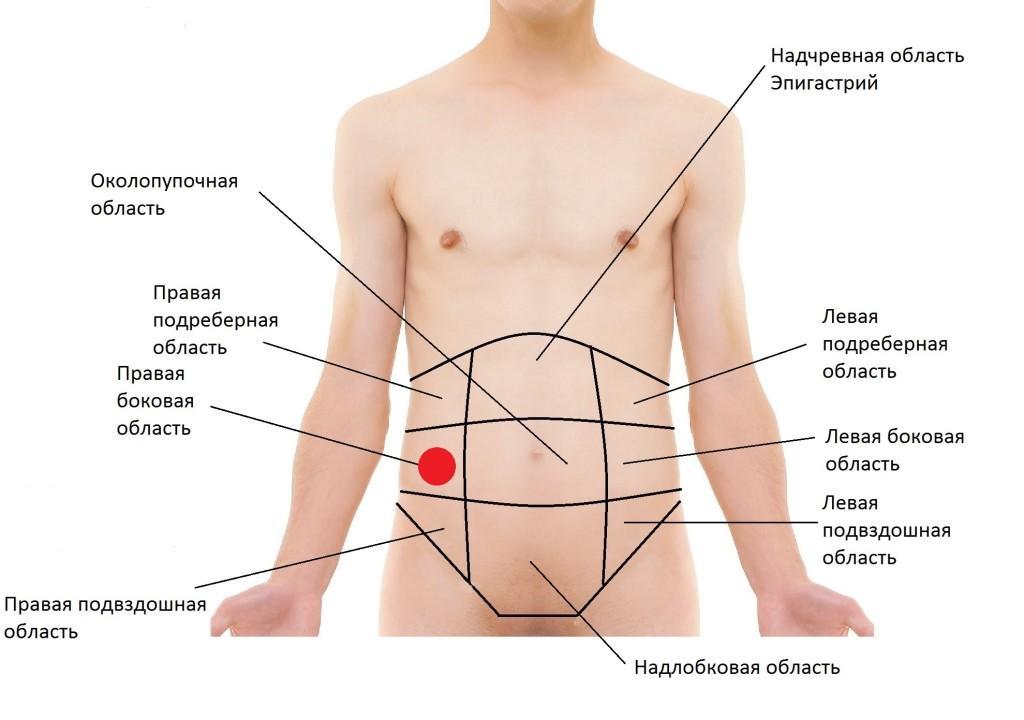
Areas of the abdomen
When doing a physical exam, doctors first note the person's appearance. An outwardly calm person rarely has a serious problem, unlike someone who is very anxious, pale, covered in sweat, or clearly in pain. The main object of attention of doctors in this case is the abdomen, and doctors check its condition by probing (a process called palpation) of the abdomen. They usually examine the rectum and pelvis (in women) to look for tenderness, abnormalities, or blood. Doctors carefully probe the entire surface of the abdomen to find areas of particular painful sensitivity, as well as the presence of symptoms of peritoneal irritation.

Palpation of the abdomen
The first of these symptoms is that the patient involuntarily squeezes the abdominal muscles when the doctor touches the abdominal area. The second possible symptom is that the abdominal muscles remain in constant tension, even when the doctor does not touch the abdomen. The third characteristic sign of peritonitis is that the patient feels a sharp pain when the doctor's hand is quickly withdrawn after probing.

Abdominal muscles contract on palpation
Table. Frequently Asked Questions by Your Doctor.
| Questions asked by the doctor | Possible Answers | Possible reasons |
|---|---|---|
| Where is the pain felt? | 1. Distributed throughout the abdomen 2. In the upper abdomen (in the stomach area) 3. In the lower abdomen |
1. Acute pancreatitis, diabetic ketoacidosis, early appendicitis, gastroenteritis, intestinal obstruction, intestinal ischemia, peritonitis 2. Acute inflammation of the pancreas, herpes infection, pneumonia, myocardial ischemia, peptic ulcer, inflammation of the bile bladder, hepatitis, liver abscess, perforated duodenal ulcer, gastritis, stomach ulcer, abscess in the spleen, rupture spleen 3. Appendicitis, diverticulitis, lymph node inflammation, Crohn's disease, abscesses, abdominal wall hematomas, cystitis, hernia, kidney stones, ectopic pregnancy, torsion of the spermatic cord and testicle |
| What is pain in nature? | 1. Waves of acute pain that "take your breath away" 2. Waves of dull pain with vomiting 3. Colic-like pain that then becomes constant 4. Intense, persistent pain that increases with position changes 5. Tearing pain 6. Blunt pain |
1. Renal or biliary colic (episodes of severe pain in the kidneys or gallbladder) 2. Intestinal obstruction 3. Appendicitis, ischemic bowel obstruction (blockage that cuts off the blood supply to the intestine) mesenteric ischemia (blockage of blood flow in a part of the intestine due to a blood clot or accumulation of fatty substances in arteries) 4. Peritonitis 5. Aortic dissection (tear in the inner layer of the aorta) 6. Appendicitis, diverticulitis, kidney infection |
| Have you experienced these symptoms before? | 1. Yes | 1. Chronic conditions such as ulcers, gallstones, diverticulitis, or ovulatory syndrome (pain during ovulation, usually in the middle of the menstrual cycle) |
| Did the pain start suddenly? | 1. Yes, the pain arose abruptly and unexpectedly 2. No, the pain gradually increased |
1. Perforated ulcer, kidney stone, ruptured ectopic pregnancy, ovarian or testicular torsion 2. Most other reasons |
| What other symptoms are there besides pain? | 1. Vomiting and loose stools that precede pain 2. Delayed vomiting, no bowel movements, and no gas passage 3. Severe vomiting that occurs before severe pain in the upper abdomen, left side of the chest, or shoulder. |
1. Gastroenteritis 2. Acute intestinal obstruction 3. Perforation of the esophagus |

How does gastroenteritis develop?
Additional diagnostics for abdominal pain
In some cases, patients show clear signs of an emergency and doctors immediately understand that they need surgery. Doctors try to carry out operations on such people without delay, without spending too much time on a more thorough diagnosis using additional methods. Nevertheless, in other cases, specialists can prescribe auxiliary methods of examination that will help determine a clear diagnosis. Doctors choose additional diagnostic methods based on suspected pathologies, for example, a pregnancy test in females of childbearing age.

Features of additional diagnostics
A CT scan of the abdomen can help identify most of the conditions that cause abdominal pain. Various types of urine tests are often done to look for signs of a urinary tract infection or kidney stones. Blood tests are often done, but rarely identify a specific cause (although blood tests can be used to diagnose pancreatitis). An ultrasound scan can be helpful if doctors suspect a gynecological disorder.

Abdominal ultrasound
Treatment
The method of treatment depends on the established diagnosis. Until recently, it was considered unwise to give pain relievers to people with severe abdominal pain before until a diagnosis is made, because the pain medication can mask important symptoms.

Treatment depends on the cause of the abdominal pain
However, modern express diagnostic methods allow in some cases the use of pain relievers, provided that the patient is examined by a specialist, and does not wait for the disappearance of symptoms on one's own.