Fluoroscopy of the stomach with barium
Diseases of the digestive system, in particular of the stomach, are the most common reasons for contacting a specialist. Today, one of the most effective and minimally invasive methods for diagnosing pathologies of the gastrointestinal tract is X-ray.
The essence of the technique consists in directing a beam of rays to a certain part of the body. They pass through the skin and muscles and bounce off internal organs or bones. At the same time, various tissues do not absorb X-rays to the same extent, due to which it is possible to obtain a fairly complete picture, indicating any disturbances in the functioning of the body. With fluoroscopy, radiation is supplied continuously, and a dynamic image of the examined organ is displayed on a monitor.

Fluoroscopy of the stomach with barium
It should be borne in mind that the stomach is a hollow organ. Passing through it, X-rays are practically not delayed. To achieve a result during the study, a contrast agent is injected into the stomach - barium sulfate. It allows you to significantly improve the quality of images. The technique is based on a set of principles for standard radiographs and fluoroscopy.

Barium sulfate for fluoroscopy
Contrast fluoroscopy allows early detection of various diseases. Barium sulfate introduced into the patient's body makes it possible to study the state of the esophagus, stomach and partly the duodenum. This procedure allows you to explore the morphological features of the stomach, as well as detect pathological shadows in the lumens of its holes. In addition, a survey of the abdominal cavity, performed at the beginning of the diagnosis, displays the state of the structures surrounding the stomach.

Why take barium before fluoroscopy
Content
- 1 Features of the study
- 2 The effect of fluoroscopy on the body
- 3 Indications and contraindications for fluoroscopy
- 4 Preparation for manipulation
-
5 Analysis of data with fluoroscopy of the stomach
- 5.1 Video - How to get tested. X-ray
- 5.2 Video - Fluoroscopy of the stomach
Features of the study
Immediately before the manipulation, the specialist suggests the patient to take an orally defined amount of barium sulfate. The exact volume of the drug is determined by the individual characteristics of a person's physiology, including his height, weight and age. In a therapeutic volume, the solution does not pose any harm to the patient's body. The substance is a milky-white suspension with a pronounced chalky aftertaste.
Attention! A number of patients have an intolerance to barium sulfate. In this case, iodide is used as a contrast agent.

The structure of the stomach
To enhance the effect after taking barium, the following manipulations can be performed:
- 1-2 minutes after using the contrast medium, the patient is asked to take a solution of Aeron. It is a combined agent containing M-anticholinergics. The medicine reduces salivation, that is, salivation, and mucus formation in the organs of the digestive system.
- If necessary, a probe is inserted into the patient's stomach, which injects gas. Thus, it is possible to achieve a decrease in the folding of the organ and the alignment of its walls.
After additional procedures, the patient should take a small amount of barium sulfate again. The doctor decides whether it is necessary to take Aeron or place a probe depending on the individual characteristics of the patient.

Fluoroscopy of the stomach
After filling the stomach with a contrast agent, it becomes possible to carry out direct fluoroscopy. On average, the duration of the procedure is no more than 20-25 minutes. However, when severe pathologies are detected, the duration of the study can vary from half an hour to an hour.
During the manipulation, the patient is in an upright position, while the X-ray machine is installed on the left side. The patient is then asked to lie down on the examination table. In order for the contrast agent to be evenly distributed throughout the stomach cavity, the specialist palpates the abdominal cavity of the examined person in the epigastric region.
Attention! During the procedure, the patient may be asked to hold their breath. This measure allows obtaining images of certain areas of the stomach of higher quality and increases the reliability of the study results.

Fluoroscopy
The effectiveness of the research carried out depends on the correct behavior of the patient during the procedure. The doctor should be able to see all the necessary projections of the digestive tract on the monitor screen. Therefore, during fluoroscopy, the specialist may several times ask the patient to change the position of the body: turn, sit down, lie down and get up. If it is difficult for the examined person to follow the appointments of the diagnostician, he has the right to seek the help of relatives or other accompanying persons.
Pictures taken in a lateral or oblique projection make it possible to assess the state of the antrum, that is, the lower part of the stomach and the presence of esophageal reflux. Also, the specialist may ask the patient to take a position in which the pelvis is in an elevated position. This allows you to explore the opening of the diaphragm and exclude the presence of hernias. Images in the area of the shoulder blades and lower back are necessary for the analysis of tissue elasticity. In total, the diagnostician with fluoroscopy receives about six images.

Types of gastric hernia
Barium sulfate solution allows you to fully explore the lower third of the esophagus, determine the position of the stomach in the abdominal cavity, study the structure of its walls and the features of peristalsis.
As the contrast medium moves in the stomach cavity, the monitors display images reflecting the state of the digestive system. All images are saved on a computer and reviewed by a diagnostician after the end of the procedure.
The effect of fluoroscopy on the body
It should be borne in mind that any X-ray examination has a certain radiation on the human body.

X-ray examination of the stomach
The radiation dose of the patient during the X-ray examination
| A kind of research | Radiation dose |
|---|---|
| X-ray of teeth and mouth | 3 m3w |
| Fluoroscopy of the stomach | 15 m3w |
| Fluorography of the lungs | 2 m3w |
| Chest fluoroscopy | 10 m3w |
As with most medical procedures, fluoroscopy does not pose a health hazard to the patient when used rationally. During the study, specialists resort to using the lowest possible dosages of radiation. In the vast majority of cases, the benefits of the manipulation carried out several times exceed the possible risks.

Fluoroscopy does not pose a risk to the patient's health when used rationally
Attention! There is a group of patients who are contraindicated in the use of X-rays. These include women during gestation. Radiation in this case is associated with a potentially high probability of negative effects on the embryo. Therefore, a woman does not undergo fluoroscopy during pregnancy.
The amount of barium sulfate solution that the patient takes before diagnosis is on average about 170-250 ml, in some cases the volume of the substance reaches 350 ml. In the indicated dosages, the drug has a minimal effect on the patient's body. To avoid discomfort during hunger attacks after the study, immediately after the end of the procedure, you should drink a glass of cool water.

X-ray of the stomach for lynitis
It should be borne in mind that barium sulfate causes a fairly strong dehydration of feces. Therefore, after the procedure, it is worth temporarily limiting the consumption of food that can lead to constipation:
- yeast baked goods and fresh bread;
- meat, especially fatty;
- potato;
- alcohol;
- pasta;
- confectionery with fat cream;
- popcorn;
- hard boiled eggs.
Attention! Constipation or constipation is a pathology of the digestive system, manifested by a violation of the stool. The presence of this disorder in a patient should be discussed if defecation is absent or difficult for 48-72 hours or more.

Sample menu for constipation
To avoid constipation, you should take a sufficient amount of plant foods containing a large percentage of fiber and fermented milk products. After fluoroscopy, you should do gymnastics to improve intestinal motility and consume at least 1.5 liters of fluid per day. It should be noted that even if the digestive tract is disrupted, you should not take laxative drugs, since such drugs in this case can worsen the patient's condition.
Also, immediately after fluoroscopy, the patient may experience nausea. In most cases, the discomfort goes away within half an hour. If the condition does not improve, 1-2 tablets of Cerucal or Metoclopramide should be taken. These drugs reduce the feeling of nausea, stop hiccups and spasms in the digestive tract, and normalize intestinal peristalsis.

The drug Cerucal in the form of tablets
Within about two days after the study, the patient may notice a change in the color of feces. Fecal masses, due to the high content of barium sulfate in them, acquire a whitish or grayish tint. If the contrast agent is excreted from the body for a long time or causes disturbances in the stool, you should drink about two liters of water during the day.
Indications and contraindications for fluoroscopy
X-ray of the stomach is performed if the patient has clinical symptoms, indicating possible pathologies of the gastrointestinal tract:
- Melena or blood in the feces, including occult blood in the feces.
- Difficulty swallowing. In this case, the patient may experience spasms when food moves through the esophagus or attacks of nausea after food enters the stomach.
- Regular painful sensations in the abdominal cavity, especially in the epigastric region.
- Development of anemia of unknown etiology.
- The appearance of seals in the abdominal region.
- Severe weight loss, not caused by dietary changes or sudden loss of appetite.
- Stool disorders, bouts of vomiting and nausea, a general deterioration in well-being.

Technique for the study of fluoroscopy of the stomach with barium
It should also be borne in mind that fluoroscopy, like any other medical procedure, has a number of contraindications:
- serious condition of the patient as a result of exacerbation of chronic diseases;
- individual intolerance to barium sulfate;
- period of gestation in women;
- hemorrhagic ulceration of the walls of the esophagus and stomach.

Stomach ulcer
In some cases, it is possible to carry out fluoroscopy for women during gestation. Immediately before the examination, the patient should be examined by a gynecologist, who determines how great the risk to the fetus is in this case. A similar procedure for pregnant women is prescribed only if the research results are necessary. urgently, and alternative diagnostic techniques cannot be carried out for any reasons.
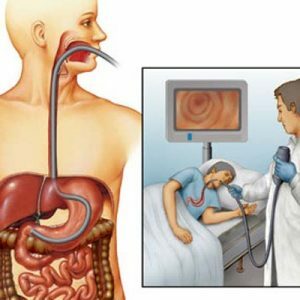
Today, instead of fluoroscopy, patients with contraindications are often given fibroesophagogastroscopy. During the examination, a flexible fibroscope equipped with a built-in lamp and a camera is inserted into the stomach through the esophagus. Thanks to this procedure, the specialist also receives an image of the organ under study on the monitor screen. In addition, if necessary, the gastroenterologist can take a small section of the mucous membrane for biopsy.

Fibroesophagogastroscopy
Preparation for manipulation
For the results of the study to be the most accurate, the patient should appear for the procedure on an empty stomach. The last meal should be no later than 20 hours a day before the fluoroscopy. If there is no chyme in the stomach, then the images of the organ are obtained with the most accurate and high quality. Also, the patient in the morning before manipulation should not drink any liquids, smoke and chew gum.
Attention! If the patient is constantly taking any pharmacological drugs, he should warn the doctor about this in advance. Otherwise, the use may adversely affect the results of the study. In addition, it is necessary to inform the diagnostician about the history of allergic reactions and intolerance to any substances.
Before the procedure, the doctor briefly instructs the patient on the rules of behavior during fluoroscopy. Also, the specialist asks the subject to remove all jewelry and metal objects.

Preparing the patient for X-ray examination of the stomach and gastrointestinal tract
Patients who have any dysfunction of the digestive tract, 3-5 days before the diagnosis you should begin to observe a special diet aimed at stopping flatulence and reducing processes gas formation. In this case, the following foods must be excluded from the diet:
- rich pastries, chocolate, pastries and cakes with cream;
- milk and dairy products;
- carbonated drinks, including carbonated mineral water;
- legumes and cabbage;
- black bread;
- fresh fruits;
- alcohol, especially beer and sweet table wines.
The basis of nutrition during this period should be porridge on the water, egg white, lean meat and fish. Activated carbon, Enzyme and Espumisan also help fight flatulence before fluoroscopy.

The drug Espumisan
In some cases, in order to obtain a more accurate result directly on the day of the study, the specialist prescribes gastric lavage to the patient. This measure is considered quite traumatic for the patient, so they rarely resort to it.
Analysis of data with fluoroscopy of the stomach
A collegium of doctors, consisting of a diagnostician, a gastroenterologist and a surgeon, is involved in decoding the results of gastric fluoroscopy. These studies provide information on the state of the epithelial membranes of the gastric walls, as well as on the motor function of the organ. Depending on the speed of movement of the barium sulfate solution, experts draw a conclusion about the presence or absence of any functional disorders in the work of the upper parts of the digestive system. In addition, fluoroscopy reveals possible violations during the evacuation of barium suspension from the esophagus into the stomach.

Changing the shape of the stomach
With the help of an X-ray, it is possible to identify the following pathologies:
- deviations from the norm in the position of the upper parts of the digestive tract, the pathology of their structure and development;
- prolapse of the stomach as a result of injury;
- tumor processes in the tissues of the esophagus and stomach;
- ulceration of the digestive system;
- the consequences of previous operations on the intestinal tract;
- strictures and obstructive changes in the lumen of the esophagus or dysfunction of the sphincters of the stomach;
Attention! A stricture is a stenosis, that is, an organic narrowing of a hollow organ, which is accompanied by a violation of its patency.

Normal esophagus in fluoroscopic image
- perforation of the gastric wall;
- cardiospasm of the esophagus - neuromuscular dysfunction, in which food masses accumulate in the upper parts of the esophagus, causing its pathological expansion;
- atrophic gastritis, which is manifested by a decrease in the folding of the mucous membranes;
- papillomatosis, polyps;
- the presence of foreign bodies.
If any pathologies are detected, specialists can prescribe additional studies to the patient: FGDS, magnetic resonance imaging, biopsy of the tissues of the esophagus or stomach, etc.

X-ray of the contrasted stomach
Gastric fluoroscopy using barium is a type of diagnostic procedure that allows you to obtain data on the state of the upper parts of the digestive system. During the examination, the specialist takes a series of pictures that are displayed on the monitor screen. To obtain a better image, the patient immediately before manipulation takes a contrast - a suspension of barium salts. Fluoroscopy is an accurate, non-invasive procedure that causes minimal discomfort to the patient. This study is necessary for people who presumably have any pathologies of the esophagus and stomach.