Lorista: instructions for use, indications and contraindications of pressure tablets

Content:
- Instructions
- Dosage
- Forms of issue
- Analogs
Instructions for use indicate that Lorista is an angiotensin receptor blocker. In this case, the blockade itself occurs in the vessels of the heart, kidneys and adrenal glands, which leads to a decrease in the patient's blood pressure.
After oral administration, the active substance losartan is rapidly absorbed in the stomach and intestines. Lorista reaches its highest concentration within an hour after ingestion.
In adults, Lorista is excreted by the liver. The withdrawal period is on average
In the presence of liver damage (cirrhosis), the active substances of Lorista may be more concentrated.
In addition, Lorista has two substitutes (full analogs): Lorista N and Lorista ND.
They are drugs with combined substances - losartan and hydrochlorothiazide. The latter substance also has a pronounced diuretic effect.
Each of these drugs has an identical purpose and composition. Their main difference is in the dosage of the active substance. The attending physician should choose which option to take to the patient, based on the patient's testimony and the reaction of his body to previously taken medications.
It has such a therapeutic effect after taking:
- Reduces high blood pressure in the patient's pulmonary circulation.
- Acts as a diuretic.
- Stabilizes the heart rate.
- Reduces the likelihood of developing cardiac hypertrophy.
- Increases the endurance of patients with heart failure to physical activity.
- Lowers blood pressure.
The drug is effective for both men and women, even in old age.
About whether it can be used during pregnancy, and what its price is - further in the article.
Lorista: instruction for use
Medical preparation Lorista (instructions for use indicate its domestic manufacturer) has the following forms of release:
- Lorista (dosage 12 mg). The tablets are intended for oral administration. They have an oval shape, a film shell. Color - light yellow. There is no smell.
- Dosage 25 mg. They are oval and yellow.
- Dosage 50 mg. White, oval.
- Dosage 100 mg. They are oval and white.
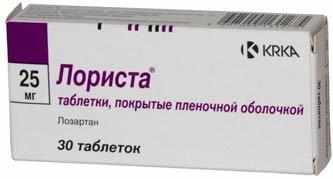 Lorista (instructions for use are attached to the product) is most often prescribed for severe arterial hypertension in a patient, as well as frequent surges in blood pressure.
Also, this remedy is often used to treat patients with left ventricular hypertrophywho are prone to developing a stroke. Another important indication is chronic heart failure a patient who does not improve even after combination therapy with ACE inhibitors.
Less often, Lorista (the instruction has a detailed description of dosage and administration) is prescribed for kidney protectorate in patients with diabetes mellitus. The purpose of the appointment is to reduce kidney damage and reduce the risk of an increase in the level of creatinine in human blood.
Contraindications are:
- Individual intolerance by the patient to the active substance or auxiliary components (allergy to them).
- Children's age of the patient (up to eighteen years old).
- The period of pregnancy and breastfeeding.
- Severe hyperkalemia.
- Reduced blood pressure.
- Impaired glucose absorption in the patient.
Moreover, it should be taken with caution in acute or chronic renal failure, severe hepatic failure and reduced blood circulation.
Also, only under the supervision of a doctor, Lorista can be treated with stenosis of the arteries in the patient, as well as the only kidney.
As shown by the results of studies and statistics of patients, the drug is well tolerated and rarely causes side effects. Despite this, in some cases, it can provoke complications from admission.
In the hematopoietic system, side effects can occur in the form of anemia and thrombocytopenia.
In the skin, disorders can develop in the form of adverse reactions, which will manifest as rash, itching, edema and urticaria.
Dizziness and headache are most often observed in the nervous system. Less commonly, sleep disturbances, drowsiness and memory impairment occur. Very rarely there is tremor of the limbs, depressive conditions, tinnitus, impaired taste and vision.
From the side of the cardiovascular system, it is possible increased heart rate, tachycardia, angina pectoris, bradycardia. This is usually observed with an overdose.
In the renal and genitourinary system, there are frequent urge to urinate, the development of infection and impaired renal function. Men may experience impotence.
Lorista, whose side effects have been monitored by scientists, in the respiratory system can cause coughing and infection in the upper respiratory tract. Less commonly, swelling of the nasal mucosa and bronchitis develops.
 The most common side effects affect the digestive system. In this case, the person may experience nausea and vomiting. Diarrhea, indigestion, abdominal pain and indigestion are also common. Less commonly, dry mouth, flatulence, exacerbation of ulcers, gastritis, hepatitis and constipation are observed. Deterioration of the liver is very rare.
In the musculoskeletal system, side effects can occur in the form of cramps, muscle pain, back and chest pain. Less commonly, arthritis worsens.
Additional possible side effects include gout and loss of consciousness.
In patients with a reduced volume of blood circulation in the body, arterial hypotension or a sharp decrease in pressure may develop.
In patients with liver cirrhosis, an increase in the concentration of the active substance in the blood is observed.
In patients with impaired renal function, as well as with diabetes mellitus, hyperglycemia may occur. The attending physician should definitely pay attention to this condition.
As for the possibility of the drug's influence on a person's reaction (when driving a car), this information is currently not available.
In case of an overdose, the patient may develop unwanted side effects in the form of tachycardia, increased heart rate and nausea. Treatment is carried out based on the observed symptoms in a hospital setting.
Lorista tablets for pressure: dosage and use for various diseases
Lorista tablets are intended for oral administration. It is desirable that general therapy with them took place in a hospital under close medical supervision. This is especially true for the treatment of patients with chronic diseases, vascular diseases and acute hypertension.
Lorista pressure tablets can be taken regardless of food intake, since it does not affect their absorption in any way.
With arterial hypertension, tablets should be taken at 50 mg per day. The maximum daily dosage is 100 mg. The duration of treatment is three weeks. If necessary, the attending physician can continue therapy for another couple of weeks.

For patients with impaired renal function and the elderly, dosage adjustment is not required.
In chronic heart failure, it is recommended to take 25 mg per day. The duration of treatment is three weeks.
In diabetes mellitus, the recommended dose is 50 mg to 100 mg per day. The duration of treatment is determined by the attending physician for each individual patient on an individual basis, depending on the indications and the general condition of the patient.
Lorista N pressure pills should be taken
The maximum daily dose of Lorista N is 125 mg. In case of impaired renal function in a patient, the dosage may be reduced. Also, during treatment, such patients require constant monitoring of the state of the kidneys and liver.
Lorista ND tablets are prescribed to a patient in serious condition, with acute heart failure and severe hypertension, which the usual Lorista could not bring down.
The permissible daily dosage is two tablets per day.
For elderly patients, dosage adjustment is not required.
For patients with severely impaired liver and kidney function, the dosage can be reduced by half.
During the treatment of Lorista ND, the patient is advised to constantly monitor blood counts, as well as blood pressure. If necessary, the drug can be canceled and replaced with an analogue.
With the development of unwanted side effects, the patient's condition should be monitored by doctors. Further therapy is symptomatic.
Lorista tablets are contraindicated to use during the period of bearing a child, since today there is no exact information on the safety of the effect of the active substance in relation to the developing fetus and the general course pregnancy.
There is no evidence that Lorista's pressure pills will not inhibit the development of the unborn child, and will not harm a woman in this position.
It is especially undesirable to take Lorista tablets in the second and third trimesters of pregnancy, since it is then that the drug can have the most negative effect.
As for taking while breastfeeding, it is also highly undesirable, since scientists have not yet identified the safety of transfer and excretion of the active substance along with breast milk and possible risks to the newborn child. For this reason, it is better not to take risks and not practice Lorista therapy during pregnancy and breastfeeding.
If it is necessary to treat high blood pressure during pregnancy, the observing physician should select safer counterparts for the patient.

Lorista pressure tablets combine well enough with other medicines. At the same time, there were no undesirable reactions when Lorista was combined with anticoagulants and cimetidine.
With the simultaneous use of Lorista and drugs for inflammation, it is possible to reduce the action of antihypertensive substances.
When administered simultaneously with diuretics, the decrease in blood pressure indicators will be additive.
Also, this drug slightly enhances the therapeutic effect of diuretics.
Lorista's medicine: types and forms
 The medicine for the pressure of Lorista of the domestic manufacturer has three editions:
- Lorista traditional.
- Lorista N.
- Lorista ND.
Each of these drugs can be used for the same diseases for complex therapy. Despite this, they have some differences.
Lorista N medicine is a combined drug that has a pronounced antihypertensive therapeutic effect. Its main difference from the Lorista pressure medicine is that it contains twice the active substance, that is, it has a stronger therapeutic focus.
In medical practice, the drug Lorista N is prescribed at a high risk of developing cardiovascular diseases, stroke, and also in the event that the usual therapy with losartan did not have the desired therapeutic effect and the patient's condition did not has improved.
The excipients of the Lorista N drug are starch and lactose.
The medicine for pressure Lorista ND is recommended for use in the absence of a therapeutic effect from taking Lorista N. This form of the drug is even more concentrated, which is why it is stronger in relation to blood pressure. Indications and contraindications for Lorista ND are identical with other forms of this drug.
Lorista drug: analogues and price
 The oral drug from Lorista pressure improves blood circulation in the body, especially in the peripheral vessels, also resists high blood pressure, normalizing it.
The pressure agent has the following analogues:
- The most commonly used drugs are Cozaar, Lotor and Losartan potassium.
- Less often, instead of the drug Lorista, Presartan, Blocktran and Renicard are prescribed.
You can buy a drug for Lorista's pressure at the pharmacy. On average, the price of a tablet is 150 rubles. Also, this cost may vary based on dosage and place of sale.
In order to better understand the effectiveness of using the drug against Lorista pressure, we present the reviews of those patients who have already tried it on themselves.
Anna:
“I have been suffering from hypertension for a long time and have already taken many medications. So far, this medicine is the best of them, since it is able to very quickly lower blood pressure and normalize my condition. I also like the fact that they do not cause me serious side effects. "
Nikolay:
“I took Lorista for several weeks after a hypertensive crisis. After the course of treatment, my condition stabilized. Now, with every increase in blood pressure, I immediately drink such pills. The only thing I don't like is that they give me indigestion and diarrhea. "
Vitaly:
“The doctor prescribed me the drug Lorista, as I have chronic heart failure. In addition to the headache, unfortunately, I did not see any effect from the therapy. I will not accept any more, because it has much stronger counterparts. "
Partial use of site materials (no more than 30% of the content of the article) is allowed only with a hyperlink on www.med88.ru, full use of the article (more than 30% of the article content) is possible only with written permission edition.