CLC syndrome: what is it, causes, symptoms, treatment, prognosis
Heart disease is often fatal. The heart is the most important organ and any problems with it lead to disruption of the mechanism of the entire body system. Therefore, in this article, we would like to consider a condition such as CLC syndrome, which is increasingly being diagnosed in humans today.
Content
- What is CLC Syndrome?
- The mechanism of development of the CLC syndrome
- CLC Syndrome Causes
- Symptoms and Signs
- Diagnostics
- CLC Syndrome Treatment
- Prophylaxis
What is CLC Syndrome?
CLC syndrome (or short PQ interval syndrome, or Clerk-Levi-Cristesco syndrome) is a congenital heart disease that may be asymptomatic. When electric impulses in the heart are transmitted through additional pathways - this is called the syndrome of overexcitation of the ventricle, and so, the syndrome of CLC is one of the varieties of overexcitation of the ventricle of the heart.
The disease was named after the scientists who diagnosed the disease.
Why this disease occurs, no one knows for sure, it can be as a harmful effect on the fetus in prenatal age when the heart is laid, or a breakdown at the genetic level. The causes of the disease of the clc syndrome are still being studied.
The mechanism of development of the CLC syndrome
In the accumulation of nerve cells that are in the right atrium, under the influence of an impulse, the whole heart contracts. It is like a battery that continuously directs impulses directly to the muscle cells of the heart. Impulses along special pathways reach the atrium, thereby forcing it to contract. At this point, blood is poured into the ventricles of the heart.
On the border with the ventricles, nature has laid a filter called atrioventricular node it is needed so that the ventricles are completely filled with blood and contract no earlier than the atria. The impulse entering the filter is slower and therefore the ventricles contract a little later than the atria. After passing the filter, the impulse very quickly goes through the entire myocardium of both ventricles and their contraction occurs.
The result of this contraction is that blood from the ventricles is pushed into the aorta and pulmonary trunk. In order for the impulse to pass through the atrium, it needs the same amount of time as it passes through the filter and is 0.1 second. It follows from this that the total time it takes for the impulse to pass through the atrium and before the ventricular contraction is 0.2 seconds. On the electrocardiogram (ECG), this distance is indicated P-Q.
In people with CLC, pathways are laid in the heart from birth, impulses pass the filter and thus are not delayed. Then the time during which the impulse passes through the atria and ventricles is 0.11 seconds. These paths are called a bunch of james. So you can see that with the help of a cardiogram, doctors can see and identify a person who has this syndrome. Sometimes it happens that impulses to the ventricle go bypass routes, and return from it through a filter. Thus, a circle is formed through which the excitement circulates. In this formed circle, the impulse moves very quickly and the heart rate is out of order, there is ventricular tachycardia. In such cases, the patient complains of poor health and pain in the region of the heart, and the syndrome can be seen on the cardiogram.
Read also:Endothelial dysfunction
CLC Syndrome Causes
The reasons are not fully understood, and no one knows why during intrauterine development the heart is not laid correctly. Most often, clc syndrome occurs in men, out of 100 healthy people, only one person has a syndrome in which the P-Q value is shortened on the cardiogram.
Symptoms and Signs

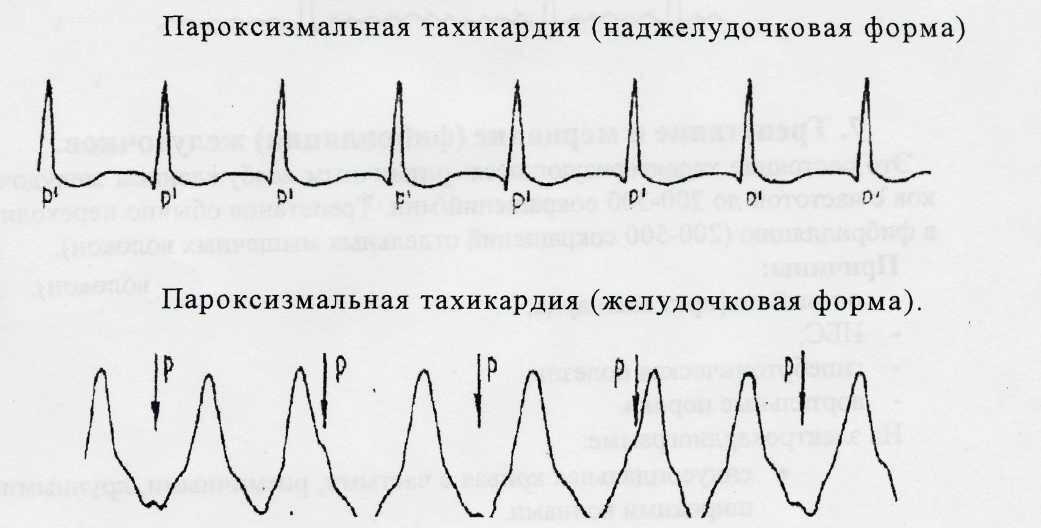
A person can live their whole life with CLC and not even be aware of the pathology of the heart. The CLC syndrome does not manifest itself in any way in the patient and does not affect the general state of health. The disease can manifest itself at any age as a consequence of the transfer of a viral disease or even start spontaneously. The disease can also develop intensively, then, the patient may feel sudden attacks of acceleration of the heartbeat, the so-called paroxysmal supraventricular tachycardia.
Paroxysmal supraventricular tachycardia manifests itself as a sudden acceleration of the heart rate from 150 to 210 beats per minute. Before the heart rate rises, the patient may feel a jolt in the chest or neck area. Such frequent attacks can pass with dizziness, an attack of nausea, and rarely fainting. Occasionally, there may be bloating, diarrhea, and vomiting. At the beginning of such arrhythmias or at the end, there may be frequent urge to urinate.
You can stop the attack with an onslaught when inhaling, if you lower your face into ice water and hold your breath, massaging the corotis sinus, which is located in the neck. Very rarely, the syndrome can be accompanied by such a manifestation as a non-rhythmic heartbeat.
Diagnostics
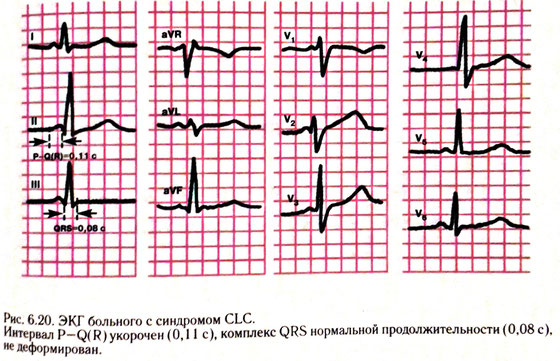
In order to diagnose clc syndrome in a patient, electrocardiography (ECG) must be done, as well as a daily cardiogram. In addition to these studies, patients with CLC are advised to undergo a transesophageal electrophysiologic cardiac examination.
The following signs can be seen on the ECG:
- Shortened PQ interval.
- P wave of normal shape.
- At the beginning of the QRS complex, auxiliary waves are formed.
- The initial part of the QRS and the auxiliary waves are directed in the same direction.
- The duration of the QRS complex depends on the duration of the delta waves.
- The longer the duration of the waves, the stronger the deformation of the QRS complex will be.
Read also:Sick sinus syndrome
To clarify the meanings and decoding, consult your cardiologist.
CLC Syndrome Treatment
Patients with this syndrome are prescribed symptomatic treatment. In case of arrhythmia attacks, it is recommended to dip your face in cold water and hold your breath or massage a special point on the neck. If these actions do not help, then need to call an ambulance. The emergency doctor will be able to remove the attack with the help of special drugs, such as sodium adesinophosphate, amiodarone and others, which are injected intramuscularly.
To stop tachycardia attacks only a doctor can, because some forms of tachycardia cannot be stopped with some drugs. Do not self-medicate, but call your doctor right away. After stopping an attack of arrhythmia, the patient is recommended to take a drug that helps to restore the heart rhythm. In the hospital, the heart rhythm can be restored using a special apparatus. This apparatus applies electrical impulses that stop the circular excitement described above.
If the attacks are repeated very often, which interferes with the daily work and the normal life of the patient, then the patient is offered surgical removal of the arrhythmia. The surgical intervention takes place through a special probe, which is inserted through the vessel. Such an operation is called radiofrequency catheter ablation.
Before carrying out such an intervention, the patient first undergoes an electrophysiological study. in order to find out where the additional path is located that conducts impulses bypassing filter. It must be remembered that each patient may have several workarounds for the impulse, then the operation becomes more complicated. If the accessory pathway is localized on the right side, then the catheter is inserted through the right femoral vein, and if from the left, then through the femoral artery. The operation is considered non-traumatic and the patient quickly recovers, returning to normal life.
One hundred percent recovery is observed in 96 percent of the operated patients. However, there are 1 percent for whom this operation does not bring results or ends in death. Only surgical treatment will be able to remove the problem of the syndrome forever and forget about tachycardia and rapid heart rate.
Read also:Sudden cardiac arrest
Prophylaxis
Patients with asymptomatic disease do not need special treatment. If the patient is tormented dyspnea, dizziness, nausea, then this is a reason to contact a cardiologist who will competently prescribe treatment and find out the reasons. Methods for the prevention of all heart diseases are:
- lose extra pounds;
- proper and balanced nutrition;
- give up all bad habits;
- healthy sleep lasting at least 8 hours a day;
- reduce salt intake;
- more fresh air;
- avoid stressful situations.
With an asymptomatic course of the disease, a person can live his whole life and not even suspect that such a syndrome is present. In rare cases, this syndrome is fatal. In any case, at the first manifestations, you need to contact a competent doctor to receive treatment and then your life will be safe.
CLC can lead to a number of complications and be exacerbated by heart disease: tachycardia, sudden cardiac death and the death of the patient.