Heart rate: norm by age, table
Heart rate is a term that provides for the number of contractions of the heart muscle per unit of time, most often in 1 minute
Content
- Heart rate rate - what doctors say.
- When does the heart rate change and what does it depend on?
- Heart rate rate by age table
- How to measure heart rate?
- If the pulse is elevated - what does it mean?
- Heart palpitations - what is the reason?
- Bradycardia - what is it and what does it mean?
Heart rate rate - what doctors say.
If we talk about heart rate, the norm in adults depends on many factors, but doctors have prescribed their own indicators - these are 60 - 80 beats per minute. With indicators below the level of 60 beats, bradycardia is diagnosed, but if these indicators are above 80 beats per minute, a diagnosis is made tachycardia of the heart.
But such indicators of heart rate are normally calculated in adults based on the fact that a person is in a calm state. But the numbers can constantly change in their indicators - it depends on age and gender, body parameters and how trained a person is.
When does the heart rate change and what does it depend on?
Heart rate indicators can vary from various factors, even from the time of day - throughout the day, the numbers can change from such factors:
- during physical exertion and at the moment of anger, fear, experiencing other positive or negative emotions;
- depending on the position of the body, when the patient is sitting or standing in a tense or relaxed state;
- after a meal, especially one rich in proteins or hot spices, or taking certain medications;
For example, with an increase in body temperature, even up to 37 degrees - Heart rate increased by 20 strokeswhen you sleep - on the contrary, it decreases by 5-6 unitsif you are sitting - by 10 percent. As doctors note, the amazing thing in the human body is that the baby heart rate there is 140 beats per minute, while in an adult, this is already a pathological deviation from the norm, a failure in the rhythm of the heart, the development of tachycardia.
Heart rate rate by age table
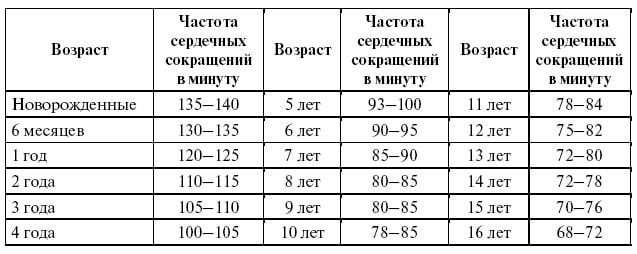
Doctors have compiled a table that provides its own rates of heart rate - it is formed by age and taking into account gender. Such indicators are as follows:
- in a newborn, this indicator varies at the level of 120-140 beats per minute, in a premature baby, the indicators are slightly higher - 140-160 beats;
- up to a year, these indicators are 110-120 beats in a baby. /мин.;
- by the age of 5, the indicators decrease by 100 beats, and by 10 - up to 90 beats. /мин.;
- at 13 - 16 years old, these indicators vary from 68 to 72;
Read also:Heart murmur
So the heart rate indicators in women are 6 beats more than in the strong half of humanity and is still increasing in period of menstruation.
How to measure heart rate?
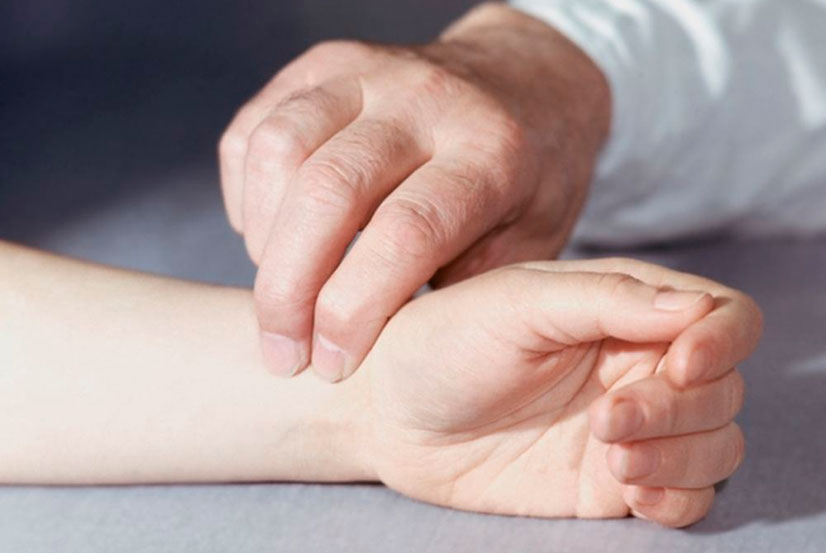
The heart rate is necessarily measured in a patient who is at rest, in a quiet and warm room. To get accurate data by measuring heart rate, you need to invite an assistant in advance and prepare a stopwatch - an hour before the procedure, you should stop any stress, calm down, do not smoke and take any medications, drink alcohol.
First of all, the patient is seated or put in a position convenient for him, in which the heart rate will be measured - in such a calm position costs 5-6 minutes lie down or sit. Next, the assistant puts his palm to the area of the left nipple of the man's breast and under the left breast of the woman.
After that, the countdown beat in the apex of the heart is determined - this is the so-called upper impulse and is heard in the 5th intercostal space, if the person is in a standing position. When it is not possible to determine it, it means that it falls on the region of the edge. Next, a stopwatch is taken in hand and the beats of the heart muscle are counted for a minute, but if the rhythm of the heart is incorrect - such a calculation is carried out for 3 minutes, after the obtained indicators are divided by 3.
As the doctors themselves note, it is possible to measure heart rate indicators in other places on the body, where large arteries are as close as possible to the skin surface. In particular, the arteries are perfectly palpable and, accordingly, it is possible to accurately determine the region of the neck, closer to the auricle, under the collarbone, as well as at the temple, on the shoulder or thigh. To get accurate and reliable results, the heart rate should be calculated on both sides of the body.
If the pulse is elevated - what does it mean?
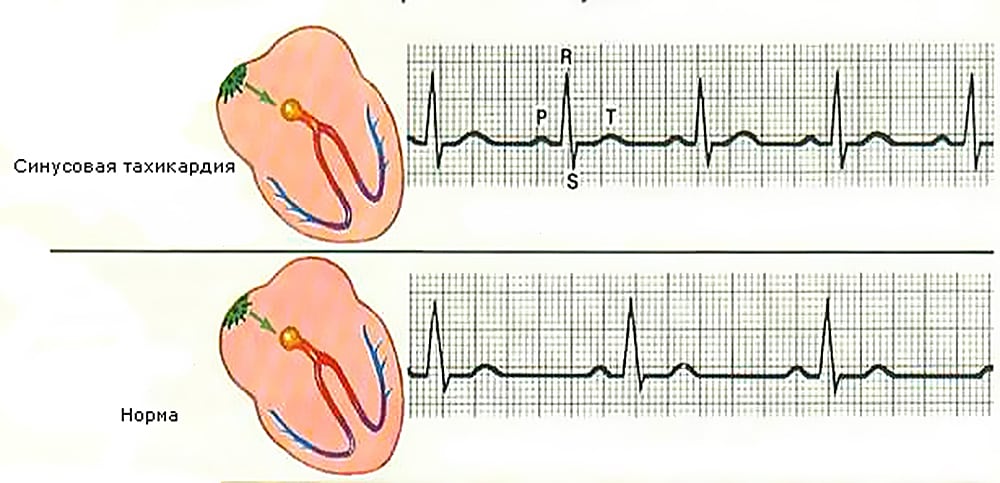
The growth and increase in the number of heart contractions, and therefore an increase in the number of beat pulse waves, will be recorded due to certain processes occurring in the body, physiological or pathological, emotional.
In particular, such processes are the influence of sports and excessive physical exertion, emotional changes, fear and joy, weather conditions and changes in heat and cold, bouts of severe pain.
Read also:Syndrome (disease) Marfan
With an increased heart rate, which does not stop some time after the provoking factor, doctors diagnose tachycardia. If there is a negative symptomatology of such a pathology as tachycardia, this may indicate the course of the following deviations and pathological changes in the body:
- heart problems and vascular diseases - arrhythmia and ischemia, vice and so on;
- the course of nervous diseases and neoplasms, which are both malignant and benign;
- during the course of the infectious process and fever in the body, with deviations in the hormonal background;
- in the case of anemia or prolonged uterine bleeding.
An insignificant increase in the heart rate level in its indicators is characteristic of all pregnant women, although signs of a functional type of tachycardia were also noted in small children. In particular, cardiopalmus is the norm for active people and athletes - their heart muscle and body are already adapted to such overloads and conditions.
If such symptomatology manifests itself in adolescence, it is worth paying special attention to, since in this transitional period, a vegetative type of cardiac destruction can develop.
Anyway - at the slightest suspicion of a deviation in the norm, pain in the sternum, the manifestation of shortness of breath and attacks of dizziness, it is recommended to visit a narrow-profile specialist.
The development of tachycardia in a patient will be indicated by such symptoms that are unusual for a healthy patient:
- frequent attacks of dizziness and lightheadedness, frequent fainting - this may indicate a failure in the cerebral blood flow;
- pain localized in the sternum, which develops due to a failure in the blood flow of the coronary type;
- decreased visual acuity and visual hallucinations, as well as frequent attacks of shortness of breath - this may indicate a violation in the small circle of blood flow;
- excessive sweating and a feeling of weakness, tremor of the extremities - manifestations of autonomic symptoms;
Heart palpitations - what is the reason?
In some patients, not only an increase in heart rate indicators can be diagnosed, but also an increased heart rate. The reasons for this unpleasant phenomenon are:
- pathologies at work, the structure of the heart and vascular system - congenital defects of the heart muscle and valves, hypertension, cardiosclerosis;
- food poisoning or poisonous chemicals, poisonous vapors and chronic diseases affecting the patient's respiratory system;
- hypoxia and hypokalemia;
- failure in the hormonal system and neurocirculatory type of dystonia (NCD);
- disorders of the central nervous system and oncology, inflammation accompanied by fever.
Many patients equate the terms - a rapid pulse in its rhythm and an excessive heartbeat. But this is not always correct, since these concepts do not always touch and accompany one another.
For example, with a certain condition of the patient, with flickering or extrasystole, the heart rate will exceed the pulse rate - we are talking about pulse dysfunction.
Such a pathology is accompanied by a terminal rhythm disturbance in a severe form of damage to the heart muscle, the root cause of which could be an electric shock or myocardial infarction, another pathology affecting the heart muscle.
Read also:Couperosis on the face: causes and treatment
Bradycardia - what is it and what does it mean?
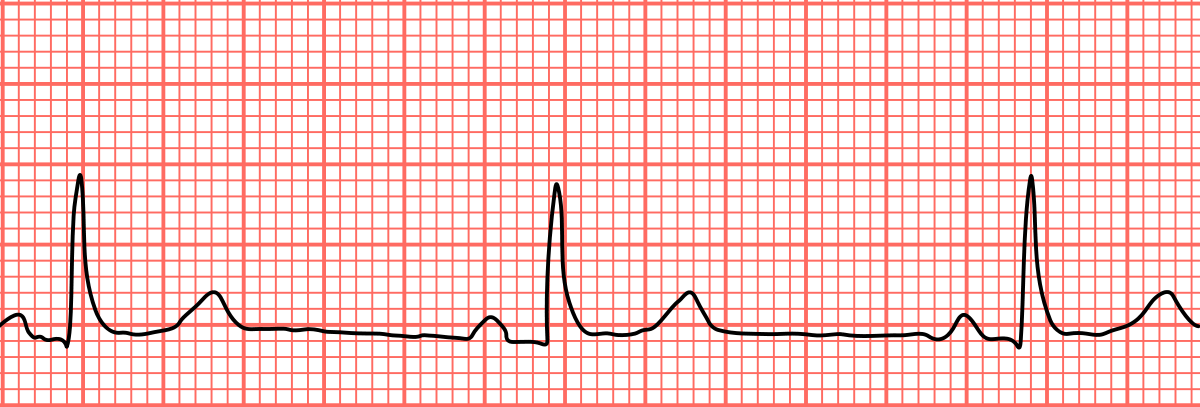
In addition to the development of an increased heart rate and the development of tachycardia, the patient can be diagnosed with low heart rate indicators - the development of bradycardia. Exactly bradycardia characterized by lowered indicators of the level and frequency of contraction of the heart muscle - the very genesis of pathology due to many pathological abnormalities and functional failures in the work of the body, internal organs and systems.
In particular, functional deviations are caused by such physiological processes as sleep and professional sports.
As practice shows - in athletes, the frequency of CC can reach, in certain cases, it can decrease to a level of 35 beats per minute, although such indicators can be diagnosed after taking certain medicines. In the latter case, doctors diagnose the development of a medication type of bradycardia.
If we talk about the pathological type of genesis, the disease can manifest itself as a consequence:
- malfunction of the vascular system and heart muscle;
- age-related negative changes in the body;
- inflammatory process in the tissues of the heart muscle;
In this case, the bradycardia is due to sinus block - the inability to produce electrical atrial impulse and the so-called sinus node. As a result, hypoxia develops, affecting tissues due to poor blood flow. Among the most common pathologies that provoke the development of bradycardia are:
- hypothyroidism or hypothyroid coma - it's myxedema;
- ulcerative form defects in the ventricle of the heart muscle;
- intracranial hypertension;
As the doctors themselves note, with a significant decrease in heart rate indicators, when they are less than 40 beats per minute, then bradycardia can provoke heart failure.
Concomitant symptoms, which indicate the development of this pathology, are dizziness and fainting, or lightheadedness, excessive sweating and pressure surges.
In conclusion, it should be said that with age, the human body does not get younger, and at the first manifestations of negative symptoms, it is worth visiting a doctor and being examined.