XYY syndrome: what is it, causes, symptoms (photo), treatment
Content
- What is XYY Syndrome?
- Signs and symptoms of XYY syndrome
- Causes of the XYY syndrome
- Similar disorders
- Diagnostics of the XYY syndrome
- XYY Syndrome Treatment
What is XYY Syndrome?
XYY–syndrome (or also referred to as YY syndrome or Jacobs Syndrome) Is a rare chromosomal disorder that affects men. The syndrome is caused by the presence of an additional Y-chromosome. Males usually have one X and one Y chromosome. However, people with this syndrome have one X and two Y chromosomes.
It is estimated that the disease affects approximately 1 in 1000 live births.
Affected people are usually very tall. Many people experience severe difficulty with acne during adolescence. Additional symptoms may include learning disabilities and behavioral problems such as impulsivity. Intelligence is usually in the normal range, although IQ is on average 10-15 points lower than that of siblings.
There have been many misconceptions about this disease in the past. It was sometimes called the male disease because it was believed that men with the syndrome were overly aggressive and lacking in empathy. Recent research has shown that this is not the case. Although people with XYY syndrome have an increased risk of learning disabilities and behavioral problems, they are not overly aggressive and are not at increased risk of any serious mental illness diseases.
Because sick boys are at a higher risk of learning disabilities, speech therapy, tutoring, and a general understanding of the specific problems they face may be helpful. Although the early years of school can be more challenging for boys with XYY, they usually lead full, healthy and normal lives.
Signs and symptoms of XYY syndrome
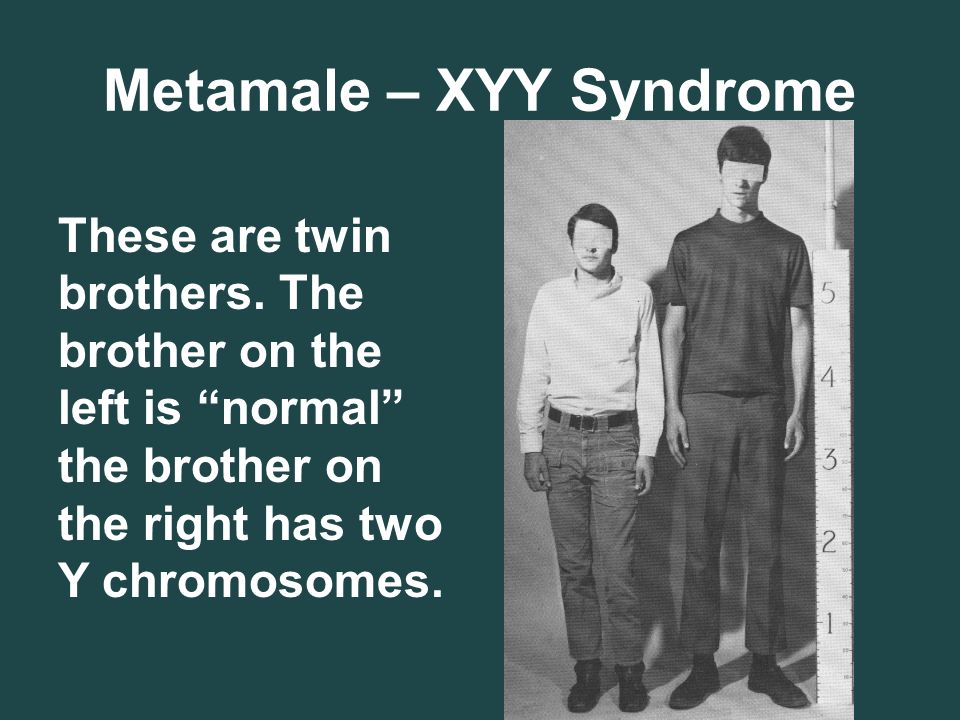
The clinical signs of XYY syndrome are often subtle and do not necessarily suggest a serious chromosomal disorder. Accordingly, men with this condition are often either not diagnosed with the syndrome or diagnosed with the wrong pathology.
The most common physical symptom is an increase in height that usually appears after 5 or 6 years of age and results in an average of about 6 feet and 3 inches in adulthood (see illustration). photo above).
Read also:Acetone in the urine of a child (acetonuria in children): what to do, causes, symptoms, treatment

Some people with XYY syndrome also develop severe cystic acne during adolescence. Fertility and sexual development are normal. In addition to the potential for increased height, most affected people usually have a normal appearance (phenotype).
Boys with Jacobs Syndrome usually have normal intelligence, although the average IQ is 10-15 points lower than that of his siblings. Affected boys may have slight delays in reaching milestones. Learning problems were reported in 50% of cases, most often with speech delays and language problems. Reading problems are common due to the increased incidence of dyslexia.
In some cases in affected people behavioral problems developsuch as explosive temperament, hyperactivity, impulsivity, provocative or, in some cases, antisocial behavior.
There is a higher level attention deficit hyperactivity disorder and less increased risk of developing autism spectrum disorders.
Causes of the XYY syndrome
XYY syndrome is a rare chromosomal disorder caused by an extra Y chromosome. Usually males have 46 chromosomes, including one X and one Y chromosome. Men with XYY syndrome have 47 chromosomes, two of which are Y chromosomes.
Most cases of XYY syndrome are associated with cell division errors in sperm prior to conception. Rarely, a cell division error occurs after conception, resulting in a mosaic of cells with 46 chromosomes and 47 chromosomes.
The exact reason why these errors in cell division occur is not clear.
Similar disorders
Symptoms of the following disorders may be similar to those of XYY syndrome. Comparisons can be useful for differential diagnosis:
Klinefelter's syndrome associated with a group of chromosomal abnormalities in males in which one or more additional X chromosomes are present. Men with the classic form of the disorder have one extra X chromosome. Men with various forms of Klinefelter syndrome have additional X and / or Y chromosomes. The extra X and / or Y chromosome can affect physical, developmental, behavioral, and cognitive functioning.
Read also:Edwards syndrome - causes, symptoms, diagnosis and treatment
Common physical features may include tall stature, no secondary pubertal development, small testicles (hypogonadism), delayed pubertal development and breast enlargement (gynecomastia) at the end of puberty. These features may be associated with low testosterone levels and elevated gonadotropin levels.
Sotos syndrome (Cerebral Gigantism Syndrome) is a variable genetic disorder characterized by overgrowth before and after birth. One of the main features of Sotos syndrome is a distinct facial appearance, which includes facial flushing, an abnormally pronounced forehead, downward tilted eyelids, a protruding narrow jaw, a long narrow face and a head shape similar to inverted pear.

Most children with Sotos syndrome have developmental delays, which can include movement and language delays, as well as mild to severe mental retardation. Other problems associated with Sotos syndrome include jaundice in newborns, a curved spine (scoliosis), epilepsy, strabismus, conductive hearing loss, congenital heart defects, renal impairment, and behavioral problems. Affected people also have a slightly increased risk of developing certain types of tumors.
Sotos syndrome is caused by an abnormality (mutation) in the NSD1 gene.
Marfan syndrome - a genetic disease that affects connective tissue, which is the material between the cells of the body that gives the tissues shape and strength. Connective tissue is found throughout the body, and many organ systems can be affected in people with Marfan syndrome. Most often, the cardiovascular system, skeletal and ocular systems are affected.

The main symptoms include excessive growth of the bones of the arms and legs, abnormal curvature of the spine from side to side (scoliosis (see. photo)), depression or protrusion of the chest wall, dislocation of the lenses of the eyes (displacement of the lens of the eye), myopia, enlargement (aneurysm) and rupture (dissection) of the main artery that carries blood from the heart (aorta), prolapse mitral valve and reverse blood flow through the aortic and mitral valves (aortic and mitral regurgitation).
Read also:Symptoms and treatment of laryngitis in children
The specific symptoms and severity of Marfan syndrome vary greatly from case to case. Marfan syndrome is inherited as an autosomal dominant trait.
Defects or abnormalities (mutations) in the fibrillin-1 (FBN1) gene are associated with Marfan syndrome and related disorders.
Diagnostics of the XYY syndrome
Diagnosis of XYY syndrome is based on careful clinical evaluation, detailed medical history, and specific tests (i.e. e. chromosome analysis), which reveal the presence of an additional Y chromosome (47, XYY karyotype).
The diagnosis of XYY syndrome can be made before birth (in utero) with amniocentesis or chorionic villus sampling. During amniocentesis, a sample of fluid that surrounds the developing fetus is removed and analyzed, while chorionic villus sampling involves removing tissue samples from parts of the placenta. Chromosomal studies performed on such fluid or tissue samples may reveal the presence of an additional Y chromosome.
— Clinical testing and examination
Speech and language assessments should be completed within the first 24 months. Reading assessment should be done at school age to avoid dyslexia. Behavioral assessment should be considered for children who have difficulty with symptoms such as impulsivity and poor focus.
XYY Syndrome Treatment
Treatment for XYY syndrome is symptomatic and supportive. Speech therapy, occupational therapy, or learning assistance may be helpful.
In most cases, affected people are very responsive to early intervention and treatment, and problems can be completely resolved within a few years.
Treating acne can help the sufferer with self-esteem.
Attention deficit and hyperactivity, difficulty with social interaction, or other behavioral problems can be treated with therapy or medication in the same way as people who do not have XYY.