Shoulder-scapular periarthritis: causes, symptoms and treatment
Content
- What is periarthritis of the shoulder scapula?
- ICD-10 code
- Causes of the humeral scapular periarthritis
- Symptoms of the humeral scapular periarthritis
- Stages of humeroscapular periarthritis
- Diagnostics
- Treatment of humeral scapular periarthritis
- Drug treatment
- Physiotherapy
- Exercises
- Surgery
- Prophylaxis
- Related Videos
What is periarthritis of the shoulder scapula?
Shoulder-scapular periarthritis is a disease during which processes based on inflammation in the tendons and shoulder joint capsules. Affects the soft periarticular tissues, causes pain and blocks the functionality of the joint.
Despite the prevalence of symptoms, and even if it is the shoulder-scapular pain that is felt, periarthritis is sufficient rare, diagnosed in 10% of patients, and in 80% of those who seek medical help, the cause of this ailment is arthrosis of the shoulder joints.
There are also the names "consulite" and "frozen shoulder syndrome". It is observed in every fourth person, as a rule, after injuries, bruises, blows, severe overload, often occurs in loaders and those who actively raise the barbell. The risk of pathology is also often found in those patients who have had problems with the cervical vertebrae, with the transfer
myocardial infarction or operable intervention in the work of the mammary glands, with liver diseases.ICD-10 code
In the tenth revision of the ICD, periarthritis of the humerus was not included in the list of nosological units and is not an official diagnosis.
Pathology is under the code M75.0 adhesive capsulitis of the shoulder (implies total damage to the capsule of the shoulder joint) - this is the most approximate definition of joint pathology.
Previously, periarthritis of the shoulder joint implied damage to the joint and a number of located tissues, the cause of which was not acute trauma.
Causes of the humeral scapular periarthritis
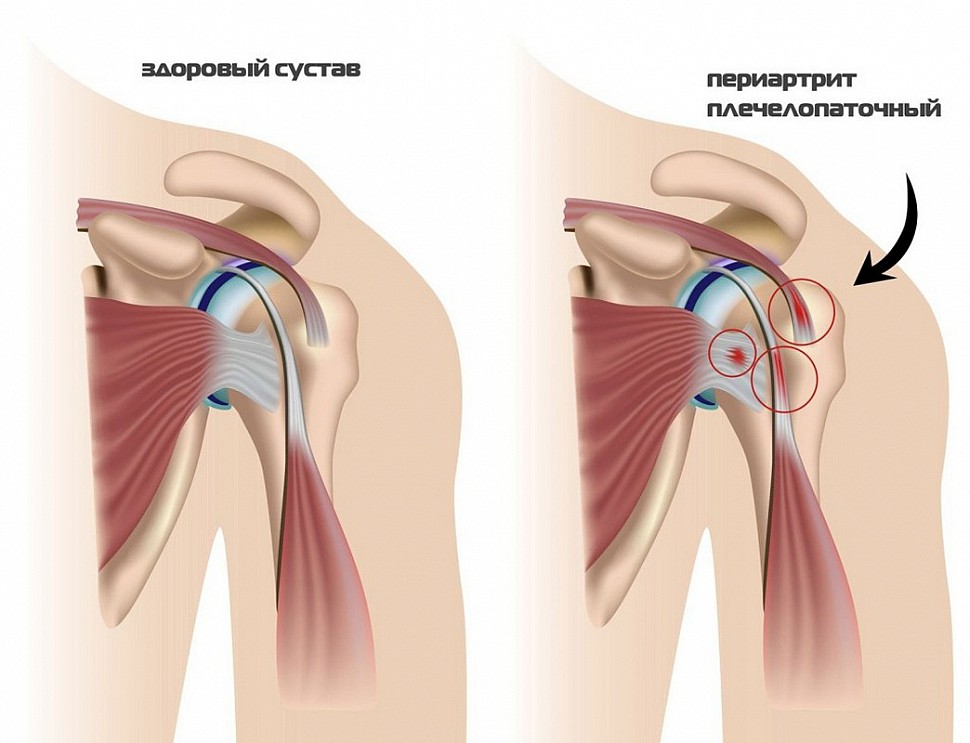
Both men and women face the problem of the appearance of humeroscapular periarthritis, but few people know what kind of disease it is. Moreover, some people need strong loads for diseases of the joints, and it is enough for someone to overload themselves, all the signs are individual. But you can identify the main causes of the disease.
Since pain comes "with a delay", many patients find it difficult to remember what could have led to the disease. However, the main reasons are most often overexertion or unusual activity for the joints. This can be carrying a too heavy cabinet or hours of painting.
Diseases of internal organs that have been forgotten. So, for example, after a myocardial infarction, left-sided periarthritis may appear, since this transferred disease is associated with the death of blood vessels, and not one, but whole groups. This blocks the blood flow to the shoulder. Tendons become exhausted and begin to break. Spasms and inflammation complete the process and give rise to painful sensations.
For the same reason liver disease can provoke periarthritis in the right shoulder. There are also many vessels in the liver that are responsible for blood circulation in the body, therefore, disruption of their work can cause right-sided periarthritis.
Women who have had their mammary glands removed often suffer from this ailment. The operation affects the blood flow in the thoracic region, not all vessels are sutured and fused so that after the intervention they work like new ones. This is what makes it difficult for blood to flow, and worsens the condition of the joints.
Symptoms of the humeral scapular periarthritis
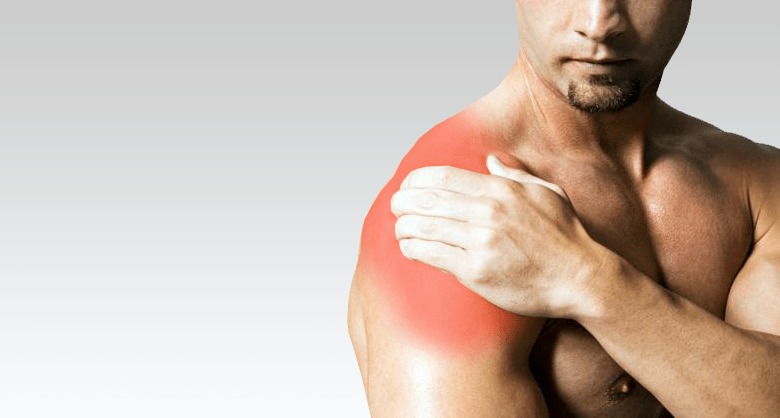
With periarthritis, the joint and cartilage remain intact. This is its uniqueness in contrast to arthrosis or arthritis. The main indicator of the disease is excessive stress, which will manifest itself in 5-7 days in the form of the following symptoms:
- sharply begins to hurt in the cervical spine, pulls the shoulder or the muscles of the arm are acutely felt;
- at night, when the body is most relaxed, the pain becomes stronger;
- circular movements bring more pain than manipulating the hand back and forth in the same plane;
- the shoulder may swell a little;
- due to the inflammation in the body, the overall body temperature may rise slightly, up to 37.5.
Read also:Ankylosing spondylitis
As with many diseases, if you delay the visit to the doctor, you can very quickly go from the initial form of the disease to the chronic form.
Stages of humeroscapular periarthritis
This disease does not stand out as an independent section, due to the fact that there are many reasons for its appearance.
Doctors classify humeroscapular periarthritis according to several characteristics:
- simple - when the shoulder begins to hurt, this is the first stage, during which it is necessary to actively engage and monitor the disease in order to prevent its transition to the next stages;
- spicy - all interventions take place exclusively at the suggestion of the attending physician;
- chronic - he is ankylosing periarthritis, "blocked" or "frozen" shoulder.
It is important not to start the disease until a stage that is easy to cure has passed into a stage that is much more difficult to deal with. The pathology of humeroscapular periarthritis is more common in unilateral form, rarely, but it occurs, bilateral humeral periarthritis.
Diagnostics
The first who can say whether there is a disease or not, at what stage and how to treat periarthritis of the shoulder scapula is a rheumatologist and arthrologist. With a personal examination of the patient, they will be able to assess the ailment by the nature of the pain and blocking of movements.
Competent doctors can diagnose periarthritis without images and tests, but there are ambiguous situations in which only additional tests can help to understand the disease.
With humeroscapular periarthritis, the following studies are performed:
- magnetic resonance imaging (MRI) or computed tomography (CT) - identify the disease and their nature of the course more qualitatively and in more detail than other analyzes and devices. Today, these are the highest priority diagnostic methods, they help to quickly identify and begin to treat periarthritis of the shoulder scapula;
- shoulder x-ray - microcrystals of calcium in the shoulder are clearly visible on x-rays. They accumulate where the joint and scapula are held together, interfering with normal arm movement. Since at this stage rotation is already difficult, it is far from the first and not the easiest to treat;
- blood analysis - in the blood of patients in whom the disease has turned into an acute form, the level of ESR (sedimentation rate of erythrocytes) and C-reactive protein increased.
Read also:Juvenile rheumatoid arthritis in children: causes, symptoms, methods of diagnosis and treatment, prognosis for the future
Treatment of humeral scapular periarthritis
Preventive treatment is medication and begins with steroid-free drugs that stop inflammation. In a simple stage, this is quite enough to not only stop the development, but also get rid of the disease.
Drug treatment

Medication for almost any inflammation of the shoulder joint is the use of pain relievers and anti-inflammatory drugs.
Among them is a group of non-steroidal antirheumatic drugs, such as acetylsalicylic acid, diclofenac, or ibuprofen.
Medicines can be taken orally or intramuscularly (in acute cases). In addition, sometimes, if oral treatment is ineffective, local infiltrations may be chosen: the injection is injected into the shoulder joint local anesthetics and sustained-release corticosteroids.
This measure is aimed rather at relieving pain, and in most cases it copes with this, but you should not expect a complete recovery.
To make the injections more beneficial, doctors advise doing them in parallel with post-isometric relaxation and special exercises that can be performed independently at home with the permission of the doctor. They help to make the joint capsule more mobile and, in combination with medications, often contribute to the complete recovery of the patient.
Physiotherapy
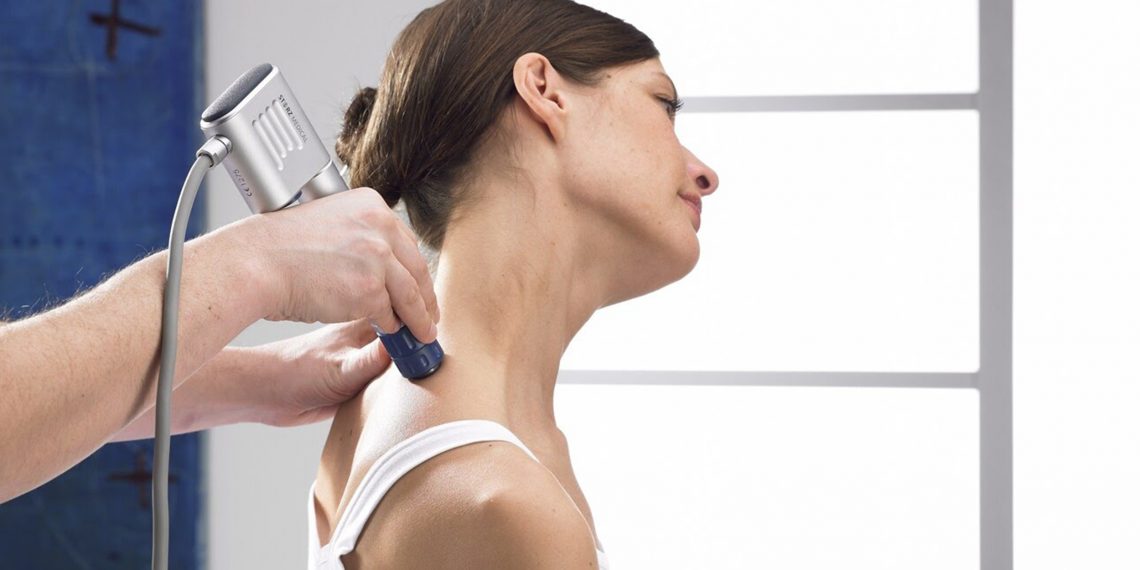
The therapeutic use of physical aids is indicated in most diagnoses associated with shoulder inflammation. It consists of: electrotherapy, RF, thermal procedures.
In physical therapy, it is important not to overload the affected shoulder or perform inappropriate movements. In addition, there are many other procedures, such as acupuncture or shock wave therapy (SWT), that can help to a greater or lesser extent with treatment.
On a note! Shockwave therapy creates an impulse vibration using a sound wave generated by the machine. It is directed to the lesion focus, it normalizes blood circulation, stimulates the regenerative processes of dense tissues, and improves the nutrition of perivascular tissues. Usually, after 5-7 procedures, positive results are visible.
PIR, or post-isometric relaxation, for periarthritis of the shoulder scapula also works very well with treatment and prevention. Most patients are 10 courses are enough.
To recover faster, it is good to combine therapy courses with therapeutic massage. Manual and laser therapy are also helpful. Post-isometric relaxation is more beneficial if it is started within a few days after the periarticular injection of corticosteroid hormones.
Read also:Scleroderma in adults
Also, doctors sometimes prescribe hirudotherapy, leech therapy, which helps patients. This type of treatment has one significant drawback noted by many doctors. In patients suffering from this particular type of disease, leeches often provoke signs of an allergic reaction.
In general, it is almost always possible to cure periarthritis, the most difficult is with the stage of "frozen shoulder", here the chances are significantly reduced. First, they eliminate the problem due to which the disease arose. For example, if the vertebrae in the neck have shifted, their position needs to be corrected by manual therapy.
Exercises
Unlike massage, which should be carried out by a specialist, because it is important not to pinch the joints and influence on them with special strength, physiotherapy exercises can be done at home on their own, here are some of the useful exercises:
Surgery
In cases of shoulder inflammation, surgery is usually not required. But in some cases, the degree of injury or the cause of the inflammation of the shoulder joint requires surgery to finally resolve the patient's problem. Even if symptoms do not improve for at least six months or worsen, despite adequate and continuous treatment, surgery may be required.
However, open surgery is currently performed less due to arthroscopy (minimally invasive surgical procedure). Therefore, open shoulder surgery in cases of inflammation becomes less necessary.
Prophylaxis
In principle, inflammation of the shoulder joint cannot be prevented in advance, however, it is possible to prevent the stage of "frozen shoulder" or "frozen shoulder syndrome". Since most of the time this condition is caused by shoulder pain, the arm should be protected and not overstrained. As soon as the first symptoms or signs of inflammation in the shoulder joint appear, you should consult a doctor, as the effectiveness of treatment will be greater.
If the joint is suddenly ill, after those activities that did not foreshadow the disease, you need to urgently consult a doctor, do not hide the symptoms and start treatment immediately.
The doctor will help diagnose the disease at an early stage, which means it will be easier for him to choose the most loyal treatment for the body. Treatment of periarthritis in the early stages is possible. The main thing is not to start the disease, not to be lazy to do therapeutic exercises and carefully monitor your health.