Lyme disease: what it is, causes, symptoms, treatment
Content
- What is Lyme disease?
- Causes and risk factors
- Symptoms and Signs
- Diagnostics
- Treatment
- Prophylaxis
What is Lyme disease?
Lyme disease (tick-borne borreliosis) Is a pathology of bacterial origin that mainly affects the skin, but internal organs, joints and the nervous system are also often affected.
The disease belongs to the group of anthropozoonoses or to the group of diseases that are naturally transmitted by vertebrates to humans. In this particular case, disease transmission is not direct but insect-mediated.
Vector of infection - a tick that becomes infected after being bitten by a sick animal and transmits the infection to people with the bite.
Most often they get sick in summer and early autumn. Most often, children and young people who live in wooded areas are infected.
Causes and risk factors
Lyme disease is considered a multisystem disease mainly caused by a spiral beating known as Borrelia burgdorferi. This spirochete was identified as the causative agent of Lyme disease only in 1982, thanks to research by a biologist from Montana, Dr. Burgdorfer (who owns the name).
Lyme disease is also known as tick-borne borreliosis.
- Disease transmission.
Lyme disease is not spread to humans directly these bacteria: in fact, the bacterium infects the ticks, which, in turn, through the bite, can transmit the infection to humans and other animals.
Many mammals (eg deer, hedgehogs), birds and rodents are ideal reservoirs for replication.
- People most susceptible to the disease.Risk categories include people in contact with wildlife, security guards, foresters, veterinarians and tourists.
The bacteria that cause Lyme disease are transmitted to humans by the bite of an infected tick, when a sucked tick remains on the skin for more than 36 hours. Short periods of attachment rarely result in disease transmission.
First, bacteria multiply in the area around tick bite. After 3–32 days, bacteria migrate from the site of the bite to the surrounding skin, causing a rash called erythema migrans. The bacteria can enter the lymphatic system and infect the lymph nodes. Alternatively, bacteria can enter the bloodstream and spread to other organs, such as the skin of other parts of the body, the heart, nervous system, and joints.
Infection Borrelia burgdorferi does not give immunity, so Lyme disease can be infected several times in a lifetime.
Symptoms and Signs
Lyme disease has three stages:
- Early localized;
- Early disseminated (widespread);
- Late.
The early and late stages of Lyme disease are usually separated by an asymptomatic period.
- Early localized stage of Lyme disease.
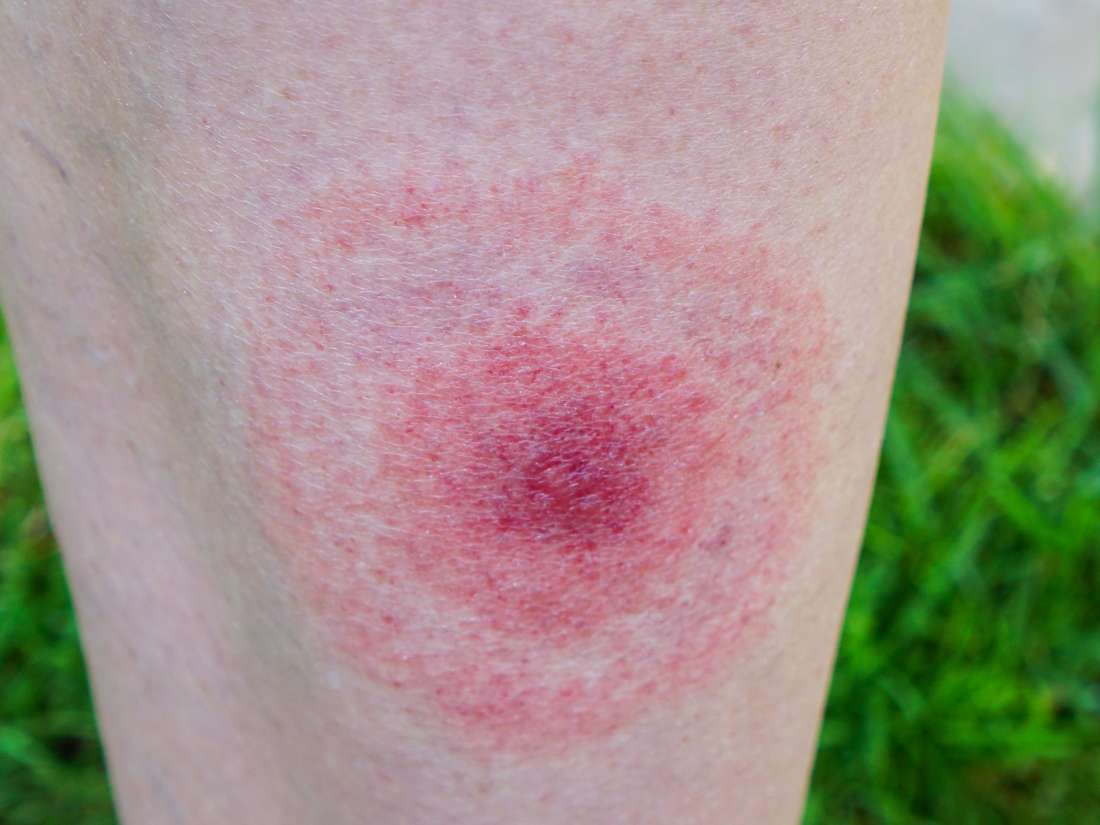
Usually, a large, raised red spot (erythema migrans) develops at the site of the bite, most often on the thigh, buttocks, trunk, or armpits. This spot usually appears 3–32 days after the tick bite, which most people do not notice.
The spot begins to slowly grow up to 50 centimeters in diameter, often forming a clearing in the center. But its appearance can be different. For example, the center may remain red, or multiple rings (looking like a bull's eye or a target) may appear around the red center. Although erythema migrans is not itchy or painful, it can be warm to the touch. The stain usually disappears after 3-4 weeks.
Approximately 25% of infected people never develop the characteristic red spot, or they simply do not notice it.
- Early disseminated stage of Lyme disease.
This stage begins with the spread of bacteria throughout the body. This stage can begin a few days or weeks after the spot appears.
Common symptoms: fatigue, chills, fever, headache, stiff neck muscles, muscle pain, painful and swollen joints. These Lyme disease symptoms can persist for several weeks. In about half of cases, if untreated, small spots of erythema migrans develop in other parts of the body. Less commonly, a person suffers from back pain, nausea, vomiting, sore throat, enlarged lymph nodes, and enlarged spleen.
Although most symptoms are transient, the feeling of soreness and fatigue can last for several weeks. These symptoms are often mistaken for flu or common viral infections, especially if erythema migrans is absent.
Sometimes more severe symptoms develop. The nervous system is affected in 15% of infected people. Common symptoms include meningitis (which causes headache and neck stiffness) and Bell's palsy (which causes muscle weakness on one or both sides of the face).
These problems can last for months. Neuralgia and weakness can develop elsewhere in the body and last longer.
8% of infected people develop heart disease. These problems include:
- Slow passage of electrical signals through the heart, resulting in abnormal heart rhythms (arrhythmias) called heart block
- inflammation of the heart tissue (myocarditis) and heart bag (pericarditis) with chest pain.
Arrhythmia can cause palpitations, pallor, or fainting.
- Late stage of Lyme disease.

If the infection is not treated early, other problems may develop over the months or years.
More than half of cases develop arthritis, usually in the first few months. Over the course of several years, some large joints, such as the knee, become swollen and painful. Most often, the knees are swollen but not painful, hot to the touch, and rarely red. Cysts can form behind the knee joints and subsequently rupture, thus increasing pain. In 10% of people with arthritis, knee problems last more than 6 months.
Some people develop pathological conditions associated with the brain and dysfunction of nerve fibers. Mood, speech, memory and sleep may also be affected. Some people have numbness or shooting pains in the back, legs, and arms.
Diagnostics
Lyme disease is usually diagnosed on the following grounds:
- typical symptoms, including rash (especially erythema migrans);
- assumptions about the possibility of infection (due to living or visiting regions where the disease is common);
- analysis results.
Usually, doctors measure the level of antibodies to bacteria in the blood. (Antibodies are proteins produced by the immune system to protect the body from certain types of attacks, such as from Borrelia burgdorferi.) However, antibodies may be absent if the test is performed in the first few weeks after infection, or if an antibiotic is prescribed before the development of antibodies.
More than 95% of people who get sick for at least a month develop antibodies, especially if they have not taken antibiotics. After the antibodies are produced, they remain in the blood for many years. Thus, antibodies may be present after Lyme disease resolves, or in people who have had an infection that does not cause symptoms.
Interpreting blood test results is complex. The uncertainty of the results raises several problems. For example, in areas where Lyme disease is common, many people who experience joint pain, difficulty concentrating, experience constant fatigue, fearing they have advanced Lyme disease, even if they have never had a rash or other symptoms associated with early Lyme disease Lime. Usually, the disease is not the cause of these conditions. But in some cases, antibodies may be found in the blood due to the fact that many years ago a person was infected, and the antibodies remained for a long time. Therefore, if a doctor prescribes treatment based solely on antibody test results, most patients without Lyme disease undergo a long and completely useless course antibiotics.
Crops are also useless as Borrelia burgdorferi difficult to grow in the laboratory.
Sometimes, using a needle, the doctor takes a sample of intra-articular fluid for analysis or performs a cerebrospinal (lumbar) puncture to obtain a sample of fluid that washes over the brain and spinal cord (spinal liquid). Fragments of bacterial genetic material can be present and detected using the polymerase chain reaction method (PCR). This technique creates multiple copies of the gene, making it easier for doctors to quickly identify bacteria. Borrelia burgdorferi.
Treatment
Lyme disease is treated with antibiotics.
Although all stages of Lyme disease respond to antibiotics, only early treatment can prevent complications.
Antibiotics such as doxycycline, amoxicillin, or cefuroxime are taken by mouth for 2 to 3 weeks. They are effective in the early stages of the disease. If the disease is detected early, patients may need treatment for only 10 days. If a person cannot take these drugs, azithromycin is sometimes prescribed, although it is less effective. Doxycycline is usually not given to children under 8 years of age, pregnant or breastfeeding women.
Antibiotics can also relieve many of the symptoms of Lyme disease.
For Lyme arthritis, antibiotics such as amoxicillin, cefuroxime, or doxycycline are given by mouth for 28 days, or intravenous ceftriaxone for 28 days.
For most neurological abnormalities and abnormalities in the heart rhythm (arrhythmias) called cardiac blockade of the third degree (complete heart block), given ceftriaxone or penicillin intravenously over 2-4 weeks. Sometimes a complete heart block requires a temporary pacemaker. Doxycycline, taken by mouth for 2–3 weeks, may help treat first-degree heart block and mild Bell's palsy.
Antibiotics kill bacteria and, in most cases, relieve the symptoms of arthritis. However, in some cases, arthritis does not go away even after all the bacteria that might trigger it have been eliminated because the inflammation persists. Even after successful antibiotic treatment, some people still have other symptoms such as fatigue, headache, and mental problems.
Non-steroidal anti-inflammatory drugs (NSAIDs), such as aspirin or ibuprofen, relieve pain from joint inflammation. Fluid that accumulates in damaged joints can be pumped out. Crutches may be needed.
Prophylaxis
Precautions should be taken against tick bites. In case of possible contact with ticks, the entire body should be carefully examined after each possible contact and the ticks found must be removed. This is effective because the tick must usually be on the skin for more than a day and a half to transmit Lyme disease.
- Prevention of tick bites.
A person can reduce the likelihood of an infection or tick bite by following these guidelines:
- stay on paths and trails when hiking in the forest
- walk along the center of paths to avoid touching plants and branches
- not sit on the ground or on stone walls
- wear long sleeves
- wearing long pants and tucking them into boots or socks
- wear light-colored clothing that makes it easier to see the tick
- apply a repellent containing diethyltoluamide (DEET) to the skin
- applying insect repellent containing permethrin to clothing, or wearing clothing that has been pretreated with permethrin
Lyme disease is usually transmitted by juvenile deer mites (pupae), which are much smaller than dog mites. Therefore, people who may have come into contact with ticks should carefully examine the whole body every day, especially the areas covered with hair. This is effective because the tick must remain on the skin for more than a day and a half to transmit Lyme disease.
To remove a tick, take sharp-pointed tweezers, grab the tick by the head or mouth where it penetrates the skin, and gradually pull it out. The body of the tick cannot be pulled or squeezed. Do not use petroleum jelly, alcohol, lighted matches, or other irritants.