Hailey-Hailey disease: what is it, causes, symptoms, treatment, prognosis
Content
- What is Hailey-Hailey disease?
- Signs and symptoms
- Causes
- Affected populations
- Related disorders
- Diagnostics
- Standard treatments
- Forecast
What is Hailey-Hailey disease?
Hailey-Hailey disease Is a rare genetic disorder characterized by blisters and erosions, most commonly affecting the neck, armpits, skin folds and genitals. Lesions can come and go and usually heal without scarring. Sunlight, heat, sweating, and friction often make the disorder worse.
The symptoms of Hailey-Hailey disease arise from the inability of skin cells to clump together, resulting in the destruction of the affected skin layers. Hailey-Hailey disease occurs due to a mutation in a specific gene that creates a protein that is essential for healthy skin. The disorder becomes apparent after puberty, usually by the third or fourth decade, but symptoms can develop at any age.
Hailey-Hailey disease is also known as familial benign pemphiguswhich has led to considerable confusion in the medical literature. Pemphigus (pemphigus) is a general term for a group of rare autoimmune bladder skin diseases. Symptoms and skin lesions in pemphigus and Hailey-Hailey disease are similar. However, pemphigus is
autoimmune disease, a disorder that occurs when the body's own immune system mistakenly attacks healthy tissue. Hailey-Hailey disease is not an autoimmune disease and there are no autoantibodies. Hailey-Hailey disease is an overt genetic disorder caused by a gene mutation.Signs and symptoms


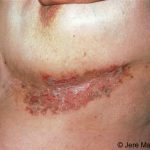

The symptoms and severity of familial benign pemphigus varies from person to person, even among members of the same family. In most cases, it is a family history of the disorder.
The disease usually first appears as an erosive, blistering skin rash, most commonly affecting the armpits, neck, chest, and groin. Lesions may develop a yellow crusted layer. In many cases, the rash can be itchy or burning. The lesions may separate, leaving painful, cracked skin. A secondary infection of the skin lesions may also occur, causing an unpleasant odor.
The skin lesions that characterize Hailey-Hailey disease usually recur and remit, which means they go away on their own but recur periodically. The duration of the outbreak and the time between the disappearance of the lesions and recurrence vary. When the lesions heal, they usually leave no scars. Skin lesions are aggravated by friction, heat, injury, and sun exposure.
Causes
Hailey-Hailey disease is caused by a genetic change (mutation) in a gene ATP2C1. Gene ATP2C1 contains instructions for making (coding) a protein that acts as a calcium and magnesium pump in cells. This protein pumps calcium or magnesium ions into a specialized organelle in the cell known as the Golgi apparatus.
Calcium ions play an important role in cell-cell adhesion, and when the calcium pump is not functioning properly, the affected cells do not clump (stick together), damaging the skin (acantholysis). The exact process by which the loss or malfunction of a protein gene product ATP2C1 causes Hailey-Hailey disease is not fully understood. Protein is most active in keratinocytes, the main cell type in the outermost layer of the skin (epidermis). The inability of keratinocytes to stick together leads to the appearance of blisters with disease.
The disease is inherited in an autosomal dominant manner. Dominant genetic disorders occur when only one copy of an abnormal gene is needed to cause a specific disorder. The abnormal gene can be inherited from one of the parents or be the result of a gene mutation in the affected person. The risk of passing the abnormal gene from the affected parent to the offspring is 50% with every pregnancy. The risk is the same for men and women.
Affected populations
Hailey-Hailey disease affects men and women in equal numbers. According to one estimate, the disorder affects 1 in 50,000 people in the general population. The disease is often misdiagnosed or misdiagnosed, making it difficult to determine its true frequency in the general population.
Although the disease usually manifests itself around puberty, some cases do not develop until the third or fourth decade. Hailey-Hailey disease was first described in the medical literature in 1939.
Related disorders
Symptoms of the following disorders may be similar to those of Hailey-Hailey disease. Comparisons can be useful for differential diagnosis.
- Follicular keratosis, also known as Darrieus disease, is a rare genetic skin disorder. People who are sick develop skin lesions that consist of thickened, rough bumps (papules) or plaques that may also be greasy or have a brown or yellow crust. These hard, scaly lesions are progressive and may gradually enlarge or spread over the skin. Nails and mucous membranes are also affected in many cases. In some cases, additional symptoms and signs may be present. Patients may have periods of time when symptoms improve (remission), but the lesions usually recur (relapse). Specific problems vary from one person to the next. Follicular keratosis is inherited in an autosomal dominant manner.
- Pemphigus (pemphigus) Is a general term for a group of rare autoimmune bladder skin diseases. Autoimmune disorders occur when the body's own immune system mistakenly attacks healthy tissue. The two main types of pemphigus are pemphigus vulgaris and pemphigus foliaceus. Each type has subtypes. Additional subtypes of the disorder are sometimes classified as pemphigus, including paraneoplastic pemphigus and IgA pemphigus. Some doctors consider these disorders to be similar, but still distinct autoimmune blisters with different clinical, immunological, and microscopic (histological) features. Symptoms and severity associated with different forms of pemphigus vary. All forms of pemphigus are characterized by the development of blistering eruptions on the outer layer of the skin (epidermis). In pemphigus vulgaris, lesions also develop on mucous membranes, such as the mucous membranes of the mouth. Mucous membranes are thin, moist covers of many of the inner surfaces of the body. If left untreated, pemphigus can progress, causing life-threatening complications. The exact cause of pemphigus is unknown.
Diagnostics
The diagnosis of Hailey-Hailey disease is made on the basis of a thorough clinical assessment, a detailed history of the patient, identification of characteristic results and various specialized tests, including surgical removal and microscopic examination (biopsy) of the affected skin fabrics. A biopsy can reveal abnormal keratin formation (keratinization) and intercellular adhesion problems (acantholysis). Blood tests in people with the disease will not be able to detect antibodies, which rules out autoimmune disorders such as pemphigus.
Also, to confirm the diagnosis, a molecular genetic study of mutations in the gene is available ATP2C1.
Standard treatments
Treatment for Hailey-Hailey disease focuses on the specific symptoms that each person experiences. Specific treatments depend on several factors, including the extent and severity of the disease, and the age and general health of the patient.
People with familial benign pemphigus are advised to avoid triggers such as sunburn, increased sweating and rubbing, and keep the affected areas dry. For some people, sunscreen, loose clothing, moisturizers, and preventing excessive heat can help prevent breakouts.
Cool compresses, dressings, mild corticosteroid creams, and topical antibiotics can be effective in treating mild cases. In more serious cases, systemic antibiotics (especially erythromycin and tetracycline) or stronger corticosteroid creams may be required. Long-term corticosteroid therapy is not recommended as it can further weaken damaged skin over time.
Drugs that fight bacterial, fungal, or viral infections are also commonly used to treat or prevent a secondary infection sometimes associated with Hailey-Hailey disease.
Genetic counseling is recommended for affected individuals and their families. Other treatments are symptomatic and supportive.
Forecast
Familial benign pemphigus is uncomfortable but not life-threatening. Benign lesions often begin in adolescence and present as itchy and unpleasant plaques. Patients with familial benign pemphigus live long and productive lives. Skin disease is more of a nuisance than a serious health threat. New treatment options are under study and offer hope for better treatment in the future.