Noah-Lax syndrome: what is it, symptoms, treatment, prognosis
Content
- What is Noah-Lax Syndrome?
- Signs and symptoms
- Causes
- Affected populations
- Diagnostics
- Standard treatments
- Forecast
What is Noah-Lax Syndrome?
Noah-Lax syndrome (SNL) is a rare genetic disorder that is inherited in an autosomal recessive manner. The syndrome is characterized by a sharp growth retardation before birth (intrauterine growth retardation); low birth weight and length; and characteristic pathologies of the head and facial (craniofacial) region. These may include a noticeable small head (microcephaly), oblique tilt of the forehead, wide set eyes (ocular hypertelorism) and other malformations leading to characteristic the appearance of the face. SNL is also usually characterized by abnormal accumulation of fluid in tissues throughout the body (generalized edema); constant flexion and immobilization of multiple joints (flexion contractures); other malformations of the limbs; and / or pathology of the brain, skin, genitals, kidneys and / or heart.
Signs and symptoms
Noah-Lax syndrome is associated with characteristic abnormalities before birth. They can include:
- severe growth retardation (intrauterine growth retardation);
- excess fluid in the thin-walled membrane (amniotic sac) surrounding the fetus during pregnancy (polyhydramnios);
- abnormal decrease in fetal movement;
- short umbilical cord;
- abnormally small placenta.
The placenta is an organ in the uterus that connects the blood supply to the mother and the developing fetus. Also, in some cases, the umbilical cord may only have two blood vessels. The umbilical cord, which is the flexible structure that connects the fetus to the placenta, usually has two umbilical arteries as well as a larger umbilical vein.
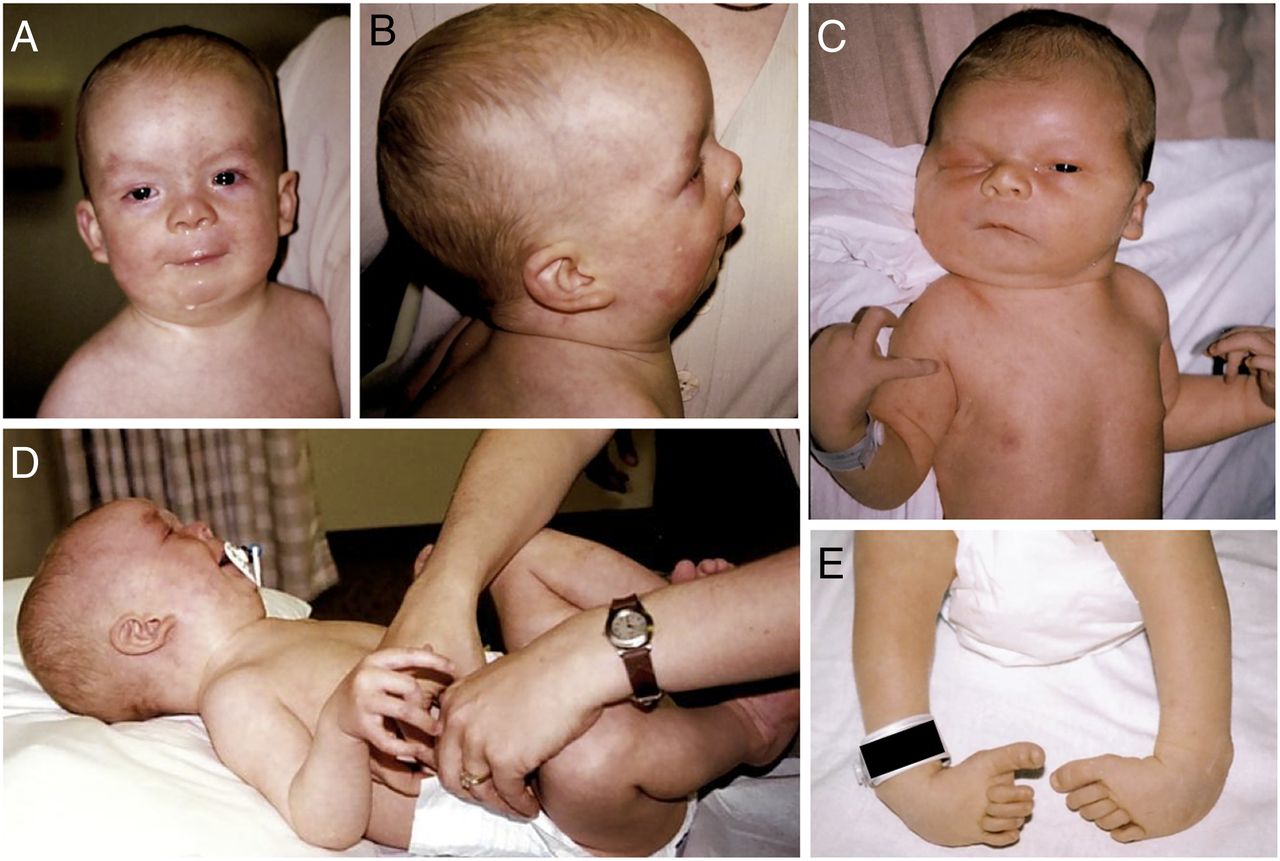
Newborns with SNL usually have abnormally low birth weight and length, and a noticeable small head (microcephaly). Additional malformations of the head and facial (craniofacial) region are also usually present, resulting in a characteristic appearance. Such anomalies include:
- oblique inclination of the forehead;
- a flattened nose with a wide bridge of the nose;
- full cheeks;
- a small underdeveloped jaw (micrognathia).
Affected newborns may also have large, low-set, misshapen (dysplastic) ears; round, open mouth with thick lips; short neck; and wide-set, unusually prominent eyes. In addition, the eyelids are underdeveloped (hypoplastic) and turned outward (ectropion), making them appear missing. Additional ocular abnormalities, such as unusually small eyes (microphthalmos) and loss of clarity in the lenses of the eyes (cataract). Some affected newborns may also have incomplete occlusion of the palate (cleft palate) and a vertical groove on the upper lip (cleft lip).
Read also:Hypophosphatasia
Noah-Laksova syndrome is also associated with musculoskeletal disorders, including permanent flexion and immobilization of large joints. (flexion contractures), such as elbows, wrists, hips, knees, and ankles, with skin weaves across some immobilized joints (eg elbows and lap). In addition, patients' arms and legs are unusually short, and their hands and feet may swell. Affected newborns may have overlapping fingers; webbed or fused fingers and toes (syndactyly); and deformation in which the feet are shaped like a rocking chair leg. In addition, there may be "under-ossification" of the bones of the arms and legs and other anomalies of bone formation. Ossification refers to the transformation of fibrous tissue or cartilage into bone.
The disease is also usually characterized by abnormal accumulation of fluid in tissues throughout the body (generalized edema). In addition, some infants may have abnormal (eg, myxomatous) proliferation of connective tissue. or excessive fat deposits under the outermost layer of the skin (epidermis) with degeneration (atrophy) of those around muscles. Less often edema may be absent or limited to the scalp. Some affected babies may also have yellowish, dry, flaky (“ichthyotic”) skin.
SNL can also be associated with malformations of the brain. In many cases, the folds (convolutions) of the outer region of the brain (cerebral cortex) do not develop completely, which makes the surface of the brain appear unusually smooth (agiria). Additional malformations may include the absence of a thick strip of nerve fibers that connects the two hemispheres of the brain (agenesis of the corpus callosum) or underdevelopment (hypoplasia) of the cerebellum, an area of the brain that plays an important role in coordinating voluntary movements and maintaining correct posture. In addition, in some cases, there may be a cystic malformation of the fourth cavity (ventricle) of the brain (malformation Dandy Walker) and associated hydrocephalus. Hydrocephalus Is a condition in which the outflow or absorption of fluid that circulates through the ventricles of the brain and the spinal canal is impaired [cerebrospinal fluid (CSF)], potentially leading to increased pressure in the brain, rapid increase in head size, or other related complications. In some cases, Noah-Lax syndrome can also be associated with additional abnormalities of the brain and spinal cord (central nervous system).
Read also:Multiple endocrine neoplasia
Some affected newborns may also have additional physical abnormalities, such as:
- underdevelopment of the genitals;
- the absence of one of the kidneys (unilateral renal agenesis) or other kidney defects;
- underdevelopment of the lungs (hypoplasia of the lungs);
- structural anomalies of the heart (congenital heart defects).
Congenital heart defects can include an abnormal opening in the fibrous septum that separates the upper or lower chambers of the heart (atrial or ventricular septal defects); the presence of a fetal opening between the two main arteries (aorta, pulmonary artery) leaving the heart (patent ductus arteriosus); or a heart defect in which the aortic and pulmonary arteries are in the normal position of each other (transposition of the great arteries).
Causes
Noah-Laksova syndrome is transmitted in an autosomal recessive manner. Human traits, including classic genetic diseases, are the product of the interaction of two genes, one from the father and the other from the mother.
In recessive disorders, the condition does not occur unless the person inherits the same defective gene for the same trait from each parent. If a person receives one normal gene and one gene for the disease, they will be a carrier of the disease, but usually asymptomatic. The risk of transmitting the disease to the children of a couple, both of whom are carriers of the recessive disease, is 25 percent. 50 percent of their children are at risk of becoming carriers of the disease, but are usually asymptomatic. 25 percent of their children can receive both normal genes, one from each parent, and will be genetically normal (for that particular trait). The risk is the same with every pregnancy.
The parents of several patients with SNL were close in blood (blood relatives). In recessive disorders, if both parents carry the same gene for the same painful disorder trait, there is an increased risk that their children may inherit two genes necessary for development disease.
Several cases have also been reported in which SNL appears to have occurred randomly for unknown reasons (sporadically).
Affected populations
Noah-Lax syndrome affects men and women in relatively equal numbers. Since the disorder was originally described in three siblings in 1971 (Neu, RL) as well as three siblings in another family in 1972 (Laxova, R), over 30 additional cases. The researchers speculate that the disorder may have a higher incidence in Pakistanis than in other geographic or ethnic groups.
Read also:Malignant hyperthermia
Diagnostics
A diagnosis of SNL can be suggested before birth (prenatally) based on specialized examinations such as repeat fetal ultrasound. During an ultrasound examination of the fetus, sound waves are used to create an image of the developing fetus. Such testing can reveal characteristic signs suggestive of SNL, such as poor fetal activity, restriction of movement. extremities, excess fluid in the membranous sac surrounding the developing fetus (polyhydramnios), small placenta and intrauterine retention development. Additional ultrasound signs that may indicate SNL include abnormally small head, sloping forehead, protruding eyes, joint contractures and / or generalized edema.
The diagnosis of Noah-Lax syndrome can also be made or confirmed after birth (postnatally) based on careful clinical evaluation and characteristic physical signs. Specialized testing can also be done to look for certain conditions that could potentially be associated with a medical condition (for example, congenital heart defects).
Standard treatments
Treatment for Noah-Laksova syndrome is aimed at eliminating specific symptoms that appear in each person. Such treatment may require the coordinated efforts of a team of healthcare professionals such as pediatricians; doctors who diagnose and treat neurological disorders (neurologists); doctors who diagnose and treat heart anomalies (cardiologists); and / or other healthcare professionals.
Specific treatments for SNL are symptomatic and supportive. In addition, genetic counseling will be beneficial to affected families.
Forecast
Most cases of Noah-Lax syndrome have a poor prognosis. Many affected newborns are either born dead or die shortly after birth or during the first weeks of life. However, SNL can be seen as part of "serine biosynthetic defects," which includes other conditions that are less severe and may have a better prognosis.