Acne conglobata: what is it, symptoms, photos, treatment, prognosis
Content
- What is acne conglobata?
- Causes and risk factors
- Epidemiology
- Pathophysiology
- Histopathology
- History and physical signs
- Diagnostics
- Treatment
- Forecast
What is acne conglobata?
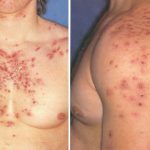
Acne conglobata - a rare but severe form of acne. It usually presents with comedones, nodules, abscesses, and drainage of the sinuses. Photo). Scars and body deformities are common with this type of acne. Comedones are often found in groups of three, and cysts often contain pus-filled, foul-smelling material that is thrown onto the surface of the skin. Acne conglobata nodules are found on the chest, shoulders, buttocks, face, and thighs. Acne conglobata can occur after a sudden exacerbation of pustular acne or a disease may occur gradually after recurrence of acne, which has not been manifested for many years old.
It is important not to confuse acne conglobata with fulminant. The main difference is that the former cause polyporous comedones and non-inflammatory cysts, while the latter do not.


Causes and risk factors
It's believed that
Propionibacterium acnes, the same organism that is involved in acne vulgaris may play an important role in the disease by altering its reactivity as an antigen. Hypersensitivity to this antigen induces an intense immunological response that manifests itself as a chronic inflammatory condition. The presence of bacteria also leads to an infectious process with the development of pus and sinus tracts. Pus usually has an unpleasant and putrid odor.Taking thyroid medications and exposure to halogenated aromatic hydrocarbons can cause acne conglobata. Other factors that can trigger acne conglobata include androgens (such as androgen-producing tumors) and anabolic steroids.
It has also been reported that acne conglobata occurs in people who stop taking anabolic hormones or as a reaction to other hormonal agents.
Some people with acne conglobata have an XYY karyotype. Skin disease is associated with HLA phenotypes.
Read also:Psoriasis
Epidemiology
Acne conglobata are not very common. In general, this type of acne is more common in men than in women. There have been many reports of athletes with this type of acne published over the past 30 years, and it is believed to be primarily related to the use of anabolic steroids. Little is known about eel conglobates outside the United States. The condition is usually seen in young people and very rarely in children or the elderly. The onset usually occurs in the second and third decades of life. It is not known if the disease is more common in any particular race.
Pathophysiology
Acne conglobata is a deep-seated abscess that is connected to each other through the sinus passages. Initially, the nodular lesion may mimic a pimple, but underneath there is a strong inflammatory response and the formation of pus. Over time, pus penetrates the surrounding tissue and comes out to the surface of the skin. Scars and body deformities are common with this type of acne. Comedones are often found in groups of three, and cysts often contain foul-smelling, foul-smelling material that is secreted on the surface of the skin.
Histopathology
Acne conglobata resembles purulent hydradenitis with large painful nodules and draining sinus passages. The affected area is severely inflamed and fluctuates. Foreign body granulomas are common.
History and physical signs
Acne conglobata can occur after taking androgenic anabolic steroids and is quite common in bodybuilders. Many young adult men go to a dermatology clinic with complaints of severe acne and facial scars. It is important to get a detailed history of anabolic steroid use because stopping these drugs is vital to treatment.
Acne conglobata can also occur in patients with purulent hydradenitis and pyoderma gangrenosum. When the disease develops after puberty, the nodules gradually grow together and become more severe in subsequent years. Active nodule formation usually persists for the first three decades of life and then becomes inactive.
Read also:Albinism
Physical examination usually reveals a severe form acne. The nodular lesions are tender and domed. When the nodules disintegrate, there is a foul-smelling discharge in the form of pus. After the pus drains, a crust often appears on the affected area, followed by the formation of large, irregular scars.
The classic sign of the disease is the presence of paired or cumulative blackheads on the trunk, neck, shoulders and buttocks.
Most patients with acne conglobata are shy and embarrassed about their skin conditions. Many tell a story of isolation and isolation. Suicidal ideation is also common in this population. Therefore, it is very important to offer the patient psychological counseling.
Diagnostics
Diagnosis is clinical, and secretions should be cultured. If putrefactive discharge is present, appropriate antibiotics should be taken. Do not wait for culture results before starting antibiotic therapy.
Treatment
The best treatment for acne conglobata is to use retinoids such as isotretinoin for 20 to 28 weeks, and in some cases even longer. Some experts even recommend oral prednisone (1 mg / kg / day) for 14–28 days. Steroids have been shown to be effective in the presence of systemic constitutional symptoms such as general malaise, fever, weight loss, and anorexia. Topical retinoids are not as effective as oral retinoids. It is important not to prescribe retinoids to women of childbearing age in the absence of effective contraception, as these drugs are known to be teratogenic.
- Other options include using minocycline, tetracycline, or doxycycline. Tetracyclines should not be combined with oral isotretinoin, since there is a real possibility of causing pseudotumor of the brain.
- In cases where the above antibiotics do not respond to treatment, dapsone can be used. There are also reports of cases of treatment of acne conglobata with infliximab and a carbon dioxide laser with or without isotretinoin.
- In severe cases of acne conglobata that cannot be treated with the above methods, external radiation is another option.
Read also:Cyanosis
Operation:
- Once the lesions have healed, dermal fillers can be used to improve the scarring. Recently, the FDA approved the use of Bellafill bovine collagen filler to treat acne scars.
- When the nodules are large and fluctuating, they can be aspirated. Occasionally, clinicians may use cryotherapy or triamcinolone inside the lesion. Large nodules can also be removed surgically.
Forecast
Acne conglobata can cause severe disfigurement. Severe scarring leads to psychological impairment; People with acne conglobata are often ostracized or excluded. Acne conglobata is also anxiety and depression in many patients.
List of sources:
https://emedicine.medscape.com/article/1072716-overview
https://www.ncbi.nlm.nih.gov/books/NBK459219/