Agrafia: what is it, symptoms, causes, treatment, prognosis
Content
- What is agraphia?
- Classification
- Causes
- Epidemiology
- Pathophysiology
- Diagnostics
- Treatment
- Forecast
- Complications
What is agraphia?
Agrafia - This is a violation or loss of the previous ability to write. The disorder can occur in isolation, although it often occurs concurrently with other neurological disorders such as alexia, aphasia, dysarthria, agnosia and apraxia. Clinically, agraphia can be divided into "central" (also called "linguistic" or “Aphasic” agraphia) and “peripheral” agraphia (also called “non-linguistic” or "Non-phase" agraphia).
To accomplish the act of writing, a person creates a series of "graphemes" to convey meaningful information. To write correctly, you first need to know the letters themselves, and then you need to be able to organize the letters in order to form the correct words and grammatically correct sentences. Lesions that disrupt these processes lead to central agraphia. Then a person must know a set of coordinated movements in order to correctly draw letters (praxis), the ability to "mentally build a queue "from a sequence of letters to form a whole word (motor programming), visual-spatial the ability to guide the writing instrument on the writing surface and finally to have a capable motor system to perform these tasks. Disruption of these latter steps involved in motor planning or motor writing activity results in peripheral agraphia. Please note that "peripheral" agraphia can be localized in the central nervous system when it does not directly affect linguistic centers, for example, in the case of motor agraphia due to damage to the motor cortex of the brain, leading to paresis of the writing limbs.
Classification
Agraphy or disruptions in the production of written language can occur in a variety of ways and in many forms, since writing involves many cognitive processes (language processing, spelling, visual perception, visual-spatial orientation of graphic symbols, motor planning, control motor skills).
Agraphy has two main subgroups: central ("aphasic") and peripheral ("non-phasic") agraphia. Central agraphies include lexical, phonological, global and semantic agraphies. Peripheral agraphia include allographic, apractic, motor, hemianoptic, and afferent agraphia.
- Central.
Central agraphia occurs when there are both impairments to speaking and impairments to various motor and visualization skills associated with writing. People with agraphia and fluent aphasia write a normal number of correctly formed letters, but cannot write meaningful words. Receptive aphasia is an example of fluent aphasia. Those with agraphia with difficult aphasia can write short sentences, but they are difficult to read. Writing them is physically demanding, but lacks proper syntax and often has poor spelling. Expressive aphasia is an example of difficult aphasia. People who have alexia with agraphia have difficulties with both production and understanding of written language. This form of agraphism does not interfere with the spoken language.
- Deep agraphia affects the phonological ability and spelling memory of a person. Deep agraphia is often the result of a lesion in the left parietal region (supramarginal gyrus or insula). People can neither remember what words look like when spelled correctly, nor can they speak them out to determine the spelling. People usually rely on their damaged spelling memory for spelling; this leads to frequent errors, usually of a semantic nature. People have great difficulty with abstract concepts and unusual words. Reading and speaking are also often impaired.
- Agrafia with Gerstmann's syndrome - This is a violation of written speech associated with the following structural symptoms: difficulty distinguishing one's own fingers, difficulty distinguishing left from right and difficulty in performing calculations. All four symptoms are the result of damage to the pathways. Gerstmann's syndrome may additionally present with alexia and mild aphasia.
- The global agraphia also impairs a person's spelling memory, although to a greater extent than deep agraphia. With global apraxia, spelling knowledge is lost to such an extent that a person can write only very few meaningful words or cannot write any words at all. Reading and speaking are also noticeably impaired.
- Lexical and structural agraphia is caused by damage to spelling memory; these people cannot visualize the spelling of a word, although they retain the ability to pronounce them aloud. This spelling impairment can mean a loss or impairment of knowledge, or simply an inability to effectively access it. There is a regularity effect associated with lexical agraphics in that people are less likely to spell words correctly without regular, predictable spellings. In addition, spelling is usually less impaired. People also have difficulty with homophones. Linguistic competence in terms of grammar and sentence writing is generally retained.
- Phonological agraphia is the opposite of lexical agraphia in that the ability to pronounce words is impaired, but the spelling memory of words may be intact. People often find it more difficult to access more abstract words without strong semantic representations (i.e., they have a harder time pronouncing prepositions than concrete nouns).
- Net agraphia is a disorder of writing without any other language or cognitive impairment.
Read also:Myoclonus
Agraphy can occur separately or simultaneously and can be caused by damage to the angular gyrus.
- Peripheral.
Peripheral agraphia occurs when various motor and visualization skills are impaired in writing.
- Aprakticheskaya agraphia is a violation of written speech associated with a violation of the motor system. It leads to distorted, slow, laborious, incomplete and / or inaccurate letterforming. Although the written letters are often so poorly formatted that they are almost illegible, the ability to pronounce them aloud is often retained. This form of agraphia is caused precisely by the loss of specialized motor plans for the formation of letters, and not by any dysfunction affecting the writing limb. Apraxic agraphia may present with or without ideomotor apraxia. Paralysis, chorea, Parkinson's disease (micrograph), and dystonia (writer's convulsion) are movement disorders commonly associated with agraphia.
- Hysterical agraphia is a violation of writing caused by conversion disorder.
- Recurring Agraphia occurs in people who repeat letters, words, or phrases in writing an abnormal number of times. Perseveration, paragraphing, and echography are examples of repetitive agraphies.
- Optico–spatial agraphia - a violation of written language, determined by the tendency to neglect one part (often the whole side) writing page, slanted lines up or down and abnormal spacing between letters, syllables and words. Orientation and correct spelling sequence will also be disrupted. Optical-spatial agraphia is often associated with neglect of the left hemisphere, difficulty in constructing or assembling objects, and other spatial difficulties.
Causes
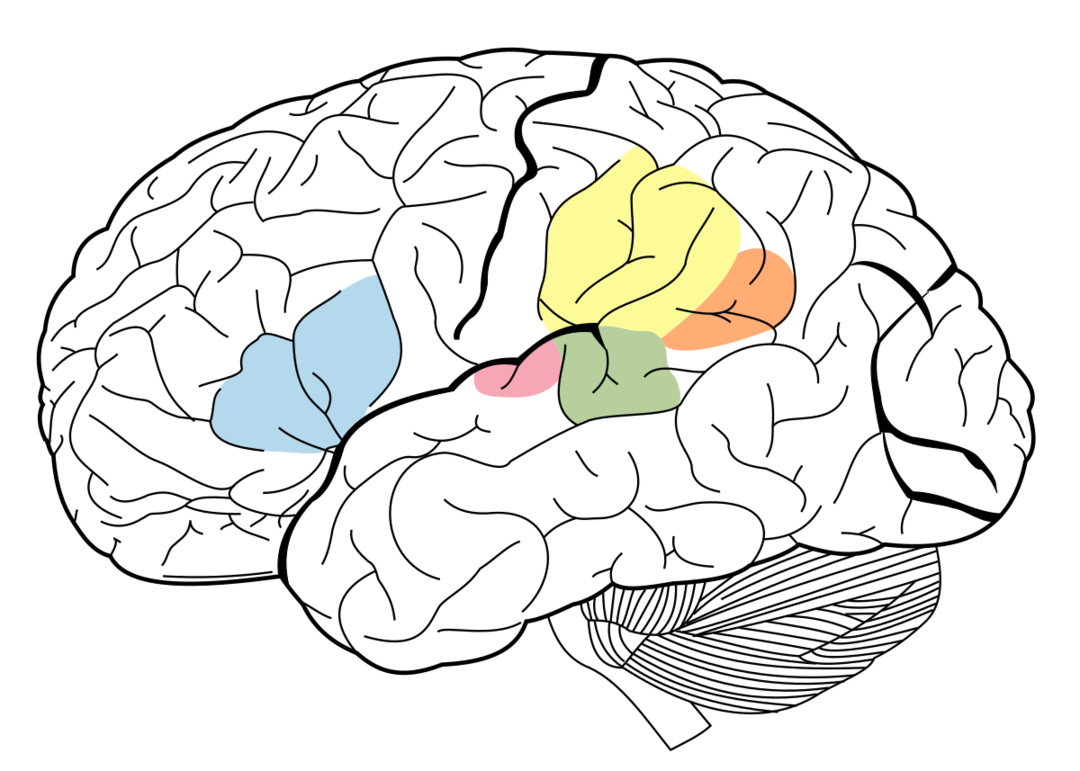
Central or linguistic agraphia can be caused by any lesion of the cortical linguistic centers of the brain or any of the associated subcortical structures. Classically, it occurs when stroke, which remains the most common cause of speech impairment in general. Virtually any lesion affecting these areas, including trauma, tumors, and infections, can lead to central agraphia.
Neurodegenerative conditions such as Alzheimer's disease or frontotemporal dementia, can also lead to central agraphia, in which case the onset is gradual with progressive deterioration. Primary progressive aphasia and its subtypes are clinical neurodegenerative syndromes characterized predominantly by slowly worsening language impairment; in particular, Alzheimer's disease and frontotemporal degeneration are implicated in most of these cases. Agraphy is also often seen in delirium. However, delirium is nonspecific, and the etiology of delirium is extremely diverse.
As with central agraphia, peripheral agraphia can be caused by a variety of lesions anywhere from the cerebral cortex to peripheral nerves and muscles. However, in peripheral agraphia, these lesions interfere with motor planning or motor writing.
Epidemiology
Data on the incidence of acquired neurological speech disorders, including agraphia, are generally limited. Stroke is considered the most common cause of acquired language impairment. One study from Switzerland found that the annual incidence of speech impairment due to a first-ever ischemic stroke is 47 cases per 100,000 inhabitants; of these, 30% of stroke patients developed aphasia. Patients with agraphia were included in this study, although the incidence of agraphia was not reported.
Pathophysiology
The pathophysiology of neurological speech disorders, including aphasia and agraphia, remains poorly understood. Generally aphasia is better studied than agraphia and is the most common model for studying neurological speech processing. However, several reports have observed a dissociation between written and spoken language, indicating places in the brain intended for writing. With that said, several areas of the brain involved in speech processing have been identified.
Read also:Alexander's disease
Classical localization methods based on vascular lesions initially identified two main language centers brain: this is Broca's area in the dominant inferior frontal gyrus and Wernicke's area in the dominant superior temporal gyrus. These areas are supplied with the upper and lower parts of the middle cerebral artery, respectively. The left hemisphere is the dominant hemisphere in over 95% of right-handers and over 70% of left-handers. Broca's area lesions usually result in inflexible language impairment; Broca's area has been shown to be related to linguistic functions, including fluency, phonological processing, grammar processing, and semantic search.
Lesions of the lower part of the middle cerebral artery are usually associated with impaired "fluency" of speech, characterized by meaningless speech and impaired understanding. It was originally thought and is still widely believed that Wernicke's area is related to word recognition and meaning. However, while more recent evidence suggests that Wernicke's field of activity is indeed related to the phonological production of language, it may not be critical to language recognition. Rather, the posterior cortical region of the tongue, which is responsible for the recognition and meaning of words that cause Wernicke's aphasia, spreads more diffusely along the temporal and parietal lobes.
It is believed that there are areas of the brain dedicated to handwriting input. The dominant angular gyrus is believed to be involved in the abstract transformation of the verbal representation of the language into the visual one. While some authors have suggested that they are involved in the ability to read, other authors have suggested that this area is intended for the production of written speech, and instead suggest that the nearby lateral occipital gyri are causing disturbances reading. Conversely, within the dominant middle frontal gyrus, there is an area that has been termed the "grapheme / motor frontal zone" (named in conjunction with the proposed "area Exner "of handwriting put forward by Sigmund Exner), which was meant as an interface between the abstract representation of words and the motor programming of written speech. Based on the aforementioned localization, it is likely that lesions in the dominant angular gyrus may cause clear linguistic agraphia, and lesions of the middle frontal gyrus can cause clear apractical agraphia.
While classical localization models remain clinically useful and help identify areas of the cerebral cortex of the brain, which are critical in various aspects of language, the data increasingly support the network model of language processing. Functional imaging studies have shown that language functions are more diffuse than previously thought. Indeed, lesions in areas such as the cerebellum, thalamus, or even the non-dominant hemisphere, can mimic damage to Broca's area or the posterior lingual area, which includes the area Wernicke. Similarly, clinical syndromes consistent with pure linguistic agraphia have been reported in the thalamus and inner capsule.
Unlike central agraphia, peripheral agraphia is much more diverse in its pathophysiology and is often localized to one or more central and / or peripheral nervous system. Localization of apractical agraphia is not standardized and is most often documented with lesions of the frontal and parietal lobes, although lesions leading to apractic agraphia have also been observed in the thalamus and cerebellum. The possible role of the Exner region in pure apraxic agraphia is postulated above. It should be noted that the agraphia, which is part of the tetrad Gerstmann's syndrome, which classically affects the posterior lobe of the dominant parietal lobe, has recently been placed under doubt to present a separate apractical agraphia affecting the adjacent superior parietal gyrus.
Paretic motor agraphia can occur from lesions anywhere in the corticospinal tract and associated muscles. Micrography is associated with parkinsonism, which itself is most often associated with substantia nigra, but can also occur with globus pallidus, striatum, or even the frontal lobe. Agraphy caused by tremor or chorea, may result from damage to structures that regulate motor control, including the basal ganglia or cerebellum.
Read also:Abulia
Repetitive agraphia may reflect phenomena such as catatonia or Tourette's syndrome. When this feature is a reflection of perseverative behavior, it is believed that it is mainly localized in the frontal or parietal lobe. Lesions anywhere along the optic pathway or in areas of cortical visual processing can lead to visual-spatial agraphia. Neglect, which is usually located in the nondominant parietal lobe, can also lead to visuospatial agraphia. Functional agraphies are complex in nature and often cannot be easily localized to any particular structure.
Diagnostics
The assessment of the patient's writing ability is part of a complete neurological study of language, which also includes fluency, comprehension, repetition, and reading. A complete assessment of oral and written speech is required to determine the cause of agraphia.
Computed tomography (CT), high-resolution magnetic resonance imaging (MRI) and scanning using Positron emission technology (PET) can help you see damage to areas of the brain where speech processing centers exist.
Treatment
The correct classification of the patient's agraphia is of paramount importance for the correct treatment, since the methods of therapy vary greatly depending on the location and etiology of the agraphia. In general, therapy in the form of speech therapy and language therapy and occupational therapy is the cornerstone of the treatment of both central and peripheral agraphia. Often, successful treatment of agraphia requires a multimodal approach that includes therapy, medication, and sometimes surgery: for example, a patient with micrographs due to Parkinson's disease may require deep brain stimulation, antiparkinsonian medications, occupational therapy, and / or orthopedic devices to correct his writing disorders.
In addition to eliminating the symptoms of agraphia, it is important to pay attention to the underlying etiology to prevent possible progression of the writing disorder. For example, a patient with a tumor leading to central agraphia should be offered appropriate chemotherapy, radiation therapy, and / or surgery.
Of the various etiologies of central agraphia, the most compelling evidence is stroke-induced central agraphia. Speech and language therapy has been shown to be beneficial for speech impairment after stroke, with evidence that intensive speech and language therapy is preferred for improving writing skills. One small study of 8 patients with alexia and agraphia due to stroke showed benefits of targeted learning to read and / or write tailored to specific needs, suggesting that treatment protocols can benefit from broad targeting of various specific disorders letters.
Limited evidence suggests that piracetam may be beneficial for agraphia in acute cases after stroke. Memantine has been shown to be effective in post-stroke aphasia, but its effectiveness in writing disorders has not been investigated. In terms of neuromodulation, evidence from small studies suggests potential beneficial effects transcranial magnetic stimulation for impaired writing after stroke, although larger research.
Treatment for peripheral agraphia is broader than that for central agraphia and depends on the subtype of agraphia. For example, opto-spatial agraphia due to hemisphere neglect can benefit from prismatic lenses. Writer's convulsions (focal dystonia of the hand) are often amenable to local injection of botulinum toxin. Orthopedic aids, occupational therapy, and relaxation techniques can also help with symptoms of focal hand dystonia.
Forecast
The prognosis of agraphia varies greatly and depends on its etiology. Generally speaking, speech impairment after a stroke follows a recovery period that peaks about three months after the stroke, which is ultimately followed by a plateau in linguistic abilities. In contrast, central agraphia due to neurodegenerative diseases is expected to progressively worsen. Peripheral agraphias have a wide range of etiologies and different prognoses.
Complications
Complications of agraphia include problems with community integration, where functional communication is vital to an independent daily life. Speech impairments can be frustrating for patients, and in stroke, they are also associated with depression. Since agraphia is not a specific disease, complications of the underlying etiology should be considered.