
Internal hemorrhoids in women: symptoms and how to treat, detailed information
Hemorrhoids are a pathology of the veins of the rectum in which varicose veins are formed in the form of nodules. Both women and men suffer from this disease equally, but women have more reasons for the development of pathology.

Internal hemorrhoids
Content
- 1 What are internal hemorrhoids
- 2 Causes
- 3 Symptoms
-
4 Diagnostics
- 4.1 Other diagnostic methods
- 5 Treatment
- 6 Traditional methods of treatment
-
7 Prophylaxis
- 7.1 Video - Hemorrhoids during pregnancy
- 7.2 Video - Hemorrhoids in women: symptoms, causes and treatment
What are internal hemorrhoids
Internal hemorrhoids are the initial stage of the disease, when the nodes are still under the mucous membrane. At first, the disease is asymptomatic, but as soon as the nodes reach a certain size, with a digital examination of the intestine, it becomes possible to palpate them, the first symptoms appear.

Internal bleeding hemorrhoids
The disease affects about 7% of the world's population, and it is rather a disaster in civilized countries, where people spend most of the day in one position.
For reference! Internal hemorrhoids in 80% of cases develop in women giving birth.
Causes
Hemorrhoids are mostly acquired diseases. However, in some cases, it occurs due to a hereditary predisposition. For example, even at the stage of embryonic development, enlarged cavernous formations are formed, as a result of which in the future there will be a tendency to the emergence of internal hemorrhoids.
Otherwise, the reasons are quite predictable and are mainly related to the lifestyle:
- Insufficient physical activity and sedentary work.

Sedentary work
- Poor diet and inadequate fluid intake that lead to constipation.

Improper nutrition
- Excessive physical activity, weight lifting.

Hemorrhoids after lifting weights
- Overweight.

Obesity and overweight
In addition, internal hemorrhoids can be provoked by:
- tumor formations in the small pelvis, which disrupt blood circulation and intestinal motility;
- intestinal infections;
- rectal trauma, damage to its mucous membrane;
- rectal muscle atrophy.
All of the above applies to both women and men. However, women have a number of additional reasons.
-
Period of menstruation. During it, the rush of blood to the pelvis increases, as a result, the veins in the rectum can swell and any provoking factor at this moment can trigger the formation of nodes.

During menstruation, the risk of developing internal hemorrhoids increases.
-
Pregnancy. During the period of carrying a baby, a woman's body changes dramatically. The fetus presses on the internal organs, defecation is less frequent and more difficult, blood circulation in the small pelvis is impaired.

Position of the fetus in the uterus at the end of pregnancy
-
Childbirth. Throughout the entire period of childbirth, a woman experiences a whole palette of pain in the pelvic area. At the same time, she pushes, pushes the baby out, and the intestinal veins are under tremendous stress. The result is knots.

Hemorrhoids are common in women after childbirth.
Basically, the triggers for the occurrence of hemorrhoids are: weak vessel walls and increased rectal pressure.
Symptoms
Internal hemorrhoids are characterized by an asymptomatic onset. The trouble is that it could be started to be treated at an early stage, but, unfortunately, there are no external signs.
With an increase in the nodes, symptoms consistently appear. There are several stages in the development of pathology.
Development stages
| Stage | Symptoms |
|---|---|
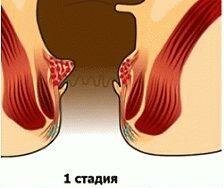 Stage 1 |
Since the enlargement of the veins is still small and the nodes are just forming, they do not bring any inconvenience. However, if bowel movements are difficult due to constipation, the stool can damage the mucous membrane and then there is a slight inflammation. At the same time, there is a burning sensation and moisture near the anus due to the separated exudate. Bloody blotches sometimes appear, but they are difficult to see with the naked eye. In general, there is an unpleasant sensation after bowel movement. |
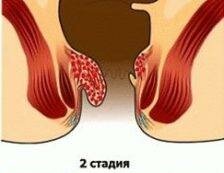 Stage 2 |
If no measures are taken at the first stage, the internal form moves on to the next stage of development. The nodes increase, there is an unpleasant feeling of a foreign body in the intestine. Under heavy load, the nodes extend beyond the anus, but at this stage they can still be pulled in on their own. Emptying is painful. Pronounced bleeding is already noticeable during bowel movements. Anemia can develop due to constant blood loss. |
 Stage 3 |
The inflamed bumps become so large that they fall out with any load, even the smallest. They can no longer be pulled in on their own, so they must be set manually. Sitting at this stage is unbearable, the pain becomes very severe, and bleeding increases. Cracks in the rectum appear. |
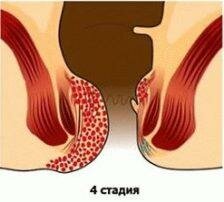 Stage 4 |
At this stage, the disease is already extremely advanced. The nodes are constantly bulging and cannot be adjusted inward. The pain is constant, aggravated by walking and trying to sit. |
In addition to the fact that the disease itself causes a lot of unpleasant feelings, additional complications may develop.
-
Thrombosis. Prolonged stagnation of blood in the veins of the rectum can provoke thrombosis and necrosis of the nodes. On examination, such formations look like blue-purple or black bumps, their palpation causes severe pain.

Types of thrombosis
-
Anemia. The constant loss of blood causes a decrease in hemoglobin, as a result of which weakness and dizziness are felt.

Anemia
-
Insufficiency of the anal sphincter. Prolonged prolapse of the nodes leads to the fact that the muscles of the intestine are not able to contain gases or feces, as a result of which emptying can occur at any time.

Loss of nodes
Diagnostics
If, in the presence of any unpleasant sensations after bowel movement, there are suspicions of hemorrhoids, you should immediately contact a proctologist. With such a delicate problem, many women are ashamed to go to a specialist, hoping that everything will go away by itself. However, this is a misconception and further, most likely, all of the above symptoms will begin to develop, and the treatment will be painful.
During the initial examination, the doctor conducts a digital examination of the intestine and collects an anamnesis.

Digital rectal examination
Putting on sterile gloves, the specialist probes the intestinal walls with his index finger, identifying the places where varicose veins have developed. The doctor determines the approximate number of nodes, their location, size, degree of pain. At this time, he will ask the patient questions about her well-being, it is necessary to answer how painful this or that manipulation is.

Digital rectal examination
The formations themselves are dense to the touch, heterogeneous structure, embossed, bleed easily when pressed with a finger.
Other diagnostic methods
-
Anoscopy. A special illuminated tube is inserted into the rectum, thanks to which the organ can be examined to a depth of 10 cm.

Anoscopy
-
Endoscopy. A special probe can be inserted into the anus to a depth of up to 25 cm. In this case, detailed information is collected about the condition of the intestinal walls, the number of nodes. In addition, thanks to this method, it is possible to take a sample of the material for biopsy.

Endoscopic examination of the rectum
-
Irrigoscopy. A method based on the introduction of a contrast agent into the intestine and its subsequent study using an X-ray.

Irrigoscopy
Before any instrumental examinations of the rectum, it is necessary to make a cleansing enema.

How to do a cleansing enema
Additionally, laboratory tests of feces are carried out to detect hidden blood, eggs or parasite cysts. This is necessary in order to exclude other possible pathologies and causes of discomfort in the rectum.
Treatment
The treatment of hemorrhoids must be approached responsibly. At the first stage, it is possible to eliminate the disease at home.
For these purposes, rectal suppositories and hemorrhoid ointments are well suited.
Popular ointments:
- Troxevasin;
- "Heparin ointment";
- "Relief";
- "Hepatrombin";
- "Posterized".

"Troxevasin" for hemorrhoids
Popular rectal suppositories:
- candles with sea buckthorn;
- candles with propolis;
- "Relief Ultra";
- "Procto-glivenol".

"Procto-glivenol"
Substances that are contained in ointments and suppositories are quickly absorbed into the mucous membrane and begin their work. The action of such drugs is aimed at suppressing inflammation, improving the state of blood vessels, regenerating damaged tissues, restoring local immunity, and antibacterial therapy.
It should be remembered that it is better to coordinate drugs with your doctor. Depending on the stage of hemorrhoids and the severity of symptoms, highly specialized agents can be used.
- In case of severe pain, ointments and suppositories with an antispasmodic effect are used: "Nigepan", "Olestezin", "Ultraproct".

Rectal ointment
- To eliminate inflammation, medications containing glucocorticosteroids (prednisolone, cortisol) are needed: Proctosedil, Aurobin.

"Proctosedil"
- To stop bleeding, drugs containing anticoagulants are used, which improve blood clotting, accelerate tissue regeneration: "Alginatol".

"Alginatol"
- For the prevention and treatment of vein thrombosis, agents containing heparin are used: "Hepatrombin", "Nigepan".

"Hepatrombin"
- To strengthen and increase the tone of the walls of blood vessels, such drugs are used as: "Troxegel", "Phleboton".

"Troxegel"
For the treatment of hemorrhoids, especially in the second and subsequent stages, it is necessary to use general agents, namely tablets.
Usually, drugs of the following groups are prescribed:
- phlebotonics;
- angioprotectors;
- hemostatics;
- pain relievers.
Such tools have proven themselves well as:
- Detralex;
- Venarus;
- "Phlebodia";
- "Paylex";
- "Hemoroidin".

Phytopreparation "Hemoroidin"
If conservative treatment does not work, minimally invasive therapy is used.
-
Cryodestruction. The essence of the method lies in the fact that hemorrhoids are subjected to ultra-low temperature treatment with liquid nitrogen. Instant necrosis and removal of damaged tissues occurs. However, this method is contraindicated in thrombosis of nodes or inflammation of the perineum and anal canal. The procedure is suitable for the initial and middle stages of the disease.

Cryodestruction of hemorrhoids
-
Photocoagulation. Method of removing nodes using infrared irradiation. The procedure lasts only a few seconds, during which the knot simply collapses, leaving behind a small crust, which then comes out during bowel movements. The method is contraindicated in the presence of pathologies of the anal canal, as well as at stages 3 and 4 of hemorrhoids.

Photocoagulation of hemorrhoids
-
Ligation with latex rings. The essence of the method is that special latex rings are put on the nodes, which squeeze the vessels that supply blood to the node. As a result, in a few days it simply dies off and falls off, and then comes out naturally through the anus.

Ligation with latex rings
-
Sclerotherapy. The method consists in injecting sclerosant preparations into the nodes themselves. Thanks to them, the walls of the veins begin to stick together, the blood supply is disrupted and the node gradually dries up. The procedure is contraindicated for anal fissures, bleeding, mixed hemorrhoids.

Sclerotherapy
In severe forms of hemorrhoids, surgical intervention is indicated, when the doctor excises the nodes. At the same time, recovery after surgery is long and difficult.

Hemorrhoidectomy operation
Traditional methods of treatment
Some home treatments can help relieve pain, relieve inflammation, or heal anal fissures at the initial stage of hemorrhoids.
Popular remedies
-
Herbal baths. It is necessary to brew oak bark, chamomile, celandine or calendula, let it brew. Then dilute the concentrate in half with water and pour into a small bath, in which you need to sit for 10-15 minutes. The procedure can be repeated several times a day. These herbs have antiseptic, wound healing and anti-inflammatory effects and significantly alleviate the condition.

Hemorrhoid bath
-
A mixture of sea buckthorn oil, propolis, petroleum jelly and birch tar - an excellent remedy for the treatment of nodes. It is necessary to lubricate them twice a day or apply compresses with a clean napkin. The course can last up to 10 days.

Sea buckthorn oil
-
Lugol on glycerin. The tool, which is more often used in ENT practice, to treat the mucous throat, has proven itself well for the treatment of hemorrhoids. Lugol has an antiseptic, bactericidal and mild analgesic effect. Components must be lubricated twice a day.

Lugol with glycerin
Prophylaxis
Since women are more prone to hemorrhoids, they need to adhere to a number of simple rules to prevent the disease. So, for example, you should be careful about your digestion, avoid constipation, so as not to irritate and strain the walls of the rectum.

Food for hemorrhoids

Diet for hemorrhoids
Be sure to exercise throughout the day. Even with sedentary work, you should get up every 40-60 minutes and do a little warm-up. It will be good not just to walk, but, for example, to go up and down the stairs several floors, so that blood circulation in the small pelvis increases.

Physiotherapy
Care should be taken when lifting heavy weights. If you need to carry a heavy load, firstly, it is better to distribute it, if possible, on 2 hands, and secondly, you need to rest every 15 minutes, if you need to carry it for a long time.
Hemorrhoids are not a sentence. Even if it appears, it can be successfully cured at the initial stages, the main thing is to consult a doctor in time and not be ashamed of your problem.


