
Treatment of hemorrhoids after childbirth
Replenishment in the family is a joyful event, especially when a healthy long-awaited child is born. But the processes of pregnancy and childbirth are difficult periods in which problems can arise with the confluence of several factors. One of the most common is the formation of hemorrhoids. Treatment of hemorrhoids after childbirth should be under the supervision of a proctologist.
The most important thing for a baby is a physically and morally healthy mother. When a woman goes through the stages of bearing a child and childbirth, then her pelvic organs are experiencing a great load in the form of increased blood circulation and muscle tension. According to statistics, more than 40% of pregnant women suffer from hypertrophy of the venous plexus of the rectum. Treatment of hemorrhoids after childbirth includes adherence to diet, regimen, and medication.

Treatment of hemorrhoids after childbirth
Content
- 1 Why does hemorrhoids appear after childbirth?
- 2 What are the symptoms of hemorrhoids?
- 3 Methods for the diagnosis of hemorrhoids
-
4 Treatment of hemorrhoids after childbirth
- 4.1 Diet
- 4.2 Mode
- 5 Complications of hemorrhoids
-
6 Drug therapy
- 6.1 Ointments
- 6.2 Candles
- 7 Baths
-
8 Kegel exercises for hemorrhoids
- 8.1 Video - Hemorrhoids after childbirth
Why does hemorrhoids appear after childbirth?
It is customary to distinguish the following reasons for the appearance of hemorrhoids in a newly-made mother, as well as provoking factors.
In the presence of several negative circumstances, the risk of problems with areas of rectal veins increases:
- Age of the expectant mother. The higher the threshold for first birth, especially after 30, the more defects appear during pregnancy and childbirth.
- Weight gain during pregnancy over 10 kg.
- Strengthening as the fetus grows, the uterus puts additional pressure on the veins of the pelvic region, which leads to congestion in the veins of the rectum.
- The negative effect of large hormonal progesterone volumes on the walls of the veins in the form of their relaxation, which leads to the formation of edema.
- The presence of constipation due to a decrease in intestinal tone and an increase in pressure on the uterus.
- The process of passing the child through the birth canal, provoking an increase in pressure inside the peritoneum, leads to an increase in the diameter of the hemorrhoidal large vessels.
- Hereditary predisposition.
- A history of cracks or recurrence of a chronic illness triggered by pregnancy.
- Chronic cardiovascular pathology.
- Physical inactivity and sedentary work.
- Violation of the process of defecation in the form of false desires.
- Frequent pathologies of the reproductive organs.
- Oncological diseases.

Stages of hemorrhoids
If, before pregnancy, the woman did not adhere to recommendations about proper nutrition, moderate physical activity, quitting smoking and abuse of alcoholic beverages, and also remained true to bad negative habits, then the appearance of hemorrhoids will not force itself wait.
What are the symptoms of hemorrhoids?
At the initial stage, the picture of hemorrhoids is manifested by intolerable itching, depriving normal sleep, the appearance of small-volume bloody discharge. With the growth of the inflammatory process, puffiness, pain syndrome of a sharp and twitching character joins.
Classification of the stages of hemorrhoids in the form of a table:
| Stage | Description |
|---|---|
| 1st stage of acute hemorrhoids | The appearance of blood clots in the nodes of the internal and external without pronounced inflammation. Palpation reveals compaction and enlargement of sensitive nodes |
| 2nd stage of acute hemorrhoids | Inflammation appears with severe pain in the area of inflamed nodes, aggravated by walking, sitting and trying to defecate. The body temperature rises to 38 °. The nodes fall out, they are dense to the touch, painful, there is no possibility of their independent repositioning. On examination: the node blocks the anus, complicates the process of cleansing the intestines. Itching and burning are unbearable, mucus is secreted from the anus |
| 3rd stage of acute hemorrhoids | The foci of infection are transferred to the pararectal tissue of the anus. Girdle pain: the lumbar region, perineum, lower abdomen and buttocks. The patient experiences a feeling of fullness in the rectum, takes a forced posture, since it is not possible to sit or lie down. The skin around the anal fissure is hyperemic, dense, painful. Temperature jumps up to 39 ° С of the body |
The chronic form of hemorrhoids is characterized by alternating periods of exacerbations and remissions, divided into 4 stages. At the first stage, a small amount of blood and mucus is released, there are no prolapsed nodes. The second stage - the nodes fall out in the process of defecation, they are set on their own. The third stage - knot reduction requires help. The fourth stage - the loss of nodes occurs with any, even insignificant, load, be it coughing, laughing, sneezing.

Acute hemorrhoids
Methods for the diagnosis of hemorrhoids
When the first symptoms of hemorrhoids appear after childbirth, you should immediately contact a proctologist, since it is easier to cure the disease at the initial stage than an advanced case. At the first appointment, the patient undergoes the following manipulations:
- The doctor takes a family and individual history.
- Examines tissue near the sphincter.
- Palpates the anal canal.
The diagnosis is made after receiving the results of instrumental examinations:
- Anoscopy reveals the presence of cracks, polyps, the condition of the anal papillae and hemorrhoids in the lower ampulla of the intestine.
- Rectoscopy allows you to assess the condition of the rectum in the upper sections.
- Colonoscopy is indicated if there is bleeding, but the first two methods have failed. It is performed under general anesthesia.
- Irrigoscopy requires setting a barium enema and subsequent X-ray diagnostics.
- Magnetic resonance imaging is one of the most reliable methods for detecting hemorrhoids after pregnancy. With its help, not only fistulas, tumors are detected, but it is also determined whether surgical intervention is necessary.

Internal and external appearance of hemorrhoids
Important! After receiving the results, a neurological consultation is required.
If cancer is suspected, tissue is taken for biopsy.
Treatment of hemorrhoids after childbirth
Most women who are faced with the appearance of hemorrhoids after childbirth try to solve the problem on their own, using pharmacy products and preferring traditional medicine. But there are those who generally refuse any medical manipulations, explaining their refusal by the fact that many drugs are prohibited when feeding. This is fundamentally wrong, the treatment of hemorrhoids after childbirth should be complete and include strict adherence to the diet, course medication, the use of ointments and the performance of exercises that strengthen the muscles, aimed at eliminating defects. Only in the absence of contraindications can folk methods be used.
Diet
The purpose of nutritional therapy is to normalize digestion, improve intestinal motility, and soften stool consistency to prevent constipation. A modified diet does not harm lactation.

Diet for hemorrhoids after childbirth
The main principles of the diet:
- Vegetable fiber in large quantities: raw vegetables and fruits, dried fruits, barley groats, oatmeal, bran, buckwheat.
- Every day, drink low-fat dairy products: kefir, yogurt, fermented baked milk, natural yoghurts, cottage cheese, sour cream. Choose products that are stored no longer than 24 hours after production.
- Exclude baked goods, carbonated drinks, seasonings, fried, smoked, fatty foods.
- Refuse to take products provoking gas formation: white cabbage, legumes, radishes, grapes.
- Food is steamed, boiling and stewing.
- Drinking regime is not less than 2 liters per day. Drinks: compotes, still mineral water, green tea, decoctions.

Nutrition for hemorrhoids
Important! The diet of a nursing mother suffering from hemorrhoids should be balanced.
Mode
In addition to diet and medical appointments, regimen plays an important role. These are daily exercises, exclusion of hypodynamia, walking. It is necessary to give up dragging underwear, tight-fitting clothing.
Toilet rules:
- after the act of defecation, wash off with water at room temperature;
- choose wet wipes instead of regular toilet paper;
- do not push hard during the bowel emptying process.

Hygienic care for hemorrhoids
Treatment of hemorrhoids after childbirth without complications is carried out on an outpatient basis.
Complications of hemorrhoids
If a woman does not pay attention to the condition of the anus and carry out the necessary treatment, then the appearance of complications will not be long in coming. The most serious consequences of ignoring hemorrhoids after childbirth:
- rupture of the anus;
- weakening of the anal sphincter muscles, leading to rectal prolapse;
- massive rectal bleeding;
- infringement of hemorrhoids;
- necrosis of strangulated nodes;
- purulent pathologies: proctitis, paraproctitis, gangrene, sepsis.

Vertical rupture of the mucous membrane of the lower rectum
Important! Complications of hemorrhoids are indications for surgery.
Drug therapy
The treatment regimen for hemorrhoids after childbirth includes phlebotonics, non-steroidal anti-inflammatory drugs, herbal complexes, laxatives. Complicated cases with the presence of purulent fistulas and necrosis are treated with antibacterial drugs.
Phlebotonics - drugs that strengthen the venous walls, prevent capillary fragility, reduce the risk of bleeding, suppress the enlargement of nodes.
Detralex based on diosmin and hesperide. Take 1 tab. three times a day before meals. Treatment within 14 days. Side effects are minimal and rarely expressed: diarrhea, nausea, headache. Contraindications - individual intolerance. When breastfeeding, consultation is necessary.

Detralex drug
Aescusan based on dry extract of horse chestnut seeds and thiamine hydrochloride. Take 15 drops inside. three times a day for up to three months. A side effect is rarely manifested by irritation of the mucous walls of the gastrointestinal tract. Contraindicated in case of hypersensitivity to the composition. Reception requires caution during lactation due to the ethanol content.
Non-steroidal anti-inflammatory drugsthat reduce inflammation and pain:
- Ibuprofen;
- Papaverine;
- Pentalgin.
Plant complexeswith a hemostatic and wound-healing effect:
-
Vikasol 2 tab. three times a day. The course is 8 days with a 4-day break. Contraindicated in case of increased blood clotting, menadione sensitivity, thromboembolism.

Vicasol tablets
- Paylex 1 tab. twice a day for 20 days. Contraindicated in case of massive bleeding, breastfeeding, during exacerbation of gastrointestinal erosions, in acute thrombosis of hemorrhoids.
- Ginkor Fort - 1 capsule twice a day for 1 month. Contraindicated in pathologies of the thyroid gland, intolerance to components, simultaneous use with MAO inhibitors.
Laxatives:
-
Duphalac based on lactulose. Dose from 15-45 ml daily for 4-7 days and as needed. Contraindicated in acute intestinal obstruction, galactosemia, hepatic encephalopathy, diabetes mellitus, lactose intolerance.

Release form of the drug Duphalac
-
Forlax - powder based on macrogol for suspension preparation. The drug is diluted in 250 ml of water - one sachet 10 g / day. Suitable for long-term use, but not more than 5 months. Contraindicated in exacerbation of gastrointestinal tract pathologies, ulcerative lesions, Crohn's disease, intestinal obstruction, congenital fructose intolerance.

Laxative Forlax
Most pills and capsules are prohibited for breastfeeding, but this is not a reason to refuse treatment, because there are many drugs that are used topically.
Ointments
The form allows deep penetration into the skin and mucous membranes, while the active substances act inside the hemorrhoids. Before applying it is necessary to wash the anus with cool water and use the applicator to apply the ointment to the affected areas. If the hemorrhoids are of an internal type, the ointment is applied to a tampon and gently injected into the rectum. Ointments are used three times a day from 3 days to a month.
- Heparin ointment - anticoagulant. Contraindicated with a decrease in blood clotting, individual intolerance, a sharp decrease in platelet blood levels, open wounds with purulent discharge.
- Heparoid Zentiva - a synthetic analogue of heparin. The drug is contraindicated in purpura, hemophilia, platelet deficiency.
- Relief - hemostatic. The drug is prohibited with a low granulocyte count, thromboembolism, hypersensitivity to the components.
- Troxevasin - venotonic. Contraindicated in gastritis, stomach ulcers, kidney pathologies.

Troxevasin ointment
Candles
Suppositories help to quickly reduce pain and inflammation, are easy to use, are approved for breastfeeding, which is especially important for the treatment of hemorrhoids after childbirth. Candles are put in the morning and in the evening in the amount of 1 pc. after pre-treatment of the anus. The course of treatment is 2 weeks.
- Proctoglivenol. Forbidden for liver failure.
- Natalsid. Cannot be used in case of hypersensitivity to the composition.
- Ultraproject. Prohibited for tuberculosis.

Rectal suppositories Natalsid
Important! It is necessary to hold the candle in the anus until it is completely dissolved.
Baths
These procedures have many advantages: ease of execution, availability of ingredients and a short list of contraindications. They are divided into hot ones with a temperature of up to 40 ° С, warm - water at body temperature, cold - water no warmer than 20 ° С.
- Hot bath with chamomile flowers: 2 tbsp. l. pour 200 ml of boiling water over the flowers, leave for 2 hours, strain, pour into a bowl, adding water at the required temperature. Duration - 30 minutes. Contraindications: bleeding, pinching and thrombosis of the nodes. Course 10 days.
- Warm oak bark bath: add 3 tsp. l. chamomile flowers, bark, sage, pour 0.5 liters of boiling water, leave for 3 hours. Strain and dilute to the required volume. Duration - 20 minutes. Contraindications: component intolerance. Course of 7 procedures.
- Cold bath with celandine: pour 100 g of grass with three liters of boiling water, leave for 12 hours. Pour and sit for the first time no more than 2 minutes. with a subsequent increase in the duration of the procedure up to 10 minutes. It is forbidden in the presence of inflammatory processes of the genitourinary system, infections of the large intestine.
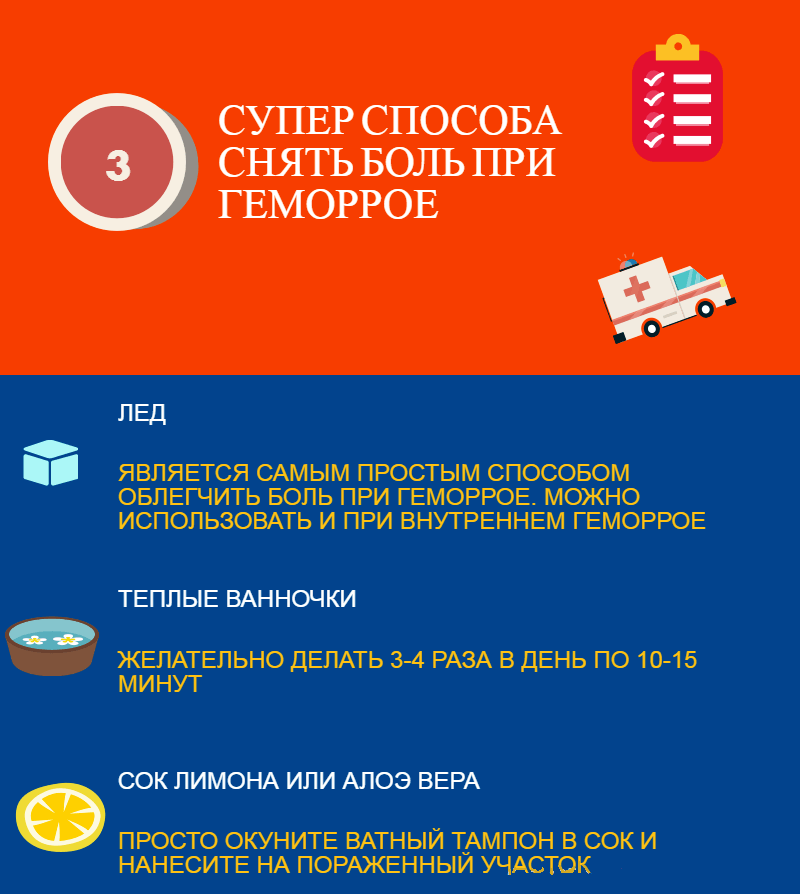
3 ways to relieve hemorrhoid pain
Important! It is necessary to alternate the herbs used every two weeks of use!
Kegel exercises for hemorrhoids
Carrying out a set of exercises allows you to reduce the risk of prolapse of hemorrhoids, strengthen the sphincter muscles, blood vessels.
How to do it: the first workouts start with light exercises. Inhale is done with tension, exhale at the moment of relaxation. Abrupt movements are excluded. The reason to stop training is the appearance of pain.
Each exercise is performed 10 times three times a week, then increased daily by 5 approaches:
- Slow compression and relaxation of the anal muscles for 5 seconds.
- Squeeze and unclench the muscles alternately.
- Contract muscles quickly and rhythmically.
- Tighten the muscles, representing pushing.
The posture at the initial stage is lying on your back, after the emergence of skills, classes are possible in any position.

Exercises for hemorrhoids
Contraindications to classes: oncological diseases, postoperative bleeding, inflammation of the pelvic organs, condition after a miscarriage or premature birth, profuse bleeding with hemorrhoids, vascular disorders of the lower extremities, perineal trauma during childbirth, hypertensive disease.
Treatment of hemorrhoids after childbirth consists in taking medications, using suppositories, baths, ointments, gymnastics and diet. It is necessary to pay attention to the state of the body in order to fully enjoy the joy of motherhood.


