
How long is dysbiosis treated in adults: how long will the intestine take to recover?
Dysbacteriosis has not received a separate diagnosis. Moreover, even in countries where the disease is generally recognized among doctors (outside the Russian Federation, for example, the possibility of a disorder microflora of the large intestine rejected by the medical community). Therefore, the treatment is prescribed complex, within the framework of another disease. For example, treating diarrhea. It has long been known that an imbalance in the intestinal biocenosis contributes to the occurrence of a number of diseases. Few doctors are able to clearly answer how much dysbiosis is treated in adults.
Most of the bacteria are found in the colon, 96% are anaerobic. Sometimes the general term dysbiosis is used to define imbalance, reflecting the disturbances introduced by helminths. This is considered a secondary pathology (and not a cause), ongoing against the background of a primary disease, aggravating the consequences.
Content
- 1 What is dysbiosis
- 2 Where does microflora come from?
- 3 Microflora composition
- 4 The role of microflora
- 5 Dysbiosis reasons
-
6 How long does dysbiosis last
- 6.1 Phases of dysbiosis
- 6.2 Time taken to make a diagnosis
- 6.3 Treatment
What is dysbiosis
The term dysbacteriosis was introduced in 1916 to denote putrefactive processes in the intestine, which occur against the background of an imbalance in the microflora of the mucous membrane. The first drugs came out in the middle of the 20th century, but the disease gained fame in the 80s. The disease is characterized by a qualitative or quantitative change in the composition of biocenosis strains. The term is rarely used abroad. Foreign doctors talk about the excess or insufficiency of a certain type of bacteria.
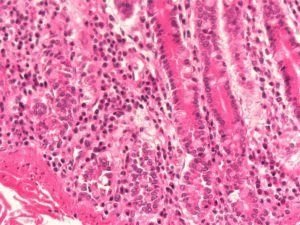
Putrefactive processes in the intestine
According to the international classification, the disease is absent, doctors consider this phenomenon to be a consequence of some pathological conditions. Russian medical practitioners have to work with section K59, the ninth part of which means “other functional intestinal disorders”. Or go to K63.
Where does microflora come from?
For the first time, studies of microflora were undertaken by Mechnikov and Nissle at the beginning of the 20th century. Then the field of research was abandoned for a long time due to the political situation on the planet. The colonization of the intestine with bacteria begins in the prenatal period. It is curious that the birth canal of a pregnant woman is overgrown with strains characteristic of the intestines. During childbirth, the child is gaining the necessary flora. Similar processes occur in the nipples of a nursing breast.
Research data is supported by information that children born by cesarean section have problems in the development of microflora. Young mothers are advised to start latching their babies to their breasts as soon as possible. Mother's milk also carries other useful qualities: it contains a number of substrates used by bacteria to feed the biocenosis. It turns out that breastfeeding encourages the growth of beneficial flora. Breast milk contains:
- Immunoglobulins.
- Lymphocytes.
- Macrophages.
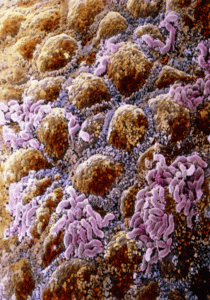
Microflora of the human mucosa
These chemicals are common in the normal gut environment. Proper nutrition for the adult population is encouraged. Simple food is rich in fiber, necessary for the growth of biocenosis. It is recommended to include in the diet:
- Onion.
- Garlic.
- Cereals.
- Artichoke.
- Chicory.
- Milk and so on.
Microflora composition
It is customary to divide the intestinal microflora into 4 categories according to their functional purpose:
- Obligate conglomerate performs a number of functions beneficial to the body. For example, it is engaged in the production of vitamins, the formation of immunity.
- The optional is represented by commensals of a fickle nature. The chosen ones are pathogenic.
- The transient component is brought in from the outside, inside the gastrointestinal tract does not exist for a long time.
- Pathogenic causes disease.
The bacteria are located in the intestinal cavity or are mucosal (located in the thickness of the mucous membrane). The first part of organisms makes up the lion's share of feces. Obligate component is formed for the most part by bifidobacteria. The total share reaches 98%. Lactobacilli are involved in maintaining the pH-factor level, regulating the conditions for the existence of the biocenosis.
The obligate conglomerate includes propionobacteria, which cause rashes in adolescents, Escherichia.
The role of microflora
Microflora promotes digestion, production of vitamins, assimilation, and the formation of immunity. Bacteria living in the environment do not allow harmful strains penetrating from the outside to multiply by regulating pH factor by the products of its own vital activity (acids: lactic, acetic, formic, amber). The main role is the fermentation of chyme, the formation of feces with simultaneous reabsorption of water.
Dysbiosis reasons
Researchers identify a number of factors in the onset of the disease:
- Exogenous:
- Climate.
- Environmental conditions, ecological situation.
- Food.
- Daily regime.
- Sanitary conditions.

- Endogenous:
- Pathology of the gastrointestinal tract of a different nature.
- Irrational intake of medications.
- Hereditary factor.
- Morphological disorders of the gastrointestinal tract.
- Violation of immunity.
Stress leads to the development of dysbiosis.
How long does dysbiosis last
Minor metabolic disorders in the gastrointestinal tract, for example, after the next party, self-heal in a period of 3 - 10 days. Experts say that the effect of taking medication in severe cases is manifested in 2-3 weeks, some symptoms are eliminated already on the second day. The duration of the manifestation of unpleasant factors is due to the nature of the disease. The disease is classified according to three degrees of severity (the doctor specifies).
The total duration consists of the time of the course of the disease in a latent form, the speed of diagnosis (up to 7 days), the duration of the course (1-2 weeks).

Phases of dysbiosis
Dysbacteriosis sequentially goes through several phases:
- An increase in the population of a particular strain.
- Suppression of neighbors due to displacement by the dominant species.
- The appearance of atypical microflora in the body. For example, in the mouth.
- The overgrown strain shows new properties, causing damage to the body. The phenomenon occurs against the background of decreasing immunity, pronounced signs of the disease.
An additional factor is the elimination of the protection of the intestinal walls. As a result, the organ is damaged by bile acids. The absorption of nutrients is impaired, leading to dehydration or weight loss. Diarrhea develops due to an excess of cAMP, which causes salt and water to enter the intestinal lumen.
Time taken to make a diagnosis
Symptoms do not begin to appear on the first day of the development of the disease, after going to the doctor it will take 5-7 days to wait for the test results. Known methods of express diagnostics.
Treatment
Treatment is prescribed individually and comprehensively. At first, a diet is drawn up, medicines (probiotics and prebiotics) are recommended. Medication is taken for a week.
You got an idea of dysbiosis, the duration of the treatment of the disease. It is recommended to undergo an examination immediately if necessary.


