Pancreas: Human Anatomy
The pancreas is an organ in the peritoneal region. The largest gland inside the body. The organ produces gastric juice, which is saturated with enzymes and hormones that are responsible for the metabolism of carbohydrates and proteins.
To know how to eliminate the emerging pathological processes, it is necessary to familiarize yourself with the structural features and functions of the organ in question.

Content:
- 1 Features of the structure of the pancreas
- 2 Dimensions (edit)
- 3 Pancreatic ducts
-
4 Functions
- 4.1 Exocrine function
- 4.2 Endocrine function
- 5 Functioning of digestive enzymes
- 6 Useful video
Features of the structure of the pancreas
Human anatomy has a complex structure. The digestive tract also has its own characteristic anatomical features.
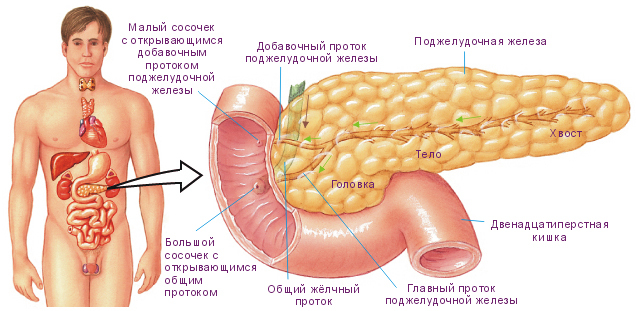
The structure of the human pancreas is expressed by a lobed, comma-shaped organ of a pink-gray hue. It is located behind and to the left of the stomach.
When the patient is laid on their back, the gland is under the stomach. This is where its name came from. The body, head and tail of the organ are highlighted.
The head is a component of the pancreas, which is connected to the duodenum. On the border of the body and the head is a notch where the portal vein is located.
The body of the gland has the shape of a trihedral prism. The anterior section is directed to the posterior wall of the stomach and up.
The posterior one is directed to the spinal column, is in close proximity to the inferior vena cava, the aorta on the peritoneum.
The lower part is directed downward and somewhat forward, located below the mesentery of the colon.
The tail of the organ in question has a pear-shaped shape, and also goes to the gate of the spleen. The Wirsung duct runs along the entire perimeter of the pancreas, which flows into the duodenum.
The pancreas assumes the presence of 2 types of tissues that carry out different functions (endocrine and exocrine).
Its backbone tissue is acini, which are separated by layers of scar tissue. Each acinus has its own excretory pathway.
These minor ducts are connected and combined into a single excretory pathway that runs in the pancreas along its perimeter, from beginning to end.
On the right edge of the head, the duct passes into the duodenum, connecting with a single biliary tract. So the gastric secretion penetrates into the duodenum.
In the middle of the lobules, there are subgroups of cells that do not have excretory pathways. However, they contain blood vessels that release insulin and glucagon directly into the bloodstream. The diameter is approximately 200 microns.
Dimensions (edit)
By its own dimensions, the pancreas holds the 2nd place among the organs capable of producing enzymes. Its formation occurs already at the 2nd month of pregnancy.
In a baby, the organ in question is 5 cm in length, in a child of 12 months - 7 cm, and at the age of 10 years, its dimensions are 15 cm in length. The organ is finally formed in adolescents, at the age of 16.
The head of the pancreas is its largest part. It reaches 5 cm or more in width, and is approximately 2 cm thick.
The body of the organ is considered the longest part; it reaches about 2 cm in width. The tail is 3.5 cm long and approximately 2 cm wide.
Due to the deep location, the detection of pathological processes of the organ in question is a rather complex process.
Therefore, it is extremely important during the diagnosis to conduct an ultrasound scan, which makes it possible to identify the shape and dimensions of the gland, as a result of which it is possible to draw specific conclusions about its tone.
The dimensions of the gland, as well as the probable provoking factors of pathology, are recorded in detail in the examination protocol. In a normal state, a homogeneous structure is characteristic of the organ in question.
Minor deviations from the standard dimensions of its components are allowed only if there are normal blood test values.
Pancreatic ducts
Acini and ducts are concentrated in the parenchyma of the organ in question. The former are cells that help produce secretions.
The outflow passes through small plug-in ducts that combine into large ones. Finally, the entire tube system is formed into a single pancreatic pathway (Wirsung duct).
Represents a tube. Through it, gastric juice penetrates into the intestine.
Before entering the duodenum of Wirsungs, the duct merges with the common bile duct. Rarely do they open separately into the intestines. Gastric juice moves in only one direction.
When the intestinal contents, due to any factors, begin to be thrown into the main path of the pancreas, and then into the interlobular pathways, this will lead to early activation of digestive enzymes and damage to the parenchyma of the organ in question by inflammatory phenomena.
The iron pathway system is interconnected with the bile ducts and the duodenum.
This is due to the extremely frequent combination of pathological processes of the pancreas and organs of the hepatobiliary system, the digestive tract.
In a patient with cholecystitis or an ulcer, pancreatitis is often found as a result.
To date, it has been established for certain that in a third of situations, pathological processes in the biliary ducts become a provoking factor of inflammatory phenomena in the gland.
Functions
The pancreas is considered a key part of the digestive system, which is characterized by mixed functioning: external and internal.
Exocrine involves the production of gastric secretions, which include digestive enzymes that are required for the proper digestion of food.
Endocrine involves the production of certain hormones and the regulation of metabolic processes.
Exocrine function
Every day, the pancreas produces 1 liter of gastric secretion, which involves the presence of enzymes, salts and water. Those components produced by the gland are called "enzymes".
Their production takes place in an inactive form. At the moment of penetration of the food lump into the duodenum, hormones are released, due to which carry out various chemical reactions that activate the enzymes of the gastric secret.
The most powerful stimulant of the secretion of the organ in question is hydrochloric acid.
It activates the release of secretin and pancreozymin mucosa at the moment of penetration into the small intestine. These components affect the production of pancreatic enzymes.
These include:
- Amylase, which breaks down carbohydrates;
- Trypsin and chymotrypsin, take part in the digestion of proteins, which begins in the stomach;
- Lipase, which is responsible for breaking down fats exposed to the action of bile from the gallbladder.
The gastric secretions contain elements in the form of acidic salts, which help to provide an alkaline reaction.
This is required in order to neutralize the acidic component of food products from the stomach, and to create the proper conditions for the digestion of carbohydrates.
The secretion of gastric juice regulates the nervous mechanisms.
In addition, it is interrelated with the consumption of food products (food of different structure helps to stimulate the production of juice that is different in quantity and composition of enzymes).
It concentrates in the interlobular pathways that flow into the main excretory pathway that passes into the duodenum.
Endocrine function
It involves the excretion of insulin and glucagon into the bloodstream.
They are produced by subgroups of cells that are located between the lobules and there are no excretory pathways (islets of Langerhans), which are in large volume in the tail of the organ in question.
These ducts suggest the presence of predominantly alpha and beta cells. Their number can normally exceed 1.5 million.
- Insulin is produced by beta cells. It is designed to maintain the balance of carbohydrate and lipid metabolism. Because of its effects, glucose is released from the bloodstream into tissues, lowering sugar levels. The cells in question occupy approximately 70% of the islets of Langerhans.
- Glucagon is produced by alpha cells. It has the opposite effect, makes it possible to increase blood glucose levels. In addition, they make it possible to produce lipocaine, which interferes with the fatty transformation of the liver. Their content is approximately 20%.
In addition, other cells are also found here in small volumes, for example, delta cells, which help to secrete ghrelin. It improves and stimulates appetite.
The destruction of beta cells inhibits the production of insulin, which leads to the formation of diabetes. The symptoms of this phenomenon will be thirst, itching on the dermis, and intense urination.
The pancreas is directly interconnected with other organs of the digestive tract. Each of her lesions or disorders in functioning will negatively affect the gastrointestinal tract.
Functioning of digestive enzymes
Exocrine functioning involves the production of such enzymes that determine the structure of gastric secretions:
- Trypsin is involved in the breakdown of peptides and proteins. Initially, production occurs by the organ in question as inactive trypsinogen, activated by enterokinase. It is secreted by the gastrointestinal mucosa. The organ in question is the only one that can produce trypsin, therefore, the establishment of its content is much more important during the diagnostic period than obtaining data on other enzymes. The establishment of activity will become a key indicator in the study of exacerbation of pathological processes and the detection of their origin.
- Lipase is considered an enzyme that digests and dissolves triglycerides. Its production is carried out as an inactive prolipase, and then, under the influence of other enzymes, it becomes active. The element in question breaks down neutral fats. In addition, it is an important element during the period of energy exchange, guaranteeing the penetration of polyunsaturated fatty acids into the tissues and the assimilation of specific fat-soluble vitamins. It can also be produced by other organs of the gastrointestinal tract. Each type of enzyme in question is considered an accelerator of the breakdown of a particular subgroup of fats. With the improper functioning of the organ in question, the activity of this enzyme will first of all deteriorate. The initial symptom is greasy, yellowish-gray stools.
- Amylase is required for the digestion of carbohydrates that enter the body. It is secreted by the pancreas and salivary glands. Deviations in the amount of such a component in the bloodstream are characteristic of a large amount pathological processes, but above all this indicates an exacerbation or chronic form pancreatitis.
A feature that distinguishes it from other components is that the enzymes of the organ in question are produced only in the process food intake - their increased release occurs after a few minutes after the penetration of food into the stomach and lasts 13 hours.
Enzymes fulfill their purpose only if the necessary volume of bile is present, which is produced by the gallbladder.
It helps to activate enzymes, is involved in the breakdown of lipids. Pancreatic enzymes are produced in a passive form and are activated only in the duodenum gap under the influence of enterokinase.
The organ in question is able to adapt to the food products consumed for a certain period of time.
Enzymes required for a specific period are produced.
For example, in the process of taking significant amounts of fatty fat, lipase will begin to be produced, during the period of an increase in protein food on the menu - trypsin, for the breakdown of products saturated with carbohydrates, the content of the corresponding enzymes.
However, one should not overload the pancreas, since often an impulse about disturbances in the functioning of the organ in question comes when the pathological process has already advanced.
The anatomy of the pancreas suggests its reaction during pathologies of other organs of the gastrointestinal tract. In this case, in the diagnosis, the specialist notes the "reactive form of pancreatitis."
The opposite situation also happens, because it is in close proximity to important organs.
The danger of damage to the pancreas is due to the fact that changes of a pathological nature appear in a short period of time.