
An enlarged pancreas: causes and treatment, diet
The pancreas is the largest gland in the human digestive tract. It performs very important functions, so any changes in the structure of this organ should not be ignored. An enlarged pancreas can only be detected by a doctor, and additional examinations will be required to make an accurate diagnosis. What is the evidence of the increase in the size of this organ, and how dangerous is it?

An enlarged pancreas: causes and treatment, diet
Content
- 1 Pancreatic functions
- 2 Reasons for an enlarged pancreas
- 3 Reasons for the total increase
- 4 Reasons for local increase
- 5 Symptoms
- 6 Diagnostics
-
7 Treatment
- 7.1 Video - Signs of pancreatic disease
-
8 Diet
- 8.1 Video - Diet number 5 according to Pevzner
- 9 Consequences of diseases
Pancreatic functions
First you need to figure out what role the pancreas plays in the human body. Unlike many other organs, it performs the functions of both external and internal secretion:
External secretion - produces pancreatic enzymes that are necessary for the process of digesting food. In addition, the acidic environment of the gastric chyme is neutralized in it, due to which it is prepared for advancement into the duodenum.
Internal secretion - inside the gland there are groups of cells that do not have excretory ducts. They secrete hormones that regulate carbohydrate metabolism directly into the systemic circulation.
On a note! Damage to the pancreas, as well as all its diseases, are considered very dangerous and require an urgent and correct treatment regimen.

Functions of the pancreas in the human body
Reasons for an enlarged pancreas
Doctors distinguish between two types of pancreatic enlargement:
- Total.
- Local.
On a note! It is very important to correctly determine the nature and localization of the increase, as this will give an understanding of the possible causes and probable disturbances in the work of the body. It must be understood that the expansion of the boundaries of an organ is only a symptom that can be caused by several diseases.
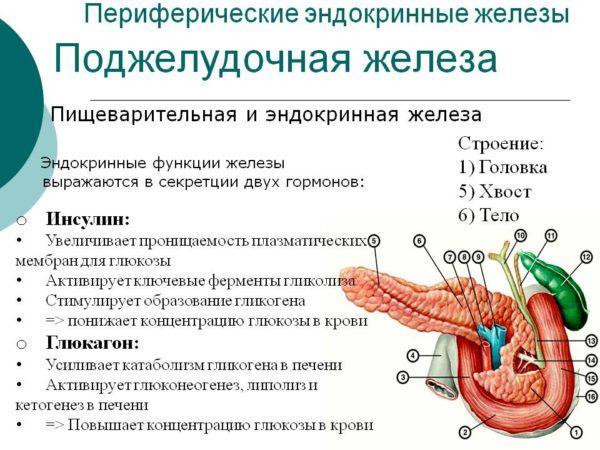
Endocrine functions of the pancreas
The general mechanism for the development of an enlarged gland is as follows:
- The organ for any reason (inflammation, hereditary characteristics, endocrine disorders) does not cope with its functions.
- Pancreatic cells begin to work harder to fill the existing deficiency of enzymes, which leads to their "bloating".
- Expansion can be uniform (when the process affects all parts of the organ) or diffuse (only a certain area swells).
Reasons for the total increase
Swelling of all cells, as a rule, is observed with inflammation of the pancreas. This condition is called pancreatitis and can be acute or chronic. A feature with a total increase is also the defeat of other organs, due to the fact that the inflammatory process is transmitted to them (liver, spleen, and others).
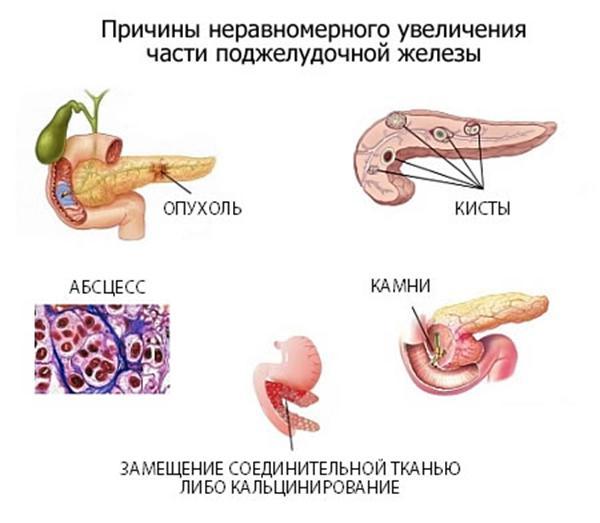
Causes of uneven enlargement of a part of the pancreas
Of the factors that can provoke such a condition, doctors distinguish:
- Cystic fibrosis.
- Infectious diseases.
- Genetically determined features of the structure of the organ.
- Abdominal trauma.
- Autoimmune processes.
- Inflammation.
- Intoxication, including drug and alcohol.
- Peptic ulcer of adjacent organs.
Reasons for local increase
In the structure of the pancreas, there are three conventional parts: the head (beginning), body (middle) and tail (end). Depending on the localization of the pathological process, doctors may suspect various diseases.
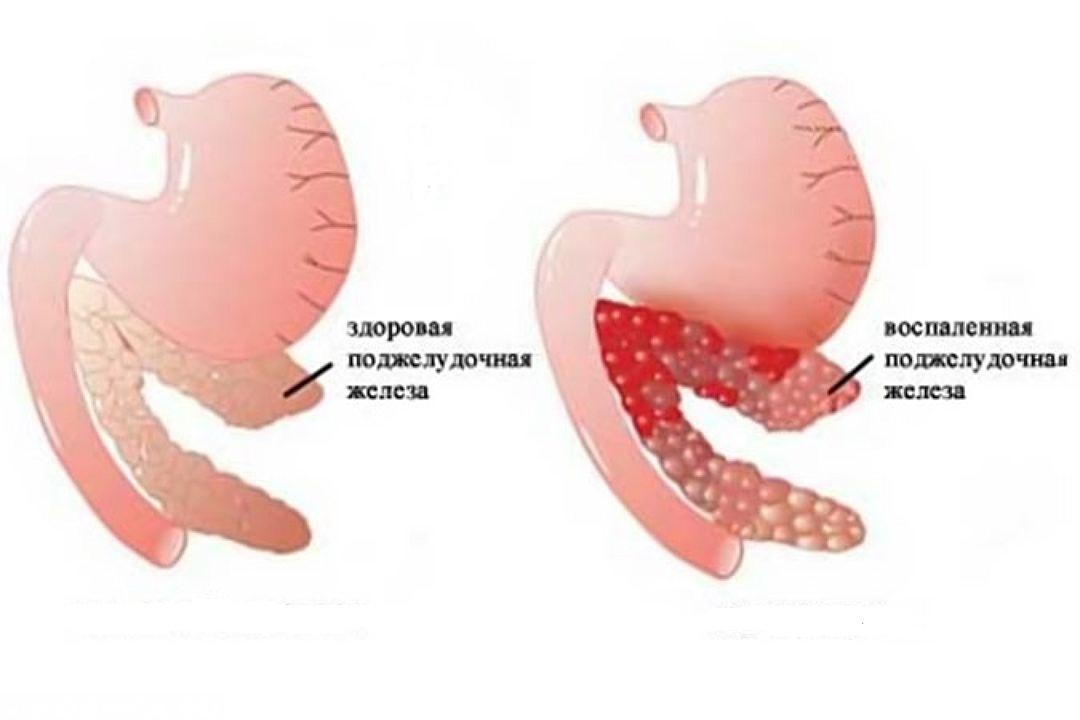
Pancreas image
An increase in a separate part of the secretory organ may indicate the presence of the following conditions:
- Pseudocyst.
- Abscess.
- Benign tumor.
- Malignant education.
- Presence of stones.
- Duodenitis with inflammation of the intestinal papilla.
On a note! Local enlargement of the middle part of the organ is much less common than the head or tail.
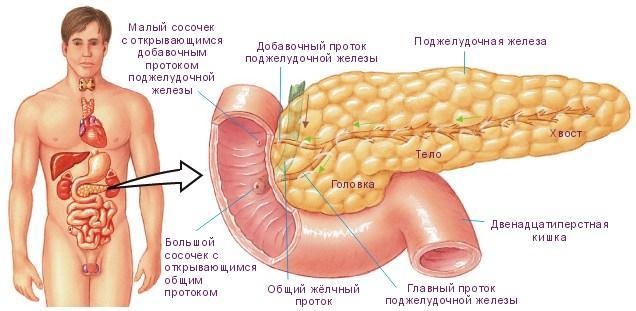
The structure of the pancreas
Symptoms
Quite often, problems with the pancreas signal themselves only at the last stage. Severe symptoms may be absent in both the adult and the child. However, the manifestations of pathology are individual and for some patients the disease can cause discomfort almost immediately.
Pain is the main symptom that does not go unnoticed. Its localization and intensity may vary. Some patients complain of exhausting and aching discomfort, which practically does not go away and resembles a burning sensation. The predominant location is the navel area and even innervation in the left hand.

Symptoms of an enlarged pancreas
Depending on the diagnosis, the temperature may rise, up to high values.
On a note! If other organs are involved in the pathological process, the spectrum of unpleasant symptoms expands. With liver damage, a person may complain of nausea, vomiting, bitterness in the mouth, changes in the color and consistency of stools.
With a high probability, problems with the pancreas can be suspected by such a complex of symptoms: fever, diarrhea, nausea, and abdominal pain.

Symptoms at different stages of pancreatitis
Diagnostics
In most cases, the increase is not detected in the initial stages. Palpation to detect the expansion of the boundaries of the organ is quite difficult, since the gland is hidden in the abdominal cavity. Only when the patient has complaints, the doctor prescribes additional studies. Sometimes pathology is discovered by chance, during a comprehensive examination.
Very often, the symptoms of the disease are absent until the very last stage, and the pathology progresses at the same time.
An informative diagnostic method is ultrasound, and in addition to it, a biochemical blood test is prescribed.
The gastroenterologist deals with the problem, but the final decision can be made together with the surgeon, who helps to decide between conservative and surgical treatment. In case of chronic inflammation, treatment in a hospital is required and a subsequent assessment of the dynamics of improvements.

Pancreas ultrasound
Treatment
Pancreas treatment is always complex. It includes:
- Special diet.
- Prescribing drugs that suppress the activity of the pancreas.
- Reception of enzymes that compensate for the lack of pancreatic function.
On a note! With the ineffectiveness of conservative treatment, they resort to surgical intervention.
The main goal of therapy is to eliminate the main cause that led to the pathological process in the pancreas. In parallel with this, symptomatic treatment is prescribed in order to alleviate the patient's condition. Any medications, including pain relievers, should only be prescribed by a doctor.

Additional causes of an enlarged pancreas
Groups of drugs that can be prescribed:
- Enzymes (Creon, Pancreatin).
- Antispasmodics (No-shpa, Spazmalgon, Meverin, Duspatalin).
- Antacids (Almagel, Maalox).
- Antibiotics (Clarithromycin, Amoxicillin).
- Blocking the enzymatic function of the organ (Omez, Ranitidine, Famotidine).
You can relieve the condition on your own with the help of non-carbonated mineral water. The liquid helps to remove excess pancreatic juice, and also removes toxins from the entire body. After stopping the acute condition, the doctor will prescribe supportive therapy and give a list of drugs that the patient will take on their own. To control the state of the pancreas, it is recommended to be examined by a gastroenterologist, even if there are no complaints.
Video - Signs of pancreatic disease
Diet
For diseases of the pancreas, a gentle diet is prescribed, which corresponds to the fifth dietary table. Basic rules to be followed in the patient's diet:
- The portions should be small. In this case, it is recommended to eat 4-5 times a day. This reduces the burden on the digestive organs and also ensures a regular outflow of bile.
- Meals should be rich in vitamins and fully satisfy the needs for proteins and carbohydrates. Fats are recommended to be consumed of vegetable origin, and their total amount in the diet should be reduced.
- The method of cooking and the temperature of the food is important. Preference is given to cooking and baking. If possible, the finished dish should be mashed. It is optimal to take warm food, and exclude cold and hot dishes, so as not to irritate the pancreas.
- Vegetables and fruits should be eaten daily, you can cook stews from them.
- Warm soup or low-fat broth is well accepted by the pancreas. It is allowed to cook them from chicken, lean pork or fish.

A detailed list of foods for inflammation of the pancreas
When choosing products for cooking, you can rely on the following table:
| Forbidden | Allowed |
|---|---|
| Cookies, creams | Natural sweets, dried bread, jam, honey, crackers, marshmallow |
| Fried, smoked, spicy | Chicken, lean fish |
| Legumes, all mushrooms | Low-fat lactic acid products |
| Sorrel, onion, garlic, radish | Water-boiled porridge |
| Carbonated drinks, alcohol | Dried fruit compote, jelly, sweet tea |

Diet for pancreatitis
Below is a menu with which you can provide yourself with a nutritious and varied diet:
| Breakfast | Snack | Dinner | Afternoon snack | Dinner |
|---|---|---|---|---|
| Semolina porridge with apple and green tea; rice porridge with orange; oatmeal and jelly; rice porridge with croutons; barley porridge with honey |
Pumpkin puree; baked apple; cottage cheese with honey and tea; steam cutlet and rosehip infusion; grated apple with cottage cheese and biscuit biscuits |
Vegetable broth with boiled meat, croutons; carrot soup with other vegetables and meatballs, compote; vegetable puree soup, meatballs; lean steamed fish, mashed potatoes; rabbit cutlets, stew |
Low-fat cottage cheese with fruit; low-fat yogurt with croutons, honey and apple; steam omelet; cottage cheese casserole; baked apple |
Beef cutlet, compote; potato casserole with minced meat, jelly; baked fish with vegetables; mashed potatoes, steamed fish; vegetable casserole, boiled chicken |
On a note! At the end of the acute period, the patient can eat quite variedly, the main thing is a gentle cooking regimen.
Video - Diet number 5 according to Pevzner
Consequences of diseases
If pathologies are found in the pancreas, it is recommended to start treatment immediately. Untimely therapy leads to a deterioration in the patient's condition, up to a lethal outcome. Due to organ dysfunction, there are violations of all types of metabolism in the body (carbohydrate, fat and protein), as well as endocrine disruptions. An increase in the pancreas can subsequently cause:
- Pancreatitis
- Diabetes.
- Pancreatic necrosis.
- Purulent processes, the release of toxins into the blood.
- Benign formations.
- Pathology of the hepatobiliary apparatus.
- Acetonemic syndrome (especially in children).
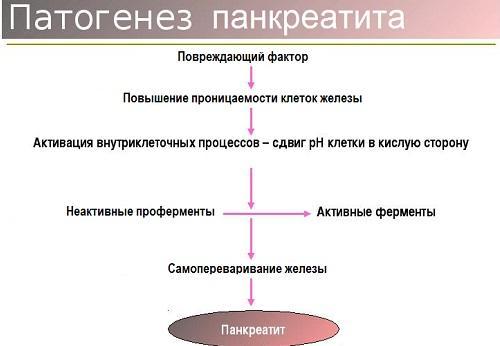
Pathogenesis of pancreatitis
Patients should remember that after completing the course of treatment, food restrictions must still be observed. For many people, dietary table # 5 is the basis of nutrition for the rest of their lives. The pancreas is an organ that is difficult to treat, and surgery and resection are quite dangerous and do not always lead to recovery.
Everyone can avoid problems with the pancreas in the absence of congenital pathologies. To do this, you need to adjust your lifestyle and pay great attention to proper nutrition. Compliance with a diet, exclusion of alcohol and spicy foods will help prevent serious pathologies and maintain health for many years.


