How to distinguish vomiting from regurgitation in infants: characteristic signs
It is useful for young and expectant mothers to know all the features of the child's body. In infants under the age of one year, the usual incident occurs as regurgitation of the food taken. But a more dangerous process happens - vomiting. Adults are suddenly confronted with a misunderstanding: how the process of regurgitation differs from vomiting. The answers are contained in our article.
Mothers need to study thoroughly about vomiting and regurgitation, their differences, symptoms, causes and consequences.
Vomiting is the first symptom of the disease in infants. For adults, it is less common.
Signs of vomiting:
- pale face;
- copious saliva;
- the heart often beats violently;
- nausea;
- cold limbs.
Content
-
1 Regurgitation: causes, consequences, prevention
- 1.1 Anatomical reason for regurgitation
- 1.2 Pathological causes
- 1.3 Regurgitation rate
- 1.4 The consequences of regurgitation
- 1.5 Regurgitation treatment
- 1.6 Regurgitation prevention
-
2 Vomiting in newborns
- 2.1 Vomiting of highly excitable children
- 2.2 Vomiting reactions with pyloric spasm
- 2.3 Doctor Evgeny Komarovsky is speaking
- 2.4 Causes of vomiting
- 2.5 Vomiting and diarrhea
Regurgitation: causes, consequences, prevention
Regurgitation is a process in which a small amount of food received is removed from the stomach through the mouth, accompanied by increased work of the abdominal muscles. This is the norm for the first months. The frequency in newborns is different: babies spit up every time they feed, for some this is a rare event. There are no main ways to get rid of belching. Pediatricians advise prophylaxis available to parents. It helps to reduce the amount of regurgitation and frequency.

Several reasons for regurgitation have been identified: anatomical, pathological.
Anatomical reason for regurgitation
The shape of the esophagus is not so developed to block the return flow of food, which allows it to go back. Contributes to the fact that the entrance to the stomach is open and the exit is closed.
Pathological causes
Complex reasons:
- pyloric stenosis;
- pathology of the development of the esophagus;
- intestinal obstruction;
- inflammation of the appendix.
Other reasons:
- dyspepsia (disruption of the digestive tract);
- prolonged cry;
- incorrect feeding technique;
- digestive problems (colic, flatulence, dysbiosis);
- food poisoning;
- intestinal infections.
Regurgitation rate
In most newborns, it lasts during the first weeks. It passes when the baby starts to sit and walk. Cases of primary appearance at the age of several months have been recorded.
If the child steadily gains weight, is healthy, then the mother can only wait for his growth, debugging the digestive system.
The reason to see a doctor is a gushing regurgitating mass with a smell.
The normal course of regurgitation is:
- A small mass of regurgitated food.
- There are no gagging urges.
- The frequency is less than 2 times a day.
- They pass without medication.
- The newborn is gaining weight steadily.
- The mass does not smell, looks like slightly overcooked milk.
The consequences of regurgitation
The main negative consequences of regurgitation are weight loss.
Regurgitation of food at night leads to the ingestion of food mass into the respiratory tract, from which the baby chokes and suffocates.
The baby often spits up the received food - the phenomenon of dehydration appears. There are a number of signs by which it is easy to determine the lack of fluid in the body from the symptoms of other diseases.

Signs of dehydration:
- The newborn is constantly asking for a drink.
- Refuses to eat.
- The child has constant weakness, drowsiness.
- Low body temperature.
- Infrequent urination (less than 10 times a day).
If a parent has noticed 2-3 stable signs from the listed ones, it is necessary to consult a doctor.
Regurgitation treatment
In difficult cases, the process cannot be stopped by simply moving the child in space. Sometimes other help is needed.
- Due to possible dehydration, it is necessary to replenish the amount of fluid in the baby's body. Feeding is usually insufficient. It is necessary to introduce more water, tea, juice, fruit drink into the diet.
- With frequent vomiting, regurgitation or digestive problems (constipation, diarrhea), the doctor prescribes special mixtures. It is necessary to follow the prescriptions, instructions for using the mixture.
- In especially acute cases, the doctor prescribes medication. It is worth noting that parents are prohibited from prescribing medication for a child on their own.
Regurgitation prevention
Often mothers on their own involuntarily provoke the process of regurgitation of food after feeding. To avoid it, there are rules to be followed.
Rules for mothers:
- Monitor the correct feeding.
- Wait for the child to calm down with anxiety, crying.
- Avoid overfeeding. Feed often in smaller portions.

- Do not feed the baby while lying down. Feeding positions: half-sitting, sitting, reclining.
- Strain the milk with a strong pressure.
- After feeding, hold the baby horizontally to regurgitate air.
- Do active procedures before feeding.
- Choose the right mixture.
At the moment of regurgitation, the mother should immediately shift it vertically so as not to choke. Doctors recommend putting children on their stomachs for prevention.
Vomiting in newborns
Vomiting is a complete eruption of the gastric mass. It does not indicate illness, with a one-time case, the baby does not feel sick, he is cheerful, cheerful.
The first 2 days after birth, the vomiting reaction is caused by mucus that has accumulated in the stomach during growth and development in the mother's abdomen.
Parents noticed green bile in the child's vomit - a symptom of many diseases - an urgent medical examination is required.
Vomiting of highly excitable children
There are newborns who are highly excitable, with attention deficit hyperactivity disorder. Here, the process of complete emptying of the stomach is observed every day. When angry, children provoke vomiting. Then mom immediately runs to help. Parents are quickly "led" to provoke such behavioral reactions.
Adults need to take this calmly so as not to disrupt the reeducation process. When the baby learns that parents react coldly to "strikes", the phenomena will stop immediately.

Vomiting reactions with pyloric spasm
The sphincter spasm occurs in the first 3-4 weeks. The gatekeeper (separates the stomach and intestines) does not open completely, poorly passing food. The reaction comes in the process of feeding, after it. When the spasm occurs more than twice a day, the child must be placed under medical supervision.
If babies have the urge for the first time, the case is a one-time, it is necessary to measure the temperature. Colds, flu, pathology of the digestive tract, concussion in children begins with vomiting. It passes without fever, the child looks healthy - there is no reason for concern.
Doctor Evgeny Komarovsky is speaking
Pediatrician E. Komarovsky thoroughly studied the question of regurgitation. It is very easy to distinguish vomiting from regurgitation: regurgitation is more often the norm, and vomiting is one of the causes of the disease. The first is simply the back reaction of the stomach to excess food. When regurgitating, the general condition of the child is not disturbed. With the second, the accompanying symptoms of the disease necessarily progress.
Now more about vomiting: what are the reasons, what should be the first aid.
Causes of vomiting
Primary causes:
- binge eating;
- underdeveloped vestibular apparatus;
- large pieces of complementary foods;
- overexcitation;
- air in the esophagus.
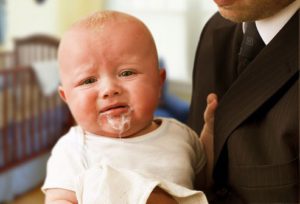
Secondary causes:
- infection and viruses;
- acute appendicitis;
- brain concussion;
- intestinal obstruction;
- abdominal trauma;
- congenital hernia;
- high blood pressure;
- reactions to the first food and medication.
First aid:
- Rinse mouth with water.
- Give water to drink to avoid dehydration.
If blood, bile impurities, mucus, feces, repeated attacks are found in the vomit, call an ambulance.
Vomiting and diarrhea
Causes:
- intestinal obstruction;
- viral diseases;
- chemical or food poisoning;
- early start of complementary feeding;
- bacteria are pathogens.

First aid:
- Give an enema.
- Flush the stomach.
- Call an ambulance.
Complications of vomiting:
- aspiration pneumonia;
- rupture of the esophagus;
- hypoglycemia;
- dehydration;
- suffocation and death.
Required examinations:
- general analysis of blood and urine;
- Ultrasound of the gastrointestinal tract;
- FGDS;
- blood biochemistry;
- x-ray of the esophagus and stomach;
- coprogram.