Abdominal pain to the left of the navel: reasons for what to do
Even a child knows: if the stomach hurts to the right of the navel, it could be appendicitis. With age, knowledge comes that the gallbladder is also on the right. Why does the stomach to the left of the navel hurt? An unpleasant sensation affecting the left abdomen can signal the occurrence of serious diseases of the following abdominal organs:
- Descending colon;
- Sigmoid colon;
- Rectum;
- Left ureter;
- Left ovary and fallopian tube (in women).
To understand which ones, you need to understand what kind of pain is manifested in a person.
Content
- 1 The nature of pain in the abdomen
-
2 Symptoms of pathologies causing pain to the left of the navel
- 2.1 Sigmoiditis
- 2.2 Crohn's disease (granulomatous enteritis)
- 2.3 Diverticulitis
- 2.4 Infectious colitis
- 2.5 The activity of parasites in the body
- 2.6 Spleen diseases
- 3 Pain in men
- 4 Pain in women
The nature of pain in the abdomen
The intensity of the sensations, how pain makes a person feel it, is the nature of the pain.
- Dull and aching - often speaks of gynecological problems. It can be an inflammatory process in the left ovary or left fallopian tube. In these cases, abdominal pain on the left is accompanied by discomfort during physical exertion, intercourse and menstruation. Dull and aching pain can also occur with varicose veins in the small pelvis; hemorrhoidal veins; chronic cystitis; diseases of the sigmoid and rectum.
- Pulling character. Pulling pain reports on purulent inflammation in the organs of the genitourinary and digestive systems. Can give to the lower back, groin, left leg.

- Stabbing character. Pain occurs with urolithiasis, when the stone passes through the left ureter. Gives to the lower back and groin. Stitching pains can accompany diseases of the sigmoid colon and rectal sphincter.
- Sharp character. Acute pain is provoked by spasms and colic. Occurs when: cystitis; urolithiasis; infectious inflammatory diseases of the gastrointestinal tract (colitis; dysentery; salmonellosis; gastroenteritis; Crohn's disease; sigmoiditis).
- Sharp character. Sharp pain in the abdomen is manifested in "female" diseases: adnexitis (inflammation of the appendages); ectopic pregnancy.
Sharp pain in the left abdomen can also occur in stage 3 and 4 cancer.
Pain can signal that there is a serious pathology in the body. It is important to seek medical help in time.
Symptoms of pathologies causing pain to the left of the navel
Look at the accompanying symptoms to understand the cause of the pain. Each disease has its own symptoms, which allows a preliminary diagnosis to be made before a complete examination.
Sigmoiditis
The cause of the pain to the left of the navel may be sigmoiditis - inflammation sigmoid colon large intestine. The disease has two forms: acute and chronic. It can be called by:
- Internal causes: infections; Crohn's disease; dysbiosis; nonspecific ulcerative colitis; problems with the vessels of the mesentery.
- External causes: poisoning with pesticides; radiation contamination.
The symptoms of sigmoiditis are:
- In pains of an acute and cutting nature, localized in the left side of the iliac region and radiating to the hip and lower back.
- Stool disorders (diarrhea or constipation).
- False urge to defecate.
- Decreased appetite.
- In general, ailments.
- In nervousness and insomnia.
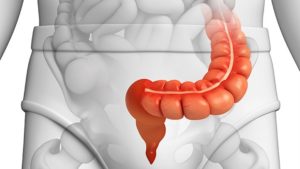
Inflammation of the sigmoid colon of the large intestine
Treatment of sigmoiditis is a strict diet, taking antibiotics and antispasmodics.
Crohn's disease (granulomatous enteritis)
The cause of pain to the left of the navel may lie in Crohn's disease - disorders of the intestinal structure with the formation of intestinal adhesions and fistulas. The disease is chronic. The duration of the acute period can be up to six months, depending on the general condition of the body.
The inflammation gradually leads to narrowing of the intestinal canal and filling of the intestine with serous fluid around the affected area.
Crohn's disease symptoms are divided into two types:
- Extraintestinal signs: feeling of weakness, weight loss, constantly elevated body temperature (37-37.5C), damage to joints, blood, kidneys.
- Intestinal signs: sharp stabbing pains, diarrhea mixed with blood and mucus, inflammation of the rectal sphincter.
Until now, doctors cannot determine the exact cause of Crohn's disease. Among the reasons influencing the development of the disease are hereditary, infectious and factors associated with immunity.
The beginning of an exacerbation can be put:
- Poisoning with chemicals;
- Diseases of the gastrointestinal tract, which are of a viral nature;
- Chronic intestinal infection;
- A stomach or intestinal ulcer;
- Decreased immunity;
- Abdominal trauma affecting the area of the sigmoid colon;
- Postoperative complication;
- Poor nutrition.
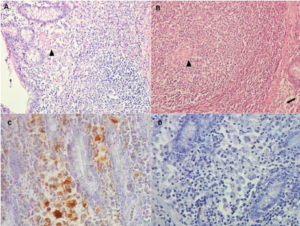
Granulomatous enteritis
Treatment of the initial stages of the disease is medication. The doctor may prescribe antagonists for the receptors of the immune system, glucocorticosteroids, sulfasalazine. If conservative treatment is ineffective, the damaged area is removed surgically. After the operation, the patient must follow a diet and take vitamins.
Diverticulitis
The cause of left-sided pain at the level of the abdomen can be intestinal diverticulitis - a complication of diverticulosis. It is important to separate these concepts.
The basis of the intestinal walls is made up of smooth muscles, due to which peristalsis is carried out, moving the contents into the lower parts. On the walls of the intestine (more often in the sigmoid colon, located immediately in front of the rectum), hernial protrusions - diverticula can form. The presence of such protrusions of the intestine is diverticulosis. Intestinal contents can enter the diverticula. It remains there, provoking an increased multiplication of microorganisms and the occurrence of an inflammatory process. This inflammatory process in diverticula is called diverticulitis.
Diverticulitis symptoms are similar to symptoms of other common diseases. The characteristic signs will help to clarify the diagnosis:
- The monotonous nature of pain, localized on the left in the lower abdomen, passing into the left side, increases with physical exertion, coughing, and laughter.
- The patient can point to a specific point - the center where pain is felt.
- The unpleasant sensations last for a long time (up to several days).
- Increased pain on palpation.
- Alternating diarrhea and constipation.
- Lack of relief after bowel movement.
Ten percent of patients with diverticulitis have blood in their stool. When the diverticulum ruptures, the bleeding becomes more profuse, and the person feels short-term acute pain.
Possible complications of diverticulitis:
- Formation of a peri-intestinal infiltrate (fluid that permeates tissue, which, on palpation, feels like a painful tumor-like formation).
- The formation of adhesions that cause intestinal obstruction.
- The appearance of fistulas, through them the contents of the intestine enters other organs.
- Development of peritonitis - inflammation of the peritoneum.
- In rare cases, the degeneration of diverticulitis into a malignant tumor.
Many have diverticula; only a few develop diverticulitis.
Its development can be facilitated by:
- Inflammatory diseases of the large intestine (colitis of various etiologies).
- A small amount of fiber (dietary fiber) consumed, which contributes to the development of constipation, which increases pressure in the intestines and provokes blockage of diverticulums.
- Hereditary factors: a child may have a predisposition to the formation of diverticula, inherited from their ancestors, it is even possible to be born with formed diverticula.
- Older age: muscle tone weakens, constipation becomes frequent, diverticulum blockage is more likely.
- Helminthiasis: worms change the natural intestinal microflora, violate the integrity of the mucous membrane, which provokes the appearance of foci of inflammation.
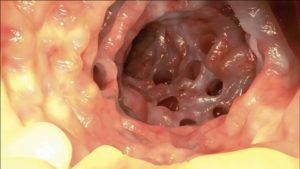
Intestinal diverticulitis
Methods for diagnosing diverticulitis:
- Colonoscopy, carried out with an endoscope inserted through the anus, can accurately determine the presence of diverticula.
- Computer and magnetic resonance imaging.
- Irrigoscopy (X-ray examination with the introduction of a contrast agent to obtain a clear image).
- Ultrasound examination of the abdominal cavity is effective in the later stages of the development of the disease, helping to identify well-filled diverticula.
- Laparoscopy is a method of diagnosis and treatment: through a small incision in the abdominal wall, using a camera, the outer side of the intestine is visually examined, diverticula are removed.
In acute diverticulitis, contrast radiography is undesirable; irrigoscopy is used to determine the effectiveness of the treatment. Ultrasound and CT help differentiate diverticulitis from other diseases affecting the abdominal cavity (appendicitis, abscesses, etc.).
Treatment is more often carried out within the walls of a medical institution. With a mild course of the disease, treatment is outpatient, by taking medication and adhering to a diet.
For therapy, drugs are used that can prevent the development of inflammation, reduce pain. The following groups are used:
- Broad-spectrum antibiotics that kill bacteria, reduce inflammation, and clear the diverticulum of feces and pus.
- Anti-inflammatory and antimicrobial agents help to eliminate pathogenic microflora and inflammation, prevent relapse of the disease.
- Light laxatives of natural origin, allowing to cleanse the intestines from stagnant feces, relieve pressure on diverticula.
- Antispasmodics help relieve discomfort.
- Allergy medications reduce swelling of the intestinal walls.
In severe cases, the administration of drugs is carried out intramuscularly or intravenously, with a mild course of the disease - orally.
Infectious colitis
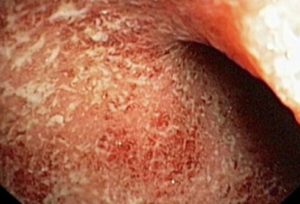
Infectious colitis
Infectious colitis is an inflammatory disease colon (the descending colon is on the left side of the abdomen) caused by pathogens.
Infectious colitis symptoms:
- Painful bowel cramps;
- Loud rumbling in the stomach;
- Frequent loose stools;
- Increased body temperature;
- Weakness.
With severe diarrhea, dehydration can develop.
To identify the cause of the malaise, laboratory diagnostics are used: bacteriological, virological and parasitological research. In case of complications, blood cultures are taken for sterility. A blood test shows an increase in the level of leukocytes, erythrocyte sedimentation rate.
Treatment is carried out conservatively: antibacterial agents are used. If the causative agent is Shigella, fluoroquinolone and 8-hydroxyquinoline are prescribed. If the pathogenic activity of Escherichia coli is detected, take modern cephalosporins. At pseudomembranous colitiscaused by Clostridial infection - taking metronidazole. Sometimes amoeba can be the causative agent of the disease. With amoebiasis, recovery should be helped by amoebocydes, metronidazole.
The fight against dehydration of the body is important: Regidron or Oralit is prescribed to saturate the body with moisture.
After the elimination of acute symptoms, a restorative diet is prescribed and the intake of enzymatic drugs (Pancreatin, Festal and others), prebiotics.
The activity of parasites in the body
Severe abdominal pain to the left of the navel may indicate the presence of parasites in the intestines. The causes of infection can be a violation of the rules of personal hygiene, reduced immunity, communication with infected animals, food that has not undergone good heat treatment.

With helminthiasis, there are:
- Stitching pain in the abdomen on the left;
- Constant feeling of nausea, urge to vomit;
- Rectal itching;
- Cough (one of the stages of development of roundworms takes place in the lungs);
- Symptoms of general intoxication;
- Skin rashes;
- Increased body temperature.
Helminthiasis is diagnosed based on the analysis of feces.
Treatment takes place by taking anthelmintic drugs (Nemozole, Pirantel, Vermox). Adherence to a strict diet, increased control over personal hygiene, processing of linen, treatment of helminthiasis in pets is recommended.
Spleen diseases
The spleen is an unpaired organ located in the left hypochondrium, which can also hurt. Responsible for hematopoiesis and immunity stability, is the place of blood deposition.
The main problems with the spleen, which can provoke discomfort in the left side of the abdominal cavity, are:
- Perisplenitis (inflammation of the connective tissue capsule that protects the spleen).
- Splenomegaly (an increase in the size of the spleen, which is a consequence of pathological processes in other parts of the body).
- Spleen vascular thrombosis.
- Spleen infarction (rupture of the spleen, often resulting from trauma, the spleen is a very fragile organ).
- Spleen rupture (also often occurs after even minor injuries).
Each of these diseases is a reason for an immediate visit to a doctor who will choose the correct treatment strategy.
Pain in men
Pain in the left side of the abdomen in men can occur for various reasons. This is:
- Inflammation of the testicles;
- The appearance of a hernia;
- Cyst development.
These pathologies cause:
- Increased body temperature;
- Weakness;
- Nausea.
The pain may not be limited to the abdominal cavity, but may descend into the groin area.
Another possible cause of painful sensations in men is inflammation of the prostate gland.
The nature of the pain is pulling or cutting. The main problem is sharp pain when urinating. Also, with inflammation of the prostate gland, erectile dysfunction is manifested.
Pain in women
Pain in the left abdomen in women is an alarming symptom. When they appear, you need to seek the help of a specialist to make an accurate diagnosis and prescribe treatment. A woman may complain of sharp pain in the lower left abdomen and the associated inability to bend low.
The reasons may be:
- Adnexitis (inflammation of the appendages);
- Ectopic pregnancy;
- The development of tumor processes in the genital area.
Pain in the left side of the abdomen cannot be ignored. If it is acute or continues to bother for several days, and is also accompanied by other symptoms, this is a reason for immediate medical attention.