
A child has diarrhea with blood and mucus: causes of the condition
At an early age, the child's digestive tract is at the stage of formation, so parents need to be careful about nutrition. For the full breakdown of food, the autonomic nerves of the gastrointestinal tract, enzyme systems, and muscle fibers are involved. The additionally consumed food should be well crushed with a chewing apparatus (as the teeth grow in babies, this process is not performed enough). The result is frequent diarrhea.

With the introduction of complementary foods, the child may have diarrhea.
This is quite normal for a small child. However, parents should be wary and go to a specialist in case of bloody diarrhea with mucus splashes.
Such manifestations indicate a serious disorder in the child's body. On the part of the parents, there should be an immediate reaction, since as a result of frequent watery bowel movements, the body is very quickly dehydrated. Therefore, it is important to know the root causes that led to this condition of the child.

Frequent watery diarrhea in a child is a sign of a malfunction in the digestive tract
Content
- 1 Main reasons
-
2 Causes of the pathological appearance of blood and mucus in the feces
- 2.1 Gray mucus in the stool of a child
- 3 How to treat bloody and mucus diarrhea in a child
-
4 Preventive actions
- 4.1 What to do if there is blood in the stool
- 4.2 Video - A child has diarrhea with blood and mucus
Main reasons
This pathology in children is conventionally divided into two groups. The first is characterized exclusively by diarrhea with a mucous manifestation, and is directly related to the process of development of the body and growth (absolutely does not pose any threat to the body).

Diarrhea with mucus is a variant of the norm
The second group includes a diarrhea with blood and mucus - indicates a disease and poses a threat to the baby's health.
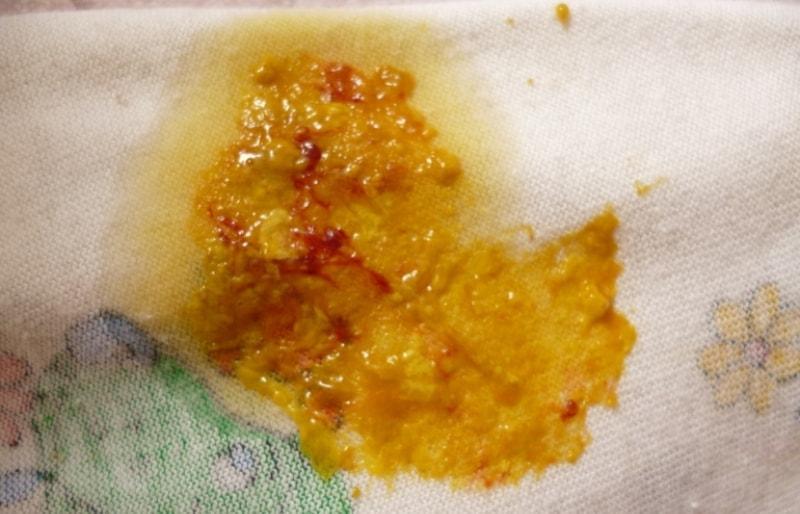
Feces with mucus and blood indicate serious problems in the child's body.
Table. Diarrhea at different ages with mucus
| Child's age | Explanation of the occurrence of diarrhea |
|---|---|
 Up to one year |
If the baby's parents observe the appearance of mucous inclusions in the feces, then do not worry. The specificity of the intestines at this age is characterized by increased production of mucus. These physiological features are an auxiliary factor for the adaptation of the digestive system. The mucus produced serves to protect the intestinal epithelium, liquefies food, and then propels it. However, when blood appears, an urgent doctor's consultation is necessary. |
 Up to two years |
At this age, the child is actively teething. A violation of the digestive process is possible. This is explained by increased production of saliva, which triggers increased peristalsis, thus activating the process of mucus production in the intestines. Again, diarrhea can not be considered a pathology in this case, if there are no bloody spots. |
 Over two years old |
If diarrhea occurs, parents should consult a doctor. |
Attention! The appearance of mucous inclusions in the feces may be evidence of a reaction of the immune system. A similar protective reaction of the body occurs with ARVI, rhinitis, allergic reactions, dyspeptic disorders.

Diarrhea can occur against the background of a cold
Causes of the pathological appearance of blood and mucus in the feces
Parents need to be careful about changes in the consistency and color of feces, as well as in the presence of undigested particles, blood inclusions and mucus in the feces. If diarrhea is normal in a child, under no circumstances should there be blood impurities.
It is important! It is necessary to pay attention to the fact that improper nutrition, the use of beets, dysbiosis are not able to lead to the appearance of blood in the feces.

It is important to distinguish an admixture of blood in a child's feces from particles of coloring products, such as beets.
In the event that the parents found blood and mucus upon the fact of defecation in a child, the following diseases can be assumed:
- acute intestinal infection (for example, salmonellosis);
- bleeding in the digestive tract;

Gastric bleeding
- the presence of parasites;
- the presence of polyps in the large intestine;

Types of intestinal polyps
- the appearance of hemorrhoidal nodular neoplasms with a subsequent inflammatory process;
- formations of a malignant nature.

Bowel tumors can cause bloody stools
If a child has scarlet blood that completely soaks the feces, then this is a sign of bleeding in the lower intestine. Bloody blotches are a symptom that characterizes hemorrhoids. If dark red clots are observed in the feces, then the diagnosis can show a peptic ulcer, pathology of the gastrointestinal mucosa.

Red clots in the stool are a sign of an ulcer
In the absence of an increase in temperature, in the case of polyps (benign neoplasms of the intestinal mucosa), blotches of scarlet blood are not excluded. However, with an increase in the size of the polyp, diarrhea with blood occurs.

Scarlet blood in the stool is a sign of polyps in the intestine
Often, diarrhea with mucus manifestations and blood is a symptom of Crohn's disease and peptic ulcer disease. These pathologies are characterized by the following symptoms:
- systematic appearance of blood in the feces;
- bowel movements at night;

A baby often has a bowel movement at night.
- temperature increase;
- sleep disturbance;

Sleep becomes intermittent
- slowdown in growth;
- weight loss;

Weight decreases
- a general deterioration in well-being and a decrease in the level of activity;
- lack of appetite.

Loss of appetite in a baby
If the above symptoms are confirmed, an urgent appeal to a gastroenterologist is necessary.
It is important! Most often, with minor blotches of blood in the child's stool, parents do not attach particular importance to this symptom, trying to solve the problem on their own (use of suppositories, ointments and tablets). However, there is no noticeable therapeutic result, a doctor's examination and the appointment of the correct drug treatment are required. Failure to do so can result in significant damage to children's health.

If the parents notice the slightest blotches of blood in the baby's feces, a doctor's examination is necessary.
Gray mucus in the stool of a child
In fact, a baby has a bowel movement, gray mucus can be seen - this is a sign of putrefactive dyspepsia. That is, the food consumed, namely proteins, is not capable of being fully digested. Toxic substances are formed in the body that irritate intestinal receptors. Thus, the quantitative indicator of mucus production increases. It is characteristic that the feces have a pungent unpleasant odor, and the number of daily bowel movements reaches eight.

Feces with putrid dyspepsia are usually gray
Parents can observe in the child not only gray mucus in the stool, but also green. Basically, this phenomenon can happen in a child up to one year old if fermentative dyspepsia is present.
For reference! It is a delusion that a diarrhea with blood occurs due to constipation. To lead to the appearance of blood, constipation must be systematic, which does not occur in young children.
How to treat bloody and mucus diarrhea in a child
The therapeutic scheme is based primarily on a precise diagnosis. When the root cause of the pathology is identified, the doctor can prescribe the correct medications.
Treatment methods
- When the cause of the disease is a specific pathogen. To begin with, the pediatrician directs the child to take a test for the sensitivity of the microorganisms present to antibacterial substances. Then empiric therapy is prescribed. When the pathogen is not specific, treatment with antibiotics is required (Amoxiclav, Tetracycline, Amoxicillin are used for children).

"Amoxicillin"
- For viral infection, human interferon is used. It is a universal antiviral agent of natural origin.

Interferon
- If studies have found antibodies to Hb. Pylori, then the eradication of the bacteria with complex antibiotic suppression is necessary (the course of treatment is at least seven days). The selection of phased eradication takes place on an individual basis.

Various antibiotics are used to suppress Helicobacter pylori
- In the case of Crohn's disease, the child needs immediate surgery.
Carefully! All inflammatory ailments of a chronic nature are equated with a precancerous condition, therefore, preventive observation once a year by a gastroenterologist is mandatory. For children prone to such pathologies, observation should be systematic - every six months.
Preventive actions
Studies have shown that the main cause of bloody and mucus-contaminated diarrhea in children is a bacterial infection. The activation of pathogenic-microbial flora occurs due to the not fully formed digestive system and insufficient hygiene measures. Therefore, home cleanliness, when there is a small child in the house - first of all.

The house needs to be kept clean
Additionally, parents are advised: to regularly examine the child with a gastroenterologist, dentist and therapist.
What to do if there is blood in the stool
- If after a bowel movement blood was noticed with or without mucus, then you must immediately call an ambulance.

An ambulance must be called first.
- The baby needs to measure the body temperature.

It is necessary to measure the temperature
- It is required to ask the child if he has swallowed foreign objects.

If the baby already knows how to speak, you need to ask him if he has swallowed any objects
- It is necessary to give the child rest (lay only horizontally).

It is necessary for the child to lie quietly
- Upon the arrival of the ambulance team, tell the doctor about what the child ate on throughout the day, have you had contact with animals or sick children, have you been in the last three months Abroad.
Thus, the information provided will speed up the process of collecting anamnesis, and, consequently, the provision of ambulance. Do not forget that the unformed child's body is very sensitive, therefore, the provision of self-treatment can only aggravate the baby's condition and entail serious complications.


