The first signs of appendicitis in women
Inflammatory processes in the abdominal cavity are dangerous, most often acute, conditions that in most cases require emergency surgical care. The cause of inflammation in the tissues and organs of the peritoneum can be infections, injuries, irritation with food agents (mainly of chemical origin: dyes, preservatives, stabilizers). Mortality in case of untimely medical intervention in this group of patients can reach 34.1%, so it is important to know symptoms of possible pathologies, especially if a person is at risk and is often exposed to provoking factors.

The first signs of appendicitis in women
One of the most severe surgical pathologies of the peritoneum is appendicitis. This is a catarrh (inflammation) of the vermiform appendage, which is attached to the cecum with the help of the mesentery, a ligament that attaches the organs of the abdominal space to the back wall of the intestine. In women, the frequency of diagnosis of appendicitis is almost 20% higher than in men of the same age. The average age of patients with various forms of appendicitis is from 30 to 40 years. The most dangerous is inflammation of the appendix during pregnancy, since in this case, during the provision of emergency care, there is a risk of complications and profuse blood loss. To avoid peritonitis and other serious consequences, it is necessary to know the first signs of appendicitis in women and be able to distinguish them from other pathological symptoms.

The appendix from the inside
Content
- 1 Causes of pathology in women
- 2 Which side is appendicitis in women
-
3 The first signs of appendicitis in women
- 3.1 Lack of appetite
- 3.2 Early manifestations of intoxication
- 3.3 Does the temperature rise?
- 3.4 Stool change
- 3.5 Video - Symptoms with appendicitis
- 3.6 Change in daily urine output
- 3.7 Changes in the heart and blood vessels
- 3.8 Video - Symptoms of appendicitis in women
- 4 How to recognize a seizure in pregnant women?
-
5 Treatment: surgery and drugs
- 5.1 Video - Surgical treatment of acute appendicitis
- 5.2 Video - How to distinguish appendicitis from other abdominal pain
Causes of pathology in women
Despite the high prevalence of appendicitis among all age categories (about 89.1% of all inflammatory processes in the peritoneum), scientists have not yet identified the exact causes of the pathology. To date, there are four theories, the main of which is considered a blockage of the lumen of the appendix, in as a result of which the production of mucus increases, which creates good conditions for the reproduction of pathogenic flora. Blockage can also occur due to helminthic invasion, as well as tumor processes or the ingress of a foreign body into the abdominal cavity. Against this background, acute thrombosis of the vessels of the appendix develops, which leads to rapid necrosis (necrosis) of the tissues and cells of the organ.
Infectious inflammation of the appendix can also be a secondary disease against the background of previous infectious pathologies, for example, gastritis, tuberculosis, helminthiasis. In some cases, systemic vasculitis - immunopathological inflammation of capillaries, arteries, veins and other blood vessels - can lead to an acute inflammatory process.

What is appendicitis
Doctors also refer to other causes of appendicitis in women of any age:
- chronic constipation and lazy bowel syndrome;
- low content in the diet of foods rich in fiber (cereals, cereals, herbs, vegetables, fruits);
- swallowing foreign bodies that can injure the organs of the digestive tract and abdominal cavity (grape seeds, fish bones);
- adhesions that occur in some chronic diseases: adnexitis, cholecystitis, colitis, etc.

The causes of appendicitis
Note! In some cases, the cause of acute inflammation may be a carcinoid of the appendix. It is a potentially malignant tumor characterized by slow growth. Activation of inflammatory mediators, in large quantities contained in the mucous membranes of the appendix, can also lead to appendicitis.
Which side is appendicitis in women
Pain syndrome is the main typical symptom of appendicitis, but it is not always possible to diagnose it correctly. An attack in women usually begins with mild painful sensations concentrated in the epigastric region. This is the epigastric area located in the upper abdomen. In some women, pain may be localized in the center of the umbilical ring or in the umbilical space. Within 10-12 hours, the pain usually remains intense and begins to intensify 1-2 days after the onset of the attack. The nature of the sensations most patients describe as intermittent, cramping pain with short periods of abatement. The intensity of pain during the first day remains within the moderate range.

Progression of appendicitis
A typical symptom of inflammation of the appendage is the displacement of pain in the right iliac zone. In about 13% of patients, discomfort immediately appears in this projection, but this clinical picture is not considered typical for classical cases of catarrhal appendicitis. Women with a low pain threshold may describe pain syndrome as diffuse or encircling pain, without specifying a clear location or with the definition of a point of maximum pain.
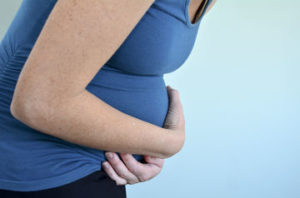
The unpleasant sensations with appendicitis are aggravated by any physical stress, for example, a change in body position or walking, so the woman tries to take a lying position (on the right side), in which there is a little soreness weakens. You can also recognize an attack of appendicitis by the characteristic posture when a woman is trying to unload the abdominal muscles by bringing her knees to her stomach. This position is called "fetal position" and is considered one of the main signs of acute inflammation.

Where can the pain of an inflammation of the appendix be localized?
Important! An attack of appendicitis always begins with painful sensations, which are most often spastic in nature and resemble cramping pains. If the first symptoms of pathology were manifestations of intoxication or a febrile state, and only after that there was a dull or cutting pain, the cause is most likely gastroenteritis - an acute concomitant inflammation of the stomach and intestines.

Symptoms of appendicitis in women
The first signs of appendicitis in women
Appendicitis has a rather vague symptomatology, therefore, its symptoms are often perceived as symptoms of gynecological diseases, especially if a woman suffers from any chronic pathology and is at risk of developing complications from the genitourinary systems. Therefore, it is very important to know the symptoms of appendicitis and be able to compare them with signs of other diseases, since untimely access to a doctor help can lead to diffuse inflammation of the peritoneal space and the death of a woman from infectious-toxic or painful shock, as well as sepsis.
Lack of appetite
Appetite in most patients disappears simultaneously with the onset of pain. The cause of the disorder is a gradually increasing intoxication, against which a woman may experience an incomprehensible weakness and drowsiness. Many patients have a sharp decline in performance and concentration, which forces them to stop working or daily activities. With a lack of appetite, slight weight loss may occur. If body weight decreases by more than 800 g per day, you should immediately consult a doctor, as acute dehydration may develop.

Lack of appetite is one of the signs of appendicitis
Early manifestations of intoxication
Nausea with inflammation of the appendix is persistent and worsens as the disease progresses. The symptom reaches its maximum value on the second or third day of the inflammatory process, after which a slight weakening of symptoms may be observed. Vomiting with appendicitis is not considered a typical symptom and can occur 1-2 times - on the first or second day of inflammation.

Nausea may signal appendicitis
Does the temperature rise?
With catarrhal appendicitis, the body temperature in most patients remains within normal limits and rarely exceeds the lower limits of subfebrile condition. In some cases, the patient may have a subfebrile fever, which usually occurs on the second day of the illness, but an increase of more than 38 ° is not typical for appendicitis. If the thermometer readings exceed this mark, there is a high risk of phlegmonous or gangrenous inflammation.

Inflammation of the appendix in women
Stool change
Stool with inflammation of the appendix also changes. The overwhelming majority (more than 60%) of women complain of constipation, which begins 2-3 days before the onset of the attack. This is especially true for women who do not follow a diet and make mistakes in nutrition, low-fiber foods and chronic disorders gastrointestinal tract. Constipation is accompanied by the accumulation of gas in the intestines, bloating, the discharge of a large amount of gas with a pungent unpleasant odor.
Diarrhea is less common in appendicitis. At the same time, the stool can have a foamy or watery consistency, light yellow color. Putrid odor, streaks of blood and mucus should be absent. Diarrhea with inflammation of the appendix, unlike constipation, occurs on the first day of an attack, and the number of bowel movements can be up to 10 times a day.

With inflammation of the appendix, most women complain of constipation.
Stool disturbance in pathology is also accompanied by other symptoms, which may include:
- spastic pain during the passage of feces through the rectum;
- soreness after a bowel movement;
- tension of the abdominal muscles not only when straining, but also at rest.
Important! Taking any medications (laxatives, pain relievers, etc.) if you suspect appendicitis is strictly is prohibited, as this may complicate the correct diagnosis and delay the provision of life-saving help.
Video - Symptoms with appendicitis
Change in daily urine output
Acute appendicitis is often accompanied by dehydration of the body, which is manifested by a change in daily urine output - the volume of urine excreted per day. A woman may feel constant thirst, the skin and mucous membranes become dry and pale. The amount of urination increases, while the volume of excreted urine gradually decreases, and on the second or third day there are false urges to empty the bladder. Urination with appendicitis is not painful, the appearance of urine does not change.
Changes in the heart and blood vessels
Symptoms from the cardiovascular system do not appear in all women, but exclude these signs from the clinical picture of the disease is impossible, since their prevalence remains quite high - at least 20-25 %. The patient may be disturbed by shortness of breath, difficulty breathing, increased heart rate.

Signs of appendicitis
Other signs of this clinical group are:
- lowering blood pressure (in women suffering from hypotension, hypotonic crisis may develop);
- dizziness;
- change in heart rate;
- cold clammy sweat.
Important! In case of pain in the heart, it is allowed to take “Nitroglycerin», But it is necessary to inform the arriving doctors about this, and also to describe in detail all the symptoms, for the relief of which the drug was used.
Video - Symptoms of appendicitis in women
How to recognize a seizure in pregnant women?
Diagnosing inflammation during pregnancy is challenging. This is largely due to the fact that pains of various etiologies during pregnancy are often perceived as a manifestation of the physiological processes occurring in the body of the expectant mother under the influence of hormones. The prevalence of pathology among pregnant women is low (no more than 1-3%), but such cases are still possible, therefore, it is important to know the main signs of the disease and not try to numb the pain with pills, but immediately call an ambulance help".
The main manifestation of pathology in this category of patients is the "acute abdomen" syndrome, characterized by acute pain in the abdomen, which gradually shifts to the area of the right hypochondrium and takes on a constant aching flow. Diagnosis of the syndrome in the later stages is complicated by the natural weakening of the muscles of the peritoneum, which does not allow revealing the tension of the abdominal walls typical of appendicitis. An incorrect definition of the localization of pain can also complicate the diagnosis, since many organs of the abdominal cavity are displaced under the pressure of the growing uterus and the fetus.

Symptoms of acute appendicitis in pregnant women
Important! It is almost impossible to diagnose appendicitis in pregnant women at home, so all women with pain syndromes of any etiology are hospitalized in a hospital for diagnostics. Appendectomy is used to treat appendicitis at any stage of pregnancy.

Location of appendicitis during pregnancy
Treatment: surgery and drugs
The main treatment for appendicitis is surgery. Patients with pathological signs lasting less than 5-7 days are referred for hospitalization and preparation for surgical treatment. At this stage, intravenous administration of saline is indicated, as well as treatment with antibiotics from the group of macrolides or cephalosporins listed in the table.
Antibiotics for conservative treatment of appendicitis (including after surgery)
| Drug name | Image | How to use? |
|---|---|---|
| "Suprax" |  |
400 mg once a day for 7 days. In some cases, the duration of admission can be increased up to 10 days. The daily dose can be divided into 2 doses |
| "Pancef" |  |
200 mg 2 times a day for 7-10 days |
| Clarithromycin |  |
250-500 mg daily for 6 days. In the presence of individual indications or a complicated course of the underlying disease, the duration of use can be increased to two weeks |
| "Fromilid" |  |
250 mg 2 times a day for 5-14 days |
If the signs of pathology last more than a week, the woman undergoes an emergency operation, after which antibacterial and antimicrobial agents are prescribed to prevent re-inflammation and possible complications. Within a month after treatment, nutritional therapy with a low content of fats and simple carbohydrates is indicated. For a quick recovery, it is also recommended to limit physical and mental stress, take multivitamins and completely quit smoking and other bad habits.
Video - Surgical treatment of acute appendicitis
>