
Adhesive bowel disease: symptoms, treatment, prevention
The term "adhesive disease" means a pathological condition caused by the proliferation of connective tissue between the internal organs of the human body and the peritoneum. Usually the desired manifestation accompanies the postoperative period. The condition of patients whose adhesions have formed inside the abdominal cavity is considered severe, since the desired pathology leads to a large number of unpleasant consequences. Today we will figure out what symptoms indicate adhesive bowel disease and what treatment will be effective in the future.

Adhesive bowel disease: symptoms, treatment
Content
-
1 Adhesive bowel disease: what is it
- 1.1 Causes of the onset of adhesive disease
- 1.2 Symptoms of adhesive disease
- 1.3 What is the risk of adhesion formation
-
2 How are diagnostic measures for the formation of adhesions carried out?
- 2.1 Instrumental diagnostics methods
- 2.2 List of required analyzes
-
3 Treatment of the disease in question
- 3.1 Conservative treatment
- 3.2 Surgical treatment
- 4 Preventive measures
-
5 Let's summarize
- 5.1 Video - treatment of intestinal adhesions
Adhesive bowel disease: what is it
Adhesive disease is a condition in which adhesions are formed between the patient's peritoneum, consisting of connective tissue. In fact, initially, the growth of connective tissue elements by nature was conceived as a protective mechanism influencing the prevention of severe complications of various types. However, this mechanism, unfortunately, is not fully thought out, since it does not reflect in the best way on the general state of a person. This is how it works.

The structure of the human intestine
Table 1. Stages of adhesion formation
| Stages | Description |
|---|---|
| First step | The body identifies the focus of pathology inside the organ, as well as the surrounding damaged tissues. |
| Second phase | To protect the rest of the abdominal cavity and organ from the desired focus, the body starts the process of forming ties from the connective tissue. |
| Stage Three | Having formed, the tissues we are considering fill the voids between the damaged or diseased part of the organ, and healthy segments of the peritoneum. |
| Fourth stage | Tie joints are initially soft and loose, however, over time they get stronger and, as it were, harden, condensing and creating what doctors define as adhesions. |

What spikes look like
Pay attention to the following fact. Despite the fact that connective tissue is also formed by our body, it, unfortunately, is not able to to ensure the performance of those functions that are performed by any of the affected and damaged organs. Unfortunately, its "help" to the body is limited to filling the voids and protecting the surrounding tissues from damage and disease.
Causes of the onset of adhesive disease
To understand where the causes of the formation of adhesions come from, it is necessary to consider what the peritoneum is. So, the peritoneum is called the serous membrane of a transparent shade, which covers:
- the abdominal cavity from the inside;
- all organs located inside the human body.

Adhesions can grow not only in the intestines, but also in other organs of our body.
The desired coating is represented by thin sheets, usually they have a smooth web, and carry out a selection of a small volume biological fluids, necessary to ensure the unhindered movement of organs in relation to each other inside the cavity belly.
Pathological processes affecting the body lead to the fact that on the serous membrane of human organs the body is sprayed from fibrin - a substance that works like the most common glue, connecting nearby fabrics. If, at the time of the formation of the joints, adequate treatment is not carried out, after the pathologies have passed, screeds from the connective tissue grow in the places where adhesion has occurred.

Adhesions become denser over time and nerves and capillaries grow inside them.
Consider the process of formation and growth of screeds. Normally, it goes through several stages.
- In view of the formations of any pathology, the serous surface of the peritoneum is covered with fibrin dusting.
- After two or three days, so-called fibroblasts (special cells) grow on the surface of the spraying, which begin to release collagen fibers.
- Inflamed and damaged structures of specific tissues of organs begin to be gradually replaced by connecting ties on the seventh day after the appearance of the fibrin layer.
- Those same adhesions are finally formed at the end of the twenty-first day from the beginning of the process of tissue replacement. During this time, dense fusion of areas occurs, inside the adhesions, significantly complicating the further process of treatment, also germinate:
- capillaries;
- nerves.

Fibroblast - structure
According to statistics, in almost one hundred percent of cases, the factors that have become provoking nuances that entailed the proliferation of connective tissue are:
- pathological processes in the internal organs;
- surgical intervention that resulted in trauma to the tissue structures of organs and peritoneum.
The risk of adhesion formation also increases under the influence of additional factors, namely:
- with the development of diseases of infectious etiology;
- organ bleeding;
- dehydration of the peritoneal layer and the like.
However, not only surgical manipulations that left traumatized areas, but also external influences, can affect the occurrence of the disease under consideration, for example:
- bruises;
- falling;
- blows, etc.
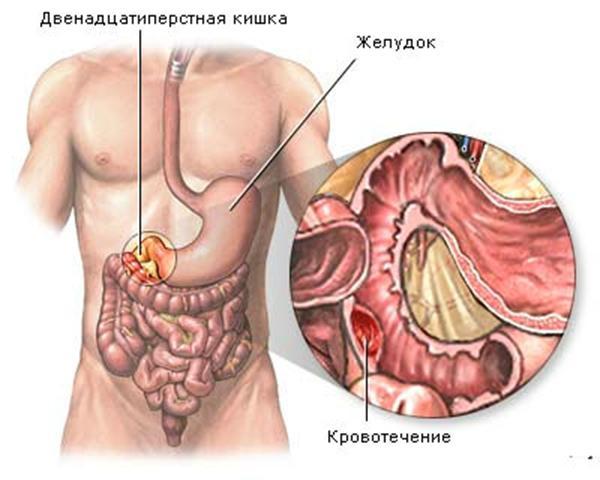
Gastrointestinal bleeding
Blunt injuries of a mechanical nature, inflicted on the intestines (or other organs inside the human body), can be accompanied by various negative health consequences, for example:
- opened bleeding;
- dysfunction of the lymphatic system;
- the formation of limited accumulations of blood;
- problems in the implementation of metabolic processes inside the affected tissue structures of the body.
The pathologies listed above and the consequences of trauma lead to the fact that the peritoneal blood flow is impaired. Various inflammatory processes occur, which in themselves cause very serious damage to your organs. The body reacts to them, including a protective function, and begins to build up screeds.
Of course, adhesive disease can also be a consequence:
- congenital anomalies;
- defects discovered in the process of growth and development of the organism;
- exposure to chemical compounds;
- the use of medicines;
- getting inside the organ of any foreign body.

Medicines must be prescribed by a doctor
The insidiousness of this disease is that the formation of adhesions cannot be predicted with certainty. Of course, in certain cases it is expected, however, sometimes it can be a surprise.
Symptoms of adhesive disease
What symptomatology will accompany the clinical picture of the desired pathology, in each case will depend on:
- areas of growth of connective tissue;
- the prevalence of tissue damage.

What are the symptoms accompanying adhesive bowel disease
In some cases, this disease can proceed without pronounced symptoms, or, on the contrary, reveal itself sharply and sharply. In the second case, in order to preserve the life and health of the patient, it is required to immediately hospitalize him and carry out an operation to remove the screeds.
Why is there an urgent need for an operation with the formation of screeds in the intestine? The point is this: adhesive tissues can block the course of the intestine, creating the so-called obstruction of the organ, accompanied by the following symptoms:
- intense pain in the abdomen;
- nausea and bowel movements;
- a serious increase in body temperature.

Abdominal pain is the most common symptom
On palpation, the patient usually informs the doctor about the occurrence of additional incisions in the abdominal cavity. However, the patient is not able to determine their exact location, since he literally has a pain in his entire stomach.
In addition, adhesive disease has a serious effect on the motility of the intestinal muscles:
- it can worsen excessively, provoking the development of diarrhea;
- on the contrary, it can weaken to an almost complete cessation of contractile activity.
In addition, dehydration is added to everything, provoked by:
- vomiting;
- or diarrhea.
In addition, the patient's blood pressure may sharply drop, and the following also appear:
- apathy;
- weakness;
- fatigue.

Dyspeptic disorders are one of the first manifestations of adhesions
In some cases, the clinical manifestations of adhesive disease can reveal themselves periodically, as if paroxysmal. Suddenly, the patient begins to experience severe pain, but after a few minutes nothing bothers him again.
The increasing and decreasing symptoms usually begin with dyspeptic disorders (diarrhea, constipation, vomiting), continue with cutting and painful pressure in the abdominal cavity.
In the case when the symptomatology accompanying the pathology manifests itself weakly, and the patient experiences lung intestinal disorder and minor pain, doctors conclude that the occurrence of adhesive disease of chronic type.

Adhesions inside the uterus
However, if we talk about the intestines, such a course of pathology is rare, usually they are faced with it sooner gynecologists, when screeds are formed inside the uterus and its growths, creating a danger to preserve the function of reproduction offspring.
What is the risk of adhesion formation
In addition to the fact that the compounds we are considering are not able to function as specific organ tissues, there are also additional negative consequences.

What are the consequences of the formation of screeds from connective tissue?
So, as a result of the gradual compaction and hardening of the adhesions, a kind of tension occurs. As we remember, they are connected with organs, which, as a result:
- pulling organs;
- create favorable conditions for the development of serious pathological processes;
- disrupt the functioning of organs.

Intestinal obstruction from the inside
As far as the gut is concerned, the adverse effects can be varied and all extremely severe. So, the most common is the so-called intestinal obstruction.
How are diagnostic measures for the formation of adhesions carried out?
Of course, as soon as a citizen who becomes ill with the pathology in question experiences everything symptoms accompanying her, he will go to see a doctor (provided that he has not already been hospitalized).

What examinations and analyzes for adhesive disease the doctor prescribes
The doctor will immediately suspect adhesive disease if in the story of a patient who has come to him there are complaints of characteristic clinical manifestations, as well as in his anamnesis there will be:
- diseases of organs located inside the abdominal cavity with an inflammatory etiology;
- surgical procedures performed;
- infection with various infections.

Inflammation in the intestines can give off aching pains in the left side of the body
After the traditional initial examination, the doctor will refer the patient to undergo research in the following categories:
- instrumental diagnostics;
- lab tests.
Instrumental diagnostics methods
1. Laparoscopy - a technique that allows you to identify adhesive disease most effectively. In fact, laparoscopy is an operation in which the penetration of instruments into the abdominal the cavity is made due to micro-incisions on the abdomen, through which special instruments are passed - trocars. The sought-after devices allow for visualized examination of the intestines, since small cameras are fixed at their ends.

Laproscopic examination and removal of adhesions
Pay attention to the following fact: As a result, a laparoscopic examination may go beyond the scope of diagnostics, since if adhesions are detected, doctors can immediately perform an operation to remove them.
2. The second procedure of the instrumental category, carried out as a study in case of suspected adhesive disease, is called radiography. The required examination is also used to detect adhesions in the abdominal cavity.

Radiography does not pose a risk to the patient's health when used rationally
The presented method allows us to note the following manifestations of the pathology we are considering:
- accumulation in the abdominal cavity of fluid secreted from the tissue of the inflamed intestine;
- the presence of active formation of gases inside the organ, as well as bloating.
Sometimes the required examination is carried out using the so-called contrast - a substance introduced into intestine, which allows you to detect obstruction within this segment of the gastrointestinal path.
3. The third way to conduct a survey involves the use of the method electrogastroenterography, in which the contraction of the musculature of the intestinal tissue is measured in the form of electrical signals.

In standard electrogastroenterography, three electrodes are attached to the patient's body (usually on the legs and right arm) and an electrical signal is removed on an empty stomach within 40 minutes
4. The fourth method, used in the diagnosis of the disease under consideration, allows us to accurately determine the localization of screeds from connective tissue, as well as the degree of their growth. It is ultrasound procedure - non-invasive "examination" of an organ using sound waves emitted by a specialized apparatus. It is completely painless. However, each of us is faced with it during our lives, including for less serious reasons.

Ultrasound procedure
5. Last, but not least, the hardware survey method is Magnetic resonance imaging. With his help, doctors receive the so-called medical images of the processes occurring in the intestine, which have a high degree of information content.

If serious bowel disease is suspected, MRI is used as an auxiliary research method.
Most likely, when you get to the hospital and are sent to undergo examinations, you will not be assigned the entire list of medical measures listed. Perhaps doctors can only get by with a few of them. It will be necessary to go through the procedures listed by the doctors, since without their implementation it is impossible to draw accurate conclusions regarding:
- specific diagnosis;
- the degree of adhesion growth;
- their localization.
List of required analyzes
Now let's look at a list of tests that are carried out in a hospital laboratory. It is also imperative to hand them over with adhesive disease in order to identify various changes in the body and possible complications.

A complete blood count is the basis for the diagnosis of most of the known diseases.
1. First of all, you need to spend general blood analysis. The desired laboratory test is recommended for each patient in the hospital, even if their disease is mild. In addition, it will not be superfluous to hold it also for those citizens who want to make sure that everything is in order with their health.
The desired analysis allows you to draw conclusions not only about the intestines, but also:
- about the work of other organs of the body;
- the functioning of all systems of the human body.
It is thanks to him that doctors sometimes detect the presence of concomitant pathological processes, and correct the treatment.

Normal blood counts
If we consider the analysis specifically in the context of adhesive disease, the following abnormalities should be found in the blood:
A) Leukocytosis - the exceeded number of leukocytes, among which the cells of the stab category predominate, makes doctors understand that in the patient's body undergoes any inflammatory processes (the higher the final indicator, the more intense the inflammatory process).

The body's defense reaction leads to an increase in the number of leukocytes.
B) Anemia - a condition in which there is an abnormal number of red blood cells in the blood, that is, they are less than it should be, due to the presence of complications such as bleeding. For adhesive disease, the desired complication is not typical, however, it can still occur in cases where:
- the patient has gone too far with physical activity;
- the walls of the organs tied with ties have torn.

Anemia
The desired complication requires additional medical intervention, since a reduced number of red blood cells will not only have a detrimental effect in the postoperative state of the patient, if necessary, but it will also seriously reduce the level of natural defense of your body in the whole.
2. Blood biochemistry - the second analysis, also carried out using our main body fluid. It also reflects the work of the organs of our body, allowing us to identify specific changes in each of them.
Provided that adhesive disease has really started up in the patient's intestines, the following deviations will be identified.

Our blood can tell about many processes in the body.
A) The urea level will appear elevated, since the adhesions may well have deformed the walls as well. accumulating urine bladder, thereby creating an obstacle to the implementation of their contractile activities. In some, especially severe cases, connective tissue may burst through the ureter, preventing one of the kidneys from expelling fluid into the bladder. It turns out that an increased level of urea is a signal that the urinary system was somehow involved in the formation of adhesions from connective tissue, and needs urgent surgical or conservative intervention.

Indicators of blood urea
B) The second important indicator, the detection of which biochemistry can achieve, is an increased level of liver enzymes. The desired indicator is found in cases where there are:
- delay in the flow of bile;
- liver failure.

List of important enzymes in the body and what they show
It should be said that adhesive disease itself has nothing to do with these changes, however, provided that simultaneously with it, there are any liver diseases, it is necessary to adjust the conservative treatment, namely:
- narrow the range of approved medicines;
- exclude the intake of drugs already prescribed prohibited for the desired pathologies.
V) Decreased hemoglobin is the next indicator that is important in adhesions. In a normal state, it is contained inside erythrocytes, therefore, when carrying out a biochemical analysis on the level of hemoglobin, in fact, the same is determined as in the case of a general blood test or erythrocytes.

General body fatigue is one of the symptoms of low hemoglobin
G) Also, when conducting a biochemical analysis, the presence of protein compounds in the blood, signaling the acute phase of inflammation, is determined. So, in our body, special proteins can be synthesized, upon detection of which in the blood it is determined that an inflammatory process has started inside the body. This is, for example, a protein of the C-reactive type.
Treatment of the disease in question
As with many other diseases, intestinal adhesive pathology is eliminated through the following two methods of treatment:
- conservative (medication);
- surgical.

How is adhesion treatment carried out?
Conservative treatment
The first type of measures can be used exclusively in the process of adhesion formation. In this case, the patient is prescribed the following kind of therapy:
- prevention of tissue adhesion and screed formation;
- elimination of the negative consequences of the process that has begun;
- relief of clinical manifestations of the disease.

Conservative treatment with xanthomas is considered to be very effective.
When a conservative treatment is chosen, first of all, doctors take up the elimination of pain that torments the patient. Many methods can help alleviate his discomfort, for example:
- in the presence of constipation or gas formation, use bowel cleansing enemas;
- for pain, also caused by dyspeptic disorders or other factors, antispasmodic drugs are also prescribed, as well as the imposition of heating pads on the stomach;
- also when the accumulation and hardening of feces in the intestine, occurring due to the formation of adhesions, is prescribed specialized nutrition, the daily menu includes food that stimulates intestinal motility musculature.
Note. If the doctor decided to prescribe a diet for you, even the smallest inaccuracies in the diet will have a detrimental effect on the body and specifically the course of the disease.

Enema helps to effectively complement the main course of treatment
If the diet has been applied, but did not give the expected effect, most likely you will be prescribed laxatives as an additional way to remove stagnant feces. If vomiting is present, the patient is given antiemetic medications and various solutions are administered to prevent dehydration.

Dehydration stages
In the event that the use of exclusively medical preparations does not help, the patient is assigned additional physiotherapy procedures, for example:
- mud treatment;
- applying paraffin patches;
- diathermy;
- iontophoresis.
To prevent the pain syndrome from increasing, patients are advised to completely abandon physical activity during treatment. However, this does not mean that you can only lie down, you can afford quiet walks, provided that you remain comfortable.
Surgical treatment
As for the surgical intervention, it is carried out under the following circumstances:
- acute conditions requiring immediate intervention;
- frequent relapses of the disease;
- constant exacerbations of the chronic process.

If conservative therapy has not yielded results, they switch to a minimally invasive method.
Surgical operations in the treatment of adhesive disease are very difficult, in addition, it is imperative to carry out a lot of preparatory measures before them. In the case when the patient's condition is extremely acute and difficult, the preparation is still carried out fully, but in a tight time frame.
To normalize the patient's well-being, eliminating dehydration and removing toxins, he is given a transfusion:
- plasma;
- sodium chloride;
- saline solutions;
- rheopolyglucin and with the addition of hydrocortisone and similar liquids.

Laparoscopy is a minimally invasive surgical procedure
The surgical procedure will vary from case to case. The scar remaining from the previous surgical intervention is not excised, since the intestinal loops are glued to it. By touching them, you can damage the organ itself, organizing additional complications.
Depending on the situation, adhesions:
- push apart;
- divide;
- removed.
In the event that the process of dying of intestinal tissues has begun, the damaged area is removed, after which:
- patency is restored;
- a stoma is applied.
In the presence of adhesions that have led to a change in the shape of the intestine, a bypass is sometimes formed.

Bypass anastamosis
Since the operation being performed can lead to an additional risk of re-formation of adhesions, during its implementation, the main preventive measures are observed:
- large cuts are made;
- the peritoneum is protected from drying out;
- bleeding stops immediately and completely;
- there is an instant removal of the excess of leaked blood;
- powder antimicrobial agents and antiseptic drugs are not added to the operation site;
- no foreign objects get into the operated area;
- polymer threads are used for sewing fabrics.
After surgery, patients are prescribed an additional intake of various substances, namely:
- the introduction of enzymes of the proteolytic group into the peritoneum;
- remedies for allergies are prescribed;
- anti-inflammatory drugs are prescribed;
- stimulation of the motility of the intestinal muscles is carried out.

Powerful antiallergic drug "Cetrin"
Note: according to statistics, in 20% of cases, adhesions are formed again during surgery, therefore, the issue of postoperative therapy must be approached wisely.
Preventive measures
If intestinal adhesions are observed in a single amount, then the prognosis is likely to be very favorable. In the case of detection of multiple lesions, the disease can end in very negative consequences.

What preventive measures will help prevent the formation of adhesions
The rules of prevention against intestinal adhesive disease are simple, which also work to prevent the development of other pathologies:
- it is necessary to give up bad habits;
- eat properly and in moderation;
- do not hesitate to exercise (even a ten-minute exercise in the morning will bring significant benefits to your body).
In this case, in no case should you do the following:
- starve for a long time;
- overeat;
- alternate prolonged fasting with overeating.

Monitor your health
In order not to miss the onset of the disease, you must:
- monitor the regularity of bowel movements;
- undergo preventive examinations by a gastroenterologist.
As you can see, really nothing complicated. Even a person who lives in the dynamic rhythm of a modern city can cope with these simple rules.
Let's summarize
Adhesive bowel disease is a serious pathology, mainly affecting people who have recently undergone surgery on the organ under consideration. You need to understand that surgical intervention is far from the only reason for their growth.
If you find the first signs, you should consult a specialized doctor.
The healthier your lifestyle is, the less likely they are to occur. Take care of your health by regularly visiting doctors for preventive examinations, eat healthy food and enjoy life!


