Under what anesthesia is appendicitis removed: the choice of anesthesia
Surgery to remove an inflamed appendix is the most common surgical procedure performed in the abdomen. The need to remove the affected process can arise in any person.
Surgery to cut off the appendix due to its inflammation is called appendectomy. Surgical intervention is possible only after the administration of anesthetics to the patient. The method of anesthesia, the drugs used - are chosen by the doctor after interviewing the patient. The patient's condition, the presence of chronic diseases, and the reaction to drugs are also taken into account. Usually, a general scheme of pain relief is used before surgery.
Surgical intervention to remove the appendix without anesthesia is impossible, since there is a high risk of developing pain shock, which leads to death.
Content
-
1 Types of anesthesia
- 1.1 Local
- 1.2 General
- 2 Contraindications
Types of anesthesia
Anesthesia is divided into two types:
- Local. This implies the introduction of painkillers directly next to the site of the future incision. It is rarely used.
- General. Immersion of the patient in sound sleep.
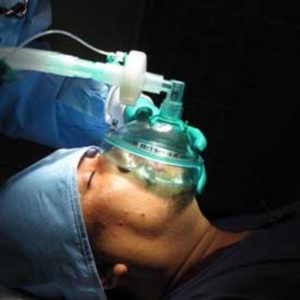
Appendicitis is removed under general anesthesia, by introducing a drug containing a large number of components. The medication helps induce sleep. The subsequent exit from it occurs gently, sensitivity is quickly restored.
Local
Another name for this procedure is regional. Today it is practically not used. But it was popular 30 years ago.
An experienced anesthesiologist makes an introduction to the peritoneal area of novocaine. This is done under pressure and covers all skin layers. As a result, the sensitivity of the nerve endings is blocked. Throughout the operation, the anesthesiologist continues to inject the solution, since the effect of the drug is short-lived.
Positive points when using the local method of anesthesia:
- The method is simple and does not require serious equipment. Suitable for use in the field.
- Safe. This method of anesthesia is not considered hazardous since there is no effect on the central nervous system. The patient is awake.
- The effect of anesthesia wears off quickly. Several hours pass, and the numbness goes away.
Negative points of the local method:
- It is not advisable for small children to undergo surgery under local anesthesia. The adult should lie still, and the child may not be restrained.
- Peritonitis. Complications take longer to perform. Novocaine lasts no more than 40 minutes.
- Appendicitis is excised using laparoscopy.
Frequent complaints of those operated on under local anesthesia that pain is felt. Today, anesthesia for a specific area of the body is performed only if general anesthesia is contraindicated.
Several methods are used to administer anesthetic to adults:
- Spinal. An injection is made in the lumbar region. This helps block nerve impulses at the roots located in the spinal cord.
- Epidural. The anesthetic is injected through the back. The catheter is placed between two vertebral discs. The drug is mixed with cerebrospinal fluid, as a result, the nerves lose sensitivity.
- Conductor. Chipping of the place is performed, requiring anesthesia. The introduction of novocaine occurs slowly, contributing to a gradual loss of sensitivity. In this case, the nerve and surrounding tissues are not damaged.
For pregnant women, when removing the affected process, only local anesthesia is used. In this case, it is necessary to save the life of not only the mother, but also the developing fetus. The dissection is done by laparotomy or laparoscopy.
General
The most popular method used in surgery. Positive points:
- The patient is immersed in a deep medical sleep. After that, the person has no memories of the process.
- No pain during surgery. Introducing sleep helps to turn off all nerve receptors.
- The anesthesiologist regulates how long the patient is sleeping. As a rule, the surgeon cannot tell in advance the duration of the surgery. It is possible that additional complications are discovered during the operation, affecting the duration of the procedure. This may be the development of peritonitis, profuse bleeding, incorrect location of the appendix.

- The anesthesiologist can tell exactly when the patient will wake up.
- Today, the pharmaceutical industry offers a wide variety of anesthetics. The choice of medication is up to the doctor. First, the patient is tested for the perception of the selected agent (allergy test).
The introduction of anesthesia is carried out gradually in several stages:
- Premedication. This is the introduction of a little anesthetic so that the cardiovascular system does not give complications, as well as to maintain the general condition of the body. There is a gradual addiction to the substance.
- Introductory anesthesia. The patient slowly falls asleep. A tube is inserted into the trachea to allow breathing and prevent saliva and juices from entering the lungs. The person is connected to artificial lung ventilation. Then drugs are injected to relax the muscles responsible for breathing.
- Maintaining a state of sleep. During the operation, the anesthesiologist is next to the patient, controls breathing, pulse. If necessary, it can prolong the effect of anesthetics.
- Removal from the state of sleep. When the operation ends, the task of the anesthesiologist is to get the patient out of anesthesia and return to natural breathing.
Modern anesthetic drugs are able to provide a smooth introduction into anesthesia and the same gentle removal from it.

They differ in the way they enter the human body:
- Intravenous;
- Masked.
The quality of anesthesia does not depend on the method of ingestion. For those on the operating table, the main thing is not to feel pain during the procedure. When the choice of medications is made, the doctor relies on the patient's condition, the duration of the surgical intervention, and the patient's characteristics.
Medicines administered through a vein: Viadril, Ketamine, Propofol, Diprivan, Sodium thiopental, Sodium oxybutyrate.
Means related to mask preparations: Sevoflurane, Halothane, Isoflurane, Desflurane, Nitrous oxide, Ftorotane.
Combined use of anesthetics is possible.
Contraindications
There are situations when the use of general anesthesia is impossible due to some circumstances:
- The examination revealed acute mental illnesses, as well as neuralgic diseases.
- Heart rhythm disturbances: periods of slowing down of the pulse or the occurrence of tachycardia, when the rhythm reaches 140 beats / min.

- The patient has atrial fibrillation.
- There are disorders that interfere with the normal blood supply to the brain.
- Myocardial infarction.
- The heart muscle is unstable.
- Swelling in the legs, shortness of breath, weakness, heart failure.
- Bronchial asthma.
- Pneumonia.
- Acute bronchitis.
- Alcoholic and narcotic state of the patient.
- Pregnancy and breastfeeding.
- Renal or hepatic impairment.
- The body shows symptoms of severe intoxication.
Typically, the procedure removal with appendicitis is urgent and urgent. This means that there is no time to eliminate the factors that prohibit general anesthesia. Therefore, a decision is made to use a regional method of anesthesia.