Gallstone disease: complications
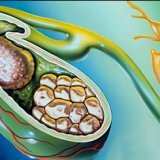
Gallstone disease is a disease characterized by stones starting to form in the bile ducts or in the gallbladder. This disease in the world is quite common. According to autopsies, every tenth man among all who died for various reasons, the stones were found in the gallbladder. In women, cholelithiasis, the complications of which are described below, was found twice as often - one in five.
Clinical manifestations of the disease are very rare, only in 10% of carriers, and mainly in women who are already over forty. More often this disease is revealed among the full women, but not among the thin. There are factors that have to the appearance of gallstones, namely: pregnancy, sedentary lifestyle, rare messy meals, between which, moreover, long periods of time, systematic overeating, as well as other causes that contribute to stagnation in the gallbladder.
As a rule, an attack of biliary colic without a trace passes, but it happens that complications arise.
In the most severe cases it is possible to observe the accumulation of pus in the gall bladder, which is manifested by the fact that the patient has a very serious general condition, with a hectic or remittent fever, a sharp pain and muscle tension in the hypochondrium on the right side, and also with increased ESR and neutrophilic leukocytosis. If, after eliminating the spasm, the stone located in the bladder flow does not move back into the gall bladder or into the common bladder flow, then a blockage of the bladder flow or the neck of the gallbladder occurs, which sometimes leads to gall bladder edema. In this situation, after a while( about 2-3 weeks) after a sharp pain, an enlarged, fluctuating, elastic, usually painless gallbladder is palpated. If there is no pericholecystitis, then it is easily displaced by breathing, and when palpated without difficulty, the bottom is displaced to the sides - a pendular bubble. Inside the bladder is a colorless or yellowish translucent liquid - this is white bile, which is formed due to the gradual absorption of bilirubin by the wall of the gallbladder. In this situation, secondary infection may occur with the development of empyema. If there was a complete blockage of the entrance to the gallbladder, then eventually, due to inflammatory scarring, it wrinkles.
Clogging of the common bile duct can occur due to the fact that stones from the gallbladder get into it. Stones of large size linger before the sphincter of Oddi - this is the narrowest part of the bile duct. After a while, as a rule, after an attack of colic, jaundice occurs, which has symptoms of subhepatic( mechanical).If a relatively small stone is delayed before the sphincter of Oddi, then the bile periodically flows into the duodenum;In this case, jaundice can sometimes increase and weaken. In this regard, the color of stools will change. With a jaundice of a mechanical nature, which arises from cholelithiasis, the gallbladder usually does not increase, since its walls are altered by the inflammatory process accompanying the disease, and therefore it loses its ability to stretch. Due to the fact that the outflow of bile is violated, the inflammatory process often occurs in the biliary tract( cholangitis, cholecystitis, hepatitis);Inflammation can manifest as fever wave or remittent nature, increased ESR, chills, a violation of the outflow of pancreatic juice, which can cause pancreatitis, neutrophilic leukocytosis.
Because of the long-term obstruction of outflow from the common bile duct, biliary cirrhosis can occur. Quite often cholelithiasis can be complicated by chronic pancreatitis. Rare complications include perforated biliary peritonitis and the development of vesicoucinal passageways( internal or external) against the background of perforation in the gallbladder( this is less common with the common bile duct).
With prolonged stays, even if there are no symptoms of cholelithiasis, gallbladder cancer can occur.