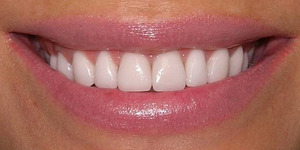
The causes of wedge-shaped dental defects, methods of treatment and prevention, dentists' advice
 A wedge-shaped defect in the teeth may appear due to an incorrect bite and periodontitis.Also, the cause of this defect may be improper hygiene of the oral cavity.
With a certain load, this pathology can provoke a chip.Treatment of a wedge-shaped defect of the teeth is simply necessary, if this is not done, the consequences are sad, this can lead to loss of the front teeth.
The treatment process is simple, but is a very unpleasant , especially if the pathology is very neglected.To avoid this, it is necessary to monitor the condition of the oral cavity and from time to time make visits to the dentistry.Prevention will prevent serious problems and save time and money.
How does the wedge-shaped defect appear?
 What is a wedge-shaped defect?This tooth lesion of a non-carious type has the pronounced V-shaped( wedge-shaped) form of .It affects the area of the neck of the tooth.
The pathology appears on the front teeth.Most of all, her fangs are prone to it, more rarely other teeth.This defect does not destroy the enamel and does not entail a change in its color, except when it penetrates inside the dental tissue.
The stages preceding the appearance of a wedge-shaped defect:
- At the very beginning of the development of the wedge-shaped defect, there are no obvious signs.Nevertheless, in the manifestation of certain symptoms, it can be determined that there is a problem.Increases sensitivity to hot, cold and sour food;When brushing your teeth and touching them, painful sensations arise.
- In the second stage, the sensitivity increases, and a visual defect is already visible.The lesion can reach 3.5 mm.
- The next stage is when the lesion affects the dentin and penetrates into other tooth tissues.The dimensions of the defect already reach 5 mm.
- The last stage of the pathology is the lesion of the pulp chamber, in this condition the tooth can easily break off at low loads.
Causes of the pathology
-
 Most often, a wedge-shaped defect of the teeth appears with an incorrect bite of the .Load during chewing food is uneven.That is, some teeth are actively involved in the chewing process, others are not.Because of this overload and there is a defect, the beginning of which is damage and chipping of the enamel in those places where the tooth is fastened.
 - Another factor in the onset of this pathology is problems inside the body of .Most often, wedge-shaped defects in teeth are susceptible to people with diseases of the nervous system, intestines, thyroid and gall bladder.
- Non-compliance with oral hygiene - is also one of the causes of the defect.Plaque and other deposits accumulate at the base of the tooth.This breaks the enamel and leads to the demineralization of calcium.The appearance of gingivitis and periodontitis is directly associated with poor oral hygiene, and this, in turn, entails the formation of a wedge-shaped defect.
- Diseases of the oral cavity , such as periodontitis and gingivitis, can trigger the appearance of pathology, as it affects the amount and composition of saliva.The disease contributes to the multiple allocation of fluid, which changes its composition and leads to the washing away of calcium from the dental tissues.
- The teeth should be cleaned correctly with , since applying a rigid brush, moreover only in a horizontal position, will lead to a breakdown of the enamel.Mechanical erasing is a long process, but it still increases the likelihood of a wedge-shaped defect.Do not brush immediately after eating, especially after acidic foods, as the acid content in their composition can lead to destruction of the enamel and the washing out of calcium.The most optimal time for cleaning is 30 minutes after eating, this time is enough that the enamel can come to a normal state.
Teeth spinal defect - treatment
How will the treatment work depends on whether is at what stage of development of is the disease.With timely access to the doctor and the provision of preventive and curative measures, no filling will be required.After treatment, you can avoid further development of the defect.Preventive methods of this disease are as effective as treatment.
-
 You can pass a course of remineralizing therapy , which consists in the fact that the teeth are treated with preparations( gels, ointments, etc.) where there is a large calcium content.Similar procedures can be done both by the doctor and by yourself.Therapy consists in the fact that the teeth are fed with calcium, due to which the enamel is regenerated.The use of such prophylaxis prevents the development of a defect and does not allow it to form on other teeth.
 - The second stage of prevention will be decrease in sensitivity and strengthening of teeth.To do this, use the fluorination method.Dental treatment is performed alternately, for this use drugs containing calcium and fluoride-containing agents.The peculiarity of this treatment is that the teeth become more protected from acids and resistant to damage of a mechanical nature.
- It is very important to use special toothpaste .They will help reduce sensitivity and significantly reduce the signs of the disease.
- The dentist must teach the patient how to properly perform the cleaning procedure, and also explain why it is necessary to remove tartar and plaque.
Prevention will be impotent if the wedge-shaped defect is at the last stage.In this situation, it is necessary to apply the treatment, which takes place in four stages.
Stages of treatment of sphenoidal defect
1) The first stage - filling .This is a rather complicated process, since the defect has a wedge shape and is positioned so that it is difficult to fix the seal normally.Because of this, there is a risk of falling out.Such features lead to the fact that the filling is carried out in stages:
-
 The tooth, where there is a wedge-shaped defect, undergoes boron treatment.This procedure is very important, as it promotes better consolidation of the seal.
 - The defect is expanded in size.It is necessary that the seal is better strengthened.
- The adhesive is treated with an adhesive.
- A patch of liquid material used for sealing, which is illuminated.
- After filling, a dense seal layer is applied.
- The dentist gives the seal the shape, so that it is not noticeable.
- The seal is repaired repeatedly.
- Grinding of the seal.
To seal well, make small grooves of .The material used for the seal should be of high elasticity, since under loads, during chewing, it must be compressed and unclenched.
A large amount of salivation can also cause poor fixation of the seal.This occurs in cases where the wedge-shaped defect is located near the gums.If the saliva enters the filler during filling, the life of the seal will be significantly reduced.To avoid this, use a cofferdam - a latex material that has a hole for the tooth.
2) The second stage - installation of veneers .Carrying out such a procedure, will restore the aesthetic appearance of the teeth and prevent the appearance of a wedge-shaped defect in the future.After the enamel is worn out, it is necessary to paste the veneer on the front part of the tooth.
3) The third stage - crown .With a wedge-shaped defect, the crown must completely cover the tooth, although in some cases it is simply impossible to do.The success of installing the crown is where the wedge defect is located.Treatment is more difficult to carry out if the defect is close to the gum.
 4) In case the wedge-shaped defect is formed due to an incorrect bite, it is necessary to correct it.Uneven distribution of the load on the teeth, leads to the formation of pathology, so that after treatment, to avoid its further appearance, the bite should be corrected.For this, uses plates and braces in dentistry.An alternative method can be the installation of crowns.This procedure will help reduce the load during the chewing process.
Although treatment is not a pleasant procedure, it is better to visit a dentist in time to avoid more serious problems.Preventing the disease will prevent its development and maintain the health of your teeth.